In this news roundup, Eos and WATTMORE; Gotion and Gamma Technologies; Middle River Power and PowerTransitions; and Electra AI and MinTech are advancing battery energy storage system (BESS) technology in the US.
Eos to incorporate WATTMORE software with LDES tech
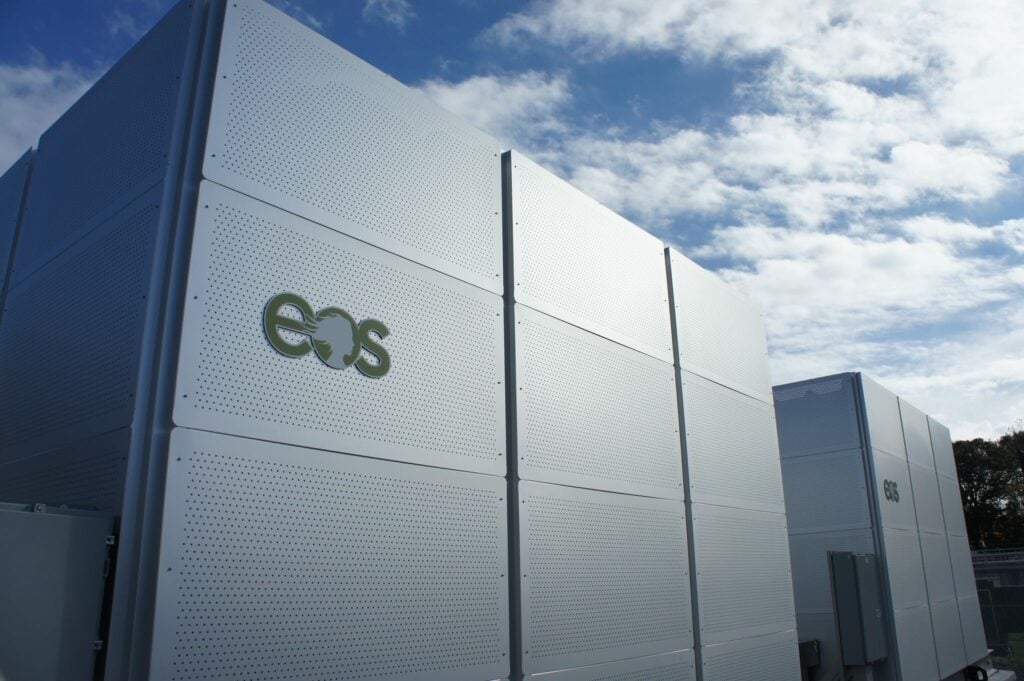
Zinc hybrid cathode battery and storage system maker Eos Energy has announced an agreement with energy intelligence company WATTMORE, incorporating WATTMORE’s software with Eos’ storage systems.
Announced 24 August, the non-exclusive strategic software and hardware collaboration agreement sees WATTMORE using its patented Intellect Operate energy management software (EMS)/power plant controller (PPC)/supervisory control and data acquisition (SCADA) platform with Eos’ Z3 long-duration energy storage (LDES) systems.
Eos utilises a proprietary aqueous zinc chemistry that is non-flammable and comprises approximately 91% domestic content, with the company reporting that its supply chain is predominantly US-based. The technology satisfies Section 842 NDAA requirements and foreign entity of concern (FEOC) compliance standards.
Try Premium for just $1
- Full premium access for the first month at only $1
- Converts to an annual rate after 30 days unless cancelled
- Cancel anytime during the trial period
Premium Benefits
- Expert industry analysis and interviews
- Digital access to PV Tech Power journal
- Exclusive event discounts
Or get the full Premium subscription right away
Or continue reading this article for free
Eos has committed to deploy WATTMORE’s Intellect Operate EMS and PPC for select customer projects and support integration of WATTMORE’s EMS platform with Eos’ DawnOS technology.
Designed, engineered, and operated by WATTMORE’s Denver, Colorado-based team, the platform “combines FEOC- and BABA-compliant hardware with Intellect Operate software to provide a pre-integrated controls option for Eos customers.”
The companies further stated that the collaboration expands the controls ecosystem around Eos’ Z3 systems, helping to streamline deployment while supporting Eos’ strategy of delivering more complete energy storage solutions around its technology.
WATTMORE and Eos have previously partnered on large-scale projects, including a 3MW/12MWh energy storage project for Nebraska utility Lincoln Electric System. The project combined Eos’ Z3 technology and WATTMORE’s controls platform to help support grid reliability while establishing the approach and scalability of the integrated solution.
Recently, Eos was awarded a Golden Dome for America contract from the US Department of Defense (DoD) to integrate “mission-ready LDES supporting requirements of the nation’s defence shield.”
Eos will deploy its Z3 solution for the controversial Golden Dome defence project announced by President Trump, though the project’s completion within the proposed timeframe, and altogether, remains highly uncertain.
Gamma Technologies announces partnership with Gotion Illinois
Software provider Gamma Technologies has announced a strategic partnership with Gotion Illinois, the US manufacturing subsidiary of China-headquartered battery manufacturer and energy storage integrator Gotion.
Announced 19 August, the collaboration pairs “Gotion Illinois’ global project experience, rapid US growth and technology-forward roadmap with GT’s simulation and productivity platform, enabling faster, more accurate, and more collaborative battery design across the full development lifecycle.”
Gotion announced its US$2 billion factory in Manteno, Illinois in 2023. In May, Gotion and US electronics manufacturer Richardson Electronics partnered to manufacture BESS at the Manteno factory.
As Gotion Illinois expands its Gigafactory operations, the company is adopting GT-AutoLion as its standard platform to provide manufacturing, design, R&D, chemistry, thermal, controls, and battery engineering teams with a “unified and reliable data foundation—enhancing speed, efficiency, and cross-functional collaboration throughout all phases of cell, module, and pack development.”
Across Gotion Illinois’ engineering organisation, GT-AutoLion is being deployed for a range of design and validation workflows. For battery pack safety analysis, GT-AutoLion captures the decomposition of different species during thermal runaway, enabling Gotion’s cell team to scale the model into different thermal management topologies to evaluate propagation risks.
In design of experiments and model calibration, Gotion Illinois leverages GT’s productivity tools, including case setup and DOE capabilities, to evaluate how cell design parameters such as electrode loading impact key performance indicators like power density while also simplifying model calibration.
The pack design and integration team is using AutoLion to evaluate different thermal management topologies and incorporate components including compression pads, busbars, and interconnects as models scale from cell to module to pack.
Gotion Illinois will also explore mechanical-electrochemical coupling to understand how different mechanical boundary conditions can impact cell, module, and pack performance. For next-generation chemistries, the company will utilise GT-AutoLion’s material database to evaluate emerging technologies like sodium-ion (Na-ion) and solid-state batteries.
Among the most significant benefits Gotion Illinois has identified is the ability to consolidate multiple point tools into a single, unified simulation platform, reducing complexity and improving consistency across teams.
Middle River Power and PowerTransitions fast-track BESS capacity
Independent power producers (IPPs) Middle River Power and PowerTransitions are fast tracking BESS capacity to improve US grid reliability.
Middle River Power and PowerTransitions were both acquired by Private equity firm Partners Group in 2025.
As of 25 August, the IPPs stated that since acquired, they have more than doubled their combined operating capacity to 4.8GW and increased EBITDA over 60%.
Middle River Power and PowerTransitions have relied on a strategy of co-locating BESS at legacy natural gas power plants. This allows the IPPs to make use of an existing interconnection point.
Partners Group explained, “By redeveloping brownfield sites, these platforms can bypass interconnection queues and bring power online much faster than greenfield alternatives with lower upgrade costs to the grid.”
Over the past year, Middle River Power has integrated BESS into four natural gas facilities in California and is currently constructing storage systems at five additional sites.
Concurrently, PowerTransitions has recently executed or finalised deals totaling 1.5GW of capacity in New York and is advancing plans to deploy 600MW of BESS.
In 2023, system integrator Ameresco announced it would deploy four BESS projects co-located with gas power plants owned by Middle River Power across California.
Electra AI announces risk prediction collaboration with MinTech
Software company Electra AI and special purpose acquisition company (SPAC) Iron Horse Acquisition II are entering into a technical collaboration with South Korean tech company MinTech.
Announced 25 August, MinTech will feed operational data from its battery diagnostic and inspection equipment into Electra’s Battery Fleet Analytics solution, delivered on a SaaS basis through the AI Brain for Batteries platform.
Electra’s AI models will then transform that data into real-time state diagnosis, analytics, and, crucially, risk prediction, intending to flag emerging issues before they become failures.
Electra went public via a US$250 million SPAC merger with Iron Horse in April. Historically, SPAC mergers have underperformed. According to analysis from Bloomberg, approximately 11% of companies that went public via SPAC merger were trading above their initial offering price in 2025.
These struggles have also been seen in the BESS market. In 2021, a wave of energy storage companies entered the public market through SPAC mergers, with the four largest being Eos, energy storage developer and system integrator Energy Vault, iron flow battery producer ESS Inc, and system integrator Stem.
By 2023, ESN Premium reported that these four companies had experienced an average share price decline of 80% since their public debuts, with one source describing the outcomes as “unmitigated disasters for investors.”
Share prices for Stem and ESS have continued to decline further, and although Eos and Energy Vault have gained some value, neither company has approached their 2021 valuation levels.
ESS CEO Drew Buckley spoke with ESN Premium last week about the iron-saltwater flow battery company’s pivot to sodium-ion (Na-ion) battery storage as a faster pathway to revenue generation, while it gives its proprietary flow battery tech a runway for R&D and commercialisation activities in the meantime.
Recently, nickel-zinc BESS manufacturer ZincFive announced its intent to go public via a SPAC merger with Spark I Acquisition. The transaction, which the companies hope will close during this year, values the company at US$752 million.
ZincFive CEO Tod Higinbotham emphasised to ESN Premium that his company enters the public markets from a fundamentally different position.
“The previous wave of SPAC transactions was largely coloured by companies going public on the promise of future revenue.” He continued, “We have already achieved commercial scale.”
Battery Asset Management Summit USA 2026 will be held 15-16 September in Garden Grove, California, hosted by Energy-Storage.news publisher Solar Media (part of the Informa Group). The agenda emphasises addressing the roles of AI, cybersecurity, and second-life applications, broken down into two tracks: Technical Asset Management and Commercial Asset Management. This year, the conference is also co-located with Solar & Storage Finance Summit USA. Visit the official site for more details.