Zinc hybrid cathode battery and storage system maker Eos Energy Enterprises has announced a strategic partnership with the US Department of Defense (DoD) to “enhance the resilience of national defence infrastructure.”
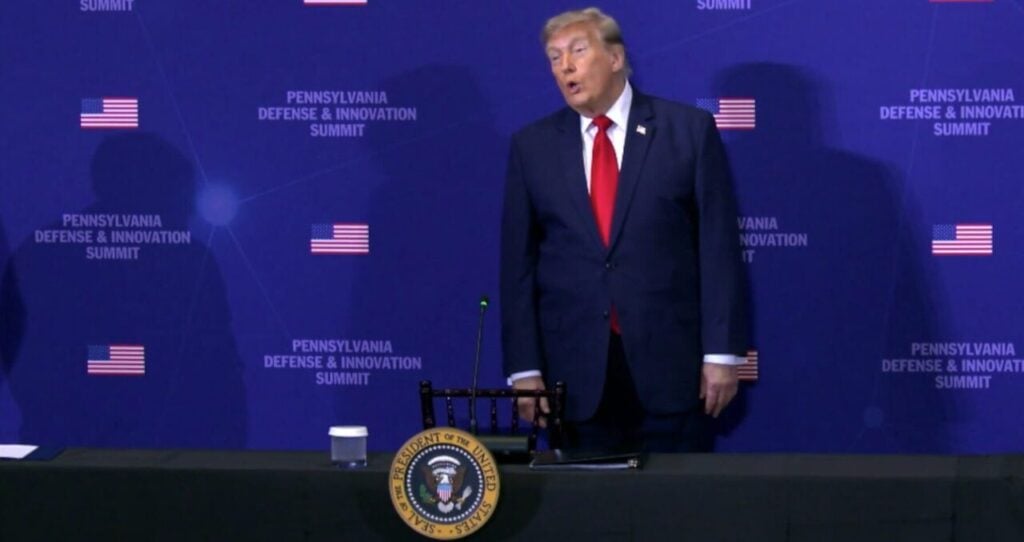
Announced 15 July by US President Donald Trump at Senator Dave McCormick’s Defence and National Security Summit in Carlisle, Pennsylvania, battery energy storage system (BESS) company Eos was awarded a Golden Dome for America contract to integrate “mission-ready long-duration energy storage (LDES) supporting requirements of the nation’s defence shield.”
During a lengthy speech where the president characterised China as “poor suckers” who “lose their ass” on wind energy, which “in my opinion kills the environment, kills the birds,” Trump said, “Eos in Pittsburgh just agreed to a multi-million-dollar partnership with the Department of War to build energy storage technology in support of our Golden Dome missile defence.”
He continued, “Yeah, we’re building a golden dome over our country and its going to be a very effective one.”
Try Premium for just $1
- Full premium access for the first month at only $1
- Converts to an annual rate after 30 days unless cancelled
- Cancel anytime during the trial period
Premium Benefits
- Expert industry analysis and interviews
- Digital access to PV Tech Power journal
- Exclusive event discounts
Or get the full Premium subscription right away
Or continue reading this article for free
Under the initiative, Eos’ Z3 zinc-based LDES solution will first be deployed as an initial prototype at a “critical installation.”
Produced and assembled in Pittsburgh, Pennsylvania, Eos’ proprietary technology features a non-flammable aqueous zinc chemistry with roughly 91% domestic content and what the company claims is a primarily US-based supply chain. The system meets Section 842 NDAA and foreign entity of concern (FEOC) compliance standards.
On 27 January 2025, Trump signed an executive order that directed the Secretary of Defence to submit a plan for the Iron Dome of America, later called the Golden Dome. Trump intends for the Golden Dome to be complete by 2029.
The project is receiving support from defence contractor Lockheed Martin, which has noted it as a “Manhattan Project-scale mission, one that is both urgent and crucial to America’s security.”
Even with the support from government and private sectors, there is serious skepticism about the success of the project. As reported by the BBC, the Congressional Budget Office has estimated that the government could spend more than US$542 billion over the course of 20 years, on the space-based parts of the project alone.
Center-right think tank American Enterprise Institute estimated that costs could range from US$252 billion to US$3.6 trillion depending on the final design used by the DoD.
Other critics have objected to the project on the basis that it would violate the 1967 Treaty on Principles Governing the Activities of States in the Exploration and Use of Outer Space, including the Moon and Other Celestial Bodies, or the Outer Space Treaty, which the US is a part of.
Eos CEO, Joe Mastrangelo said of the contract, “Today, we’re proving that America can still manufacture advanced technology at scale and deliver for our nation’s most critical missions.”
Eos preliminary Q2 financial results
Eos also released its preliminary Q2 2026 financial results on 15 July, showing the highest quarterly revenue in company history, and a loss on each unit sold during the same time.
In May, Eos’ Q1 2026 financial results showed revenue of US$56.9 million. And a gross profit loss of US$44.4 million. For Q2, the company reports revenue of US$68 million to US$69 million, with a gross margin loss between 69% and 73%.
The company further reported total cash, including restricted cash, of approximately US$364 million as of 30 June, with approximately US$78 million of customer collections received during the quarter, exceeding quarterly revenue.
Eos also noted a backlog of approximately US$807 million, representing an increase of around 25% from Q1.
Despite remaining unprofitable, the company is optimistic about its future, highlighting its transition during the quarter, to operating two commercial production lines across two manufacturing facilities.
Eos announced the start of commercial production at its Thorn Hill manufacturing facility in Marshall Township, Pennsylvania on 16 June.
The company claimed that the facility was engineered to optimise manufacturing flow and productivity. Compared to Battery Line 1, the new layout “reduces raw material travel by 86% and shortens overall production line length by 40%, improving material handling, reducing complexity, and supporting higher operating efficiency.”
The line will ramp throughout the year, with subassemblies coming online early Q3 and full production targeted in Q4.
In related news, LDES development and investment platform Frontier Power USA (FPUSA) will deploy Eos’ Z3 solution at the 100MW/400MWh Wildfire BESS project in Caldwell County, Texas.
The Wildfire selection follows FPUSA’s previously announced conversion of a 480MWh portfolio of Texas-based projects from the Bimergen portfolio and FPUSA’s selection of four projects representing approximately 920MWh under its strategic framework with Stella Energy Solutions.
Combined, the closed and selected projects account for roughly 1.8GWh of BESS capacity, equivalent to approximately 90% of FPUSA’s 2GWh capacity reservation agreement with Eos.