Aurora Energy Research has launched a forecast service to help investors and developers assess the commercial case for battery storage in the Philippines.
The Philippines Flexible Energy Forecast Add-on covers standalone and co-located battery energy storage systems (BESS), meaning projects built on their own or alongside a solar PV power plant or wind generation plant, as well as other flexible assets.
Aurora, a power market forecasting and analytics company headquartered in Oxford, UK, was founded in 2013. It said it serves more than 1,000 clients from 18 offices across Europe, the Americas, Asia and Australia.
The service provides half-hourly price forecasts for the Wholesale Electricity Spot Market (WESM), the Philippines’ electricity trading market, through 2060 across the country’s three main grids: Luzon, Visayas, and Mindanao.
Try Premium for just $1
- Full premium access for the first month at only $1
- Converts to an annual rate after 30 days unless cancelled
- Cancel anytime during the trial period
Premium Benefits
- Expert industry analysis and interviews
- Digital access to PV Tech Power journal
- Exclusive event discounts
Or get the full Premium subscription right away
Or continue reading this article for free
It also forecasts half-hourly prices in the reserve markets, where generators and BESS are paid to stand ready to maintain grid stability. These cover Regulation Up and Down, which correct small, continuous imbalances between supply and demand, and Fast and Delayed Contingency Raise, which respond when a power plant or grid link trips.
Aurora said the forecast combines project assumptions with its Central market scenario, which it developed independently and which lenders and investors in the Philippines have relied on to finance projects. Sensitivity analyses let users test how different market conditions and storage specifications could affect expected returns.
The annual subscription is an add-on to Aurora’s existing Power & Renewables Market Forecast service. It includes two reports a year, published in April and October, an Excel data book and access to Aurora’s research team for questions.
The launch follows a Department of Energy (DOE) circular issued in February 2026 that requires new variable renewable energy plants of 10MW and above to include energy storage equal to at least 20% of their capacity.
The government targets renewable energy reaching 50% of electricity supply by 2040, and a national energy storage framework law was passed earlier in 2026.
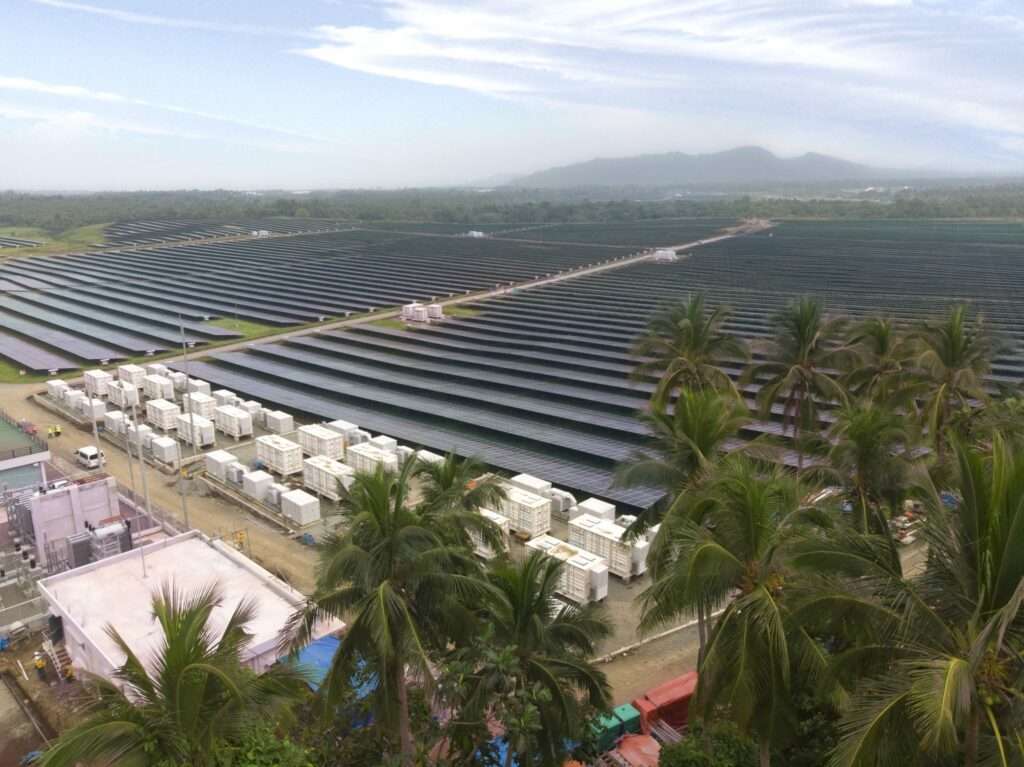
Developers are already pairing large BESS with solar PV in the country. In September 2026, ACEN, the renewable energy platform of Ayala Corporation, lent PHP9 billion (US$144 million) to subsidiaries for solar PV and battery storage projects, including PHP6 billion for a 500MW/1,000MWh BESS at its 585MW SanMar solar PV site in Zambales.
Warrick Stapleton, head of sales for BESS APAC at Trina Storage, named the Philippines among the markets driving a shift in Asia-Pacific from 10-30MWh projects to systems of 500MWh or more. Meralco Terra Solar will combine 3.5GWp of solar PV with 4.5GWh of BESS.
Patrick Tan, head of wider APAC at Aurora Energy Research, said: “The viability of a battery storage project depends on how market conditions develop over the lifetime of a project. Future price volatility, the build-out of other flexible technologies and choices around project sizing can all influence expected returns.”
Storage mandate and BESS revenue outlook
Speaking exclusively to Energy-Storage.news, Tan says Aurora’s Q4 2026 forecast shows the Philippine power system will need BESS equal to at least 20% of forecast renewable energy capacity through to 2060, whether standalone or co-located, to meet growing demand and “keep the lights on”.
“The role of a BESS is to charge when there is a surplus, such as solar at midday, and discharge when demand is high, such as from 18:00 to 22:00 in the evening. This is what we call system firming,” he says.
“So, the DOE’s 20% mandate does seem reasonable from our perspective. But rather than questioning the percentage, we think it is more important to look at how these systems can be economically viable when they are co-located with renewables.”
Tetchi Capellan, president and CEO of Philippine solar developer SunAsia, raised a related point in 2025, saying earlier policy pairing solar and storage at 20% of generation capacity did not address which grid function the storage should serve, such as peaking or baseload supply.
Tan says co-located BESS economics depend on factors including whether a system is DC- or AC-coupled, its duration of 1, 2, or 4 hours, its chemistry and degradation, its size and grid connection point, local congestion, price caps and demand growth.
For a standalone BESS coming online in 2027, “80% to 90% of revenue in the first one to five years will come from the reserve markets, mostly regulating reserve,” Tan says, adding that the share will vary by location.
“Over the rest of the asset’s life, revenue will shift from the reserve markets to energy arbitrage in the WESM,” he says.
Energy arbitrage involves charging when prices are low and discharging when they are high.
Combining these income streams remains a challenge. According to a report by the Future Energy Storage & System Integration Alliance (FESSIA) and DNV, Philippine rules do not yet let BESS combine reserve services with energy shifting, although the report named the Philippines and Vietnam as ASEAN’s first movers in battery storage.
“How fast the reserve markets become saturated also varies by region,” Tan says.
“In the Visayas, for example, a BESS providing regulating reserve on Negros may not help resolve a demand spike on Cebu, because the subsea cables between the two islands are congested.”
“It will take more BESS to bring prices down in the Visayas reserve markets, and that also depends on where they are built across the islands. In an extreme scenario where all the BESS capacity is built on Negros, the reserve markets will almost certainly not be saturated, because most of the demand is on Cebu.”
Asked what lenders want tested before financing a storage project, Tan points to the big swing factors in Aurora’s report: “market policies such as price caps and the BESS mandate, delivery of the Green Energy Auctions, such as the pumped storage hydro in GEA-3, weather patterns, and nodal dynamics, such as where a BESS is located.”
The Green Energy Auction programme is the government’s process for procuring new renewable energy and storage capacity, and nodal dynamics describe how prices and grid conditions vary between locations on the network.