
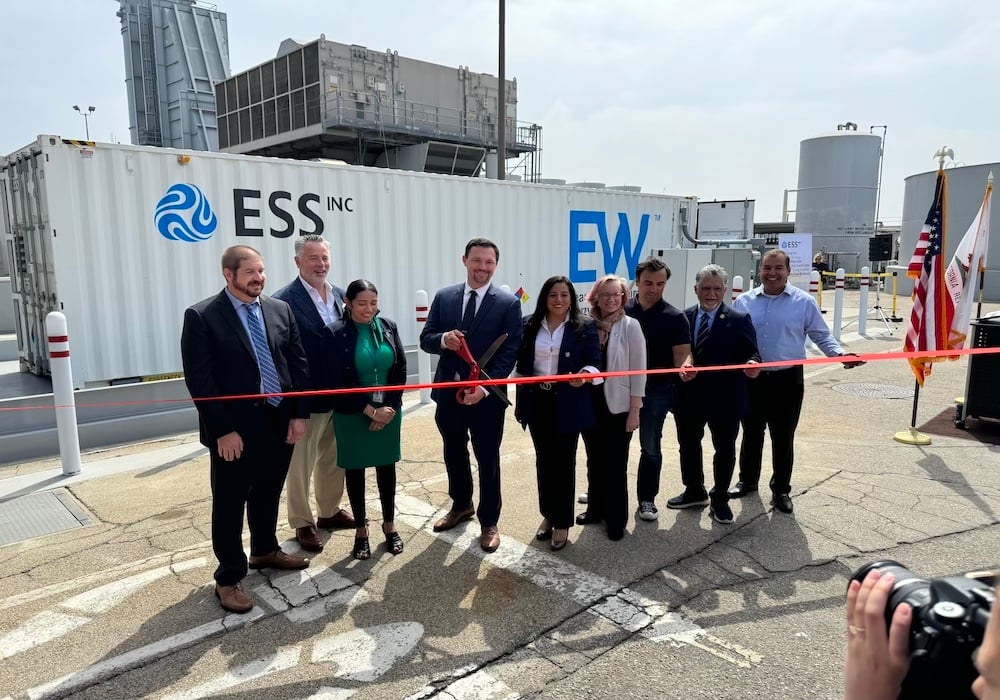
Why should people take ESS Inc and its pivot to sodium-ion BESS seriously, having failed to deliver on its iron flow battery promises since going public in 2021? We catch up with new CEO Drew Buckley about how he hopes to turn the ship around.
ESS Inc (technically ESS Tech Inc) went public on the NYSE via a special purpose acquisition company (SPAC) listing in 2021, one of several energy storage firms to have done so and subsequently underperformed against expectations.
The company’s share price has continued to plummet over the last few years with pipelines, partnerships and MOUs failing to translate into substantial and sustainable revenues, now sitting at US$0.39 at the time of writing after another quarter of heavy losses and a market cap of just US$12 million. Its latest SEC filing mentioned ‘substantial doubt to exist as to the company’s ability to continue as a going concern for 12 months’.
So Buckley, whose background is investment banking, took on an immense challenge when he became CEO in January. In this refreshingly honest 3,800-word interview, he explains where the company has gone wrong so far, the pivot to sodium-ion technology, and a possible merger with an ‘adjacent technology company in the energy space’.
Try Premium for just $1
- Full premium access for the first month at only $1
- Converts to an annual rate after 30 days unless cancelled
- Cancel anytime during the trial period
Premium Benefits
- Expert industry analysis and interviews
- Digital access to PV Tech Power journal
- Exclusive event discounts
Or get the full Premium subscription right away
Or continue reading this article for free
Iron flow battery worked in the lab, but commercial deployment was more difficult
Energy-Storage.news: When you joined a year ago, the company had been struggling for a few years to get its technology out into the market. Like a lot of new energy storage technology companies, there are always pipelines and deals announced, but for many of them, these rarely translate into firm orders and revenues. ESS has been one of those companies.
So firstly, fair play for taking on the challenge. Talk to me about how you’ve decided to approach the company and the corporate transformation you undertook on it—how you’ve been doing that and how you’re trying to position ESS to carry on as a going concern.
Drew Buckley: Absolutely, it’s a fair question. That is one of the challenges we face today. I’ll step back and talk about the last year and my vision for it. That is one of the difficulties ESS faces now as we’re making this transformation. A lot of these companies came with promises in the 2021-2022 period when everything was SPACing and a lot of money was going in. We haven’t seen, outside of lithium-ion, any other battery technology really show that it can sustain commercial agreements and make profit and sustain themselves as a business.

That was really my pitch to the board of directors to give me a chance to be CEO, and I’m really appreciative they gave me the chance. With the iron flow technology we had, it was really a question of: how much capital is it going to take to build a commercially scaled battery that works? What is the market perception and reception to that? And what’s the time it’s going to take?
Those three factors—how long is it going to take, how much is it going to cost us to get there, and will the market want it when we get there—was really the first question to answer for ESS.
The big problem over the last 15 years is that the company really started as an academic exercise, going from the idea of an iron flow battery to making it work in the lab, and they did that in the first ten years. When they went public via SPAC, the battery actually worked in the lab and worked well. At that time, it was time to raise money, and it was hard for them to say no to raising US$400 million and trying to fulfil this vision.
But what happened is they probably weren’t ready. They had a battery that worked in the lab when scientists and engineers were watching it, but putting that out in commercial deployment wasn’t really the case.
ESS spent the next four years, 2021 to 2025, basically trying to get the battery to work at commercial scale—handing it to a utility company and letting them run it—at the same time they were trying to sell as many orders as possible. That friction between getting the technology up and pushing technology out because of the money raised is really what caused the company to be in the position it was last year, where you don’t quite have a fully commercialised product and you’ve missed all the expectations you wanted to fulfill for the company.
We had to take a step back and understand what kind of timeline iron flow batteries were going to be on. We spent the first part of the year looking at: what does it really take to make this technology commercial, what’s the market reception going to be, and how much is that going to cost?
When you look at those three factors, rightly so, the market right now—or the customer profile right now—is saying they want to see the technology work before they’re actually going to buy it. Especially for newer battery technologies like iron flow, they want to see it before they start to place orders because they’ve been disappointed over time.
The way we’re thinking about it now is: the harder we pushed and the faster we wanted to develop iron flow to be commercial, the more expensive it would be and the more difficult to truly get that product to market. It would cost more, and we’d be doing development in parallel instead of in series, which would create a lot of risk and issues.
After we looked at everything, we decided to put iron flow on a longer trajectory to be commercial. All this time we’ve spent over the last five years trying to get to commercial and put a product out there, there are still so many things in between that we still need to do and understand to get to that point, because we never spent time on them—we were always trying to push batteries out the door. We need to spend that time if we’re ever truly going to get the product there. Honestly, it will be less expensive in the end than if we tried to push it out in 12 months, because we’ll be able to do development, take those learnings, and build on that over time.
For the iron flow battery, the idea is to give it a longer life to season internally and bring that to market maybe in 24 months’ time, rather than deliver on contracts toward the end of next year.
That decision, which I believe is the right one, does create a gap in the P&L. We’re a public company, so we have to have something we’re striving towards with revenues and something we really believe in. That’s where the new push towards sodium-ion comes in.
We looked at what skills ESS has and how we can use those skills to bring new business or revenue to life. We looked at all the different battery technologies out there and our skills around having strong relationships with commercial customers and engineering talent. After studying it, we saw there’s a gap in our portfolio in the shorter duration.
We wouldn’t go into lithium because there are a lot of integrators in that area right now. But that was our chance to fill a gap in our portfolio and bring a business together that we think can drive revenues, has lower tech risk than iron flow right now, lower capital intensity for us right now, and better market reception right now. It fills in a part of our portfolio that doesn’t exist yet.
So talk me through the sodium-ion product. You first announced the partnership with Alsym for the cells, so you’re not becoming a sodium-ion cell manufacturer. Then you launched the Bridge sodium-ion BESS. How can you use the experience and skills ESS has gained over the last few years to make this product launch a success? There are other sodium-ion BESS companies out there that have been more focused on just sodium-ion BESS for a longer period.
On the product side, the Bridge—we really looked at the market for lithium, took our learnings from trying to bring a product to commercial scale, and wanted to see where you have the most success and how to build an operation that can come up to speed and generate revenues really quickly.
We designed the Bridge product around being easy to drop in and install at utility scale. We wanted to replicate the energy density of lithium because we think sodium-ion has a very clear and unique application outside of lithium. A lot of that goes to the temperature range you get from sodium-ion and its ability to handle data centre workloads and AI GPU workloads a lot better than a traditional lithium system because of the temperature range.
Our vision is not that sodium-ion displaces lithium. There’s an area of the market that’s going to grow very rapidly where sodium-ion has a great place, and that’s really around AI data centre workload.
We wanted to create a product that was more turnkey for the customer, easy for them to use and install. A lot of our learnings from iron flow and the difficulty of siting, permitting, and EPC work taught us there’s a good way to put a box together. We designed Bridge around a 480-volt AC connection. Drop the box on a concrete pad and you can plug it right into a transformer.
We thought giving a turnkey box for the customer was the best way to make this business grow rapidly and be a differentiator in the market. When you look at how Tesla does the same thing with their Megapack—you drop it in, plug it right in—we thought that was a really novel approach.
On how we can do it quickly and what skills transfer from iron flow to being a different battery company, it’s really around a couple of things. First is software and designing the battery management system.
For an iron flow battery, we were designing our own BMS, and we have a lot of scale. That’s super complex—there are so many controls and touch points you have to have on an iron flow battery, so many pumps to turn on and off and flow.
Our scale and the baseline of code and technology we built on what we call our unified platform is a real differentiator for our speed to bring a new battery to market. Whatever you need in terms of BMS—getting all the data, processing it, putting it into a user interface, feeding it into an EMS system—all that baseline development around code we already had. That allows us to build this sodium-ion system that can be turnkey with a solid BMS right away.
The second thing is understanding what customer needs are. We went through a lot of siting and commercial product development and putting it at customer sites, so understanding what utilities really need and how they want the product to operate is a differentiator for us on the engineering side.
We know how we need to design it, what it needs to look like, how utilities want to site it, permit it, and use it. Also, certifications—getting all the UL stuff you need and what you need in Europe—the pain, failures, and delays we had learning that over time, that’s institutional knowledge. Knowing the timelines, what we need to do, and setting it up earlier is really important.
Using that institutional knowledge around developing a battery that can work at commercial scale, understanding all the certifications you need, what inverters and other power electronics you need, software—that’s all information we have with engineering and sales.
Finally, customer relationships. Being in the battery space and selling to customers for a decade-plus now, having that brand name and commercial awareness and a commercial team that can talk to the customer in the right way—we’ve got a good team that knows how to bring new technologies into utilities. That’s a differentiator for us as well.
You mentioned the brand name. Not to sound harsh, but is it a good brand name? It’s been around for a while but never quite got this tech off the ground. Is it viewed positively in the market?
It cuts a few different ways. When you look at the investment community or the media community, the brand name is where it is. There’s no secret we’ve struggled. There’s no secret we’ve had difficulties. I think that sticks with the brand. When you talk to investors or people in the media or around batteries overall, since I’ve joined, what I’ve tried to do is really improve that and talk about execution and under-promise and over-deliver. That should be a hallmark of where we’re going from now.
I definitely agree with where you were going, and not harsh at all. We had to recognise what we’ve done and the failures we’ve had. That’s important to me since I’ve joined—to say we’ve had struggles and those exist, but we’re trying to change that. We’ve got a totally new management team, a totally new focus on what we’re trying to do.
The nice thing about where we are today is nobody expects anything of us. We’re 1% the size of what we were when we came public now as a market cap, so nobody expects anything of ESS. Small wins and building on that should be pretty big for us. A big thing for me is to improve that brand over time.
When you talk to customers on the commercial side, because of the power and energy problems in the US—for 20 years we didn’t really have energy demand growth, and now it’s jumping off the charts—having those customer connections and the brand of a company that’s trying to bring new technology to market, the customers are receptive. They’re sceptical. They know we’ve had a difficult time having success so far, but it’s still an opening because they know us. We’ve had conversations with them. They know we’re new technology.
When we came and said, “Hey, we’ve got something new here—sodium-ion, this is what we’re working on,” there’s receptivity to that for a couple of reasons. There’s more knowledge around sodium-ion and how that can be helpful in the market. Customers who understand the sodium-ion product in a general sense know that the technology leap isn’t like iron flow or iron air. It’s very much like lithium, just a different chemistry within the box.
That’s why we’ve been able to build solid customer interest—it hits them exactly where they’re looking for something: an adjacency to lithium, potentially US supply chain for those in the US. Everything you said about the brand is right—we’ve struggled, we’re trying to improve that with small wins.
But on the customer side, being known as a company that does new technology and bringing something to them that could be really interesting right now and serve needs they have right now, that’s why we’ve been able to build such a good level of customer interest.
On that customer interest angle, you announced the deal or LOI with Juniper Energy. We covered that and our reporting looked at how serious Juniper is as an IPP. There wasn’t much info about them. I think they’ve got one guy on LinkedIn who got in touch with us and gave us his background and expertise in the sector. Some people look at that and wonder: is it just another LOI or promise that doesn’t translate into real revenues and firm orders?
They certainly need to improve their comms and get their brand awareness out there. But it is real to us, and we’re really excited about it.
What that product should potentially deliver is: we’ve got Alsym making the battery cells in the US. They’ve got a direct contract with Juniper as well as other customers. Then we’re going to do the integration.
The reason people should pay attention and think about that as exciting is: Juniper’s backed by some very well-known and recognisable companies in the energy and construction space who have put money into it, who see a future for them as a developer. There’s good backing around that. The offtake customer for that power is a major California utility. It’s not a situation where they’re just going rogue and building something by themselves. It’s backed by a real opportunity for a major California utility.
The best way to think about the Juniper contract is it’s really all of these forces coming together. If people focus on Juniper and their lack of visible presence in the market, people are very sceptical, and I totally understand why. There’s been a lot of over-promise and under-deliver. They see that now and understand how they need to improve, and we’ll see that over time.
But if you look at the pieces around it—Alsym building the sodium-ion cells, us building the boxes, the backing Juniper has in terms of their own investors and their scale, and the major California utility—I can’t mention either of those parties. It’s Juniper’s right to mention that. But there are serious players behind them, and this is a serious contract with a major California utility at the end.
I don’t want to over-promise—that’s why we’re calling our pipeline a billion in customer interest. What I can tell you is the big customers we work with now—our major Florida utility, Google, SRP down in Phoenix, the US Air Force, CTC—some of the major customers we’ve announced, we’re talking to all of them about doing sodium-ion as well, and there are high levels of interest there.
Our hope is to be able to announce something around one of those customers over the next couple of months, because that will give more validation that there is real interest and real opportunity for us.
The two things we need to do to improve our brand awareness and get people excited are: announce one of those major customers that is very visible and clear—not a Juniper, something bigger. And two, show that the product actually works—not have a rendering, but show that it’s out there outside our headquarters, plugged in, charging and discharging, and give data off of that.
Both of those are goals we have and plan to meet within the next few months—to have a real customer announcement and to have a battery working by the end of the year. That is the true unlock when the market starts to take us more seriously, because we’ve got to show technological breakthrough and true customer breakthrough. Not to say Juniper is not true—I certainly believe in them very much—but maybe higher brand awareness customers.
Let’s talk about the proposed business combination with an unnamed company that already has a manufacturing presence that you’ve announced. ESS is at the point now where it needs some kind of cash injection or raise or giant order from someone to really continue. Talk to me about that and how that might look.
The way you characterise it is quite right. We need to scale up. We can continue to raise money in the markets in small chunks, and that’s great, but it takes time, it’s more expensive, and you can’t really run as fast as you want when your capital needs come in like that.
The real idea here was to find a company in an adjacent space to us—a real one plus one equals three, where what we can give them is our product and our engineering know-how and all the things we’ve already discussed, and pair it with a company who’s got scale, who is in our adjacent space. That makes an intelligent combination from a product side—there’s an adjacency relative to the product, and that’s what this LOI and potential is.
To make something that can really take us to that next scale level, we needed to find a partner who has real revenues, operating profits, much bigger scale than us so we can fit right in there, bigger capital presence. That’s exactly what it is—to take the next level up and show we’re part of something bigger here, and there’s more opportunity outside of just the original products we’re bringing.
It’s really exciting. I’m excited about how it could be potentially transformational for us, for what it can mean for the business, and definitely for what it means for the shareholder base as well. We really kept an eye toward adding value to shareholders. That was one thing really important to me as I took the job—to think about how we create long-term value for shareholders, and we think this is a good move on that.
A bit more colour on the counterparty and what kind of transaction it would be. Would they just be buying ESS Inc? How would it work?
Think of it as a combination of two companies. The overall size the company will be at the end we’ve contemplated is about $515 million market cap. ESS shareholders would be about 5-10% of that company after we complete the combination.
A big question around it is: we’re going to become ESS shareholders, and ESS is 5-10% of this company going forward—isn’t that major dilution? What does that mean for the business?
What it gives us immediately is scale, and scale is really important. It’s going to allow us to move faster on products, deliver product faster, have more bandwidth if we want to scale up quicker and we see opportunity to do so.
The partner—all we can say right now is they’re an adjacent technology in the energy space. They have scale. They’ve been commercially active for several years now. We did this with an eye towards making a combination that really works well for the technologies, that there’s complementary nature there.
What ESS brings is that we’re listed, and this company is looking to be public as well. For the public shareholder, for an investor who’s only looking for public equities, there’s not really much in the space you can invest in in the public area in the United States. There are a few companies like EOS or Bloom, or stuff that sits on the other side of newer technology, kind of where the iron flow product was. But there’s nothing really in the space that has scale and is proven and has had success.
That’s what I think this combination brings—becoming a small piece of a much bigger pie. For the investor and the investing community, it actually gives a vehicle for people to really be able to participate in the growth of energy in the U.S. and participate in the growth of AI and data centre growth in the US.
