
BESS industry experts note that rising complexity in BESS software is driving calls for industry-wide interoperability and data standards.
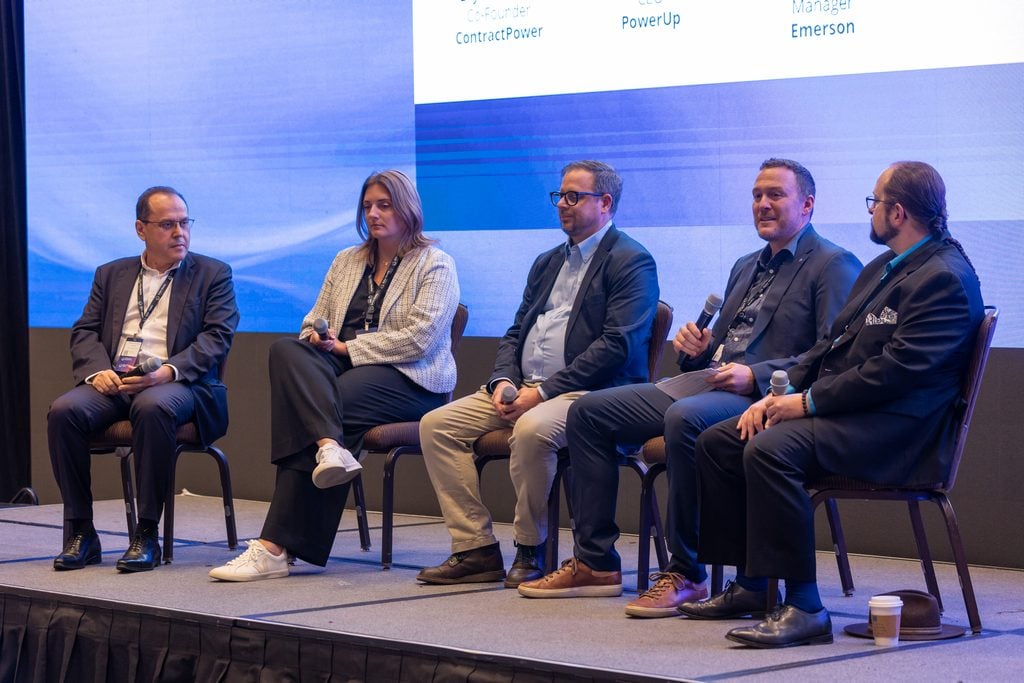
Panellists speaking onstage at the 2026 Battery Asset Management Summit USA in Garden Grove, California, and separately with Energy-Storage.news Premium, pointed to growing complexity in the battery energy storage system (BESS) software stack and called for industry-wide standards on data definitions and interoperability.
The panel, moderated by Bryan Villana, co-founder of renewables-focused AI contract services company ContractPower, included Abdelkrim Benamar, CEO of battery analytics provider PowerUp; Ryan Franks, business development manager at Emerson; Kristen Wagner, solutions architect at Power Factors; and Shawn Shaw, founder and CEO of advisory firm Camelot Energy Group.
The stack
Wagner outlined the layers of a typical BESS stack. At the site level, battery containers house cells alongside auxiliary systems — HVAC, fire suppression — coordinated by the battery management system (BMS), while power conversion system (PCS) components generate their own data streams, sometimes from a different vendor than the battery itself.
Try Premium for just $1
- Full premium access for the first month at only $1
- Converts to an annual rate after 30 days unless cancelled
- Cancel anytime during the trial period
Premium Benefits
- Expert industry analysis and interviews
- Digital access to PV Tech Power journal
- Exclusive event discounts
Or get the full Premium subscription right away
Or continue reading this article for free
Above that, definitions get murkier. SCADA, energy management system (EMS) and power plant controllers (PPCs) perform overlapping functions on industrial power conversion systems (PCSs) at site, historian functions that log and aggregate data, and control functions that interface with the PCS to execute dispatch. External access runs through firewalls and VPNs, with the robustness of that layer varying considerably by project.
Cloud-hosted layers sit on top, portfolio-wide EMS control, an asset performance management (APM) layer for performance analytics, loss allocation and fleet reporting, and further integration with external data via APIs.
Who owns what
Shaw said Camelot operates as “the glue between the pieces” rather than occupying a fixed layer, often brought in when owners have spent heavily without confidence their asset will perform to the financial model.
Franks said Emerson’s Ovation platform spans EMS, PPC and SCADA functions as hardware, software and services combined.
Wagner said Power Factors operates across the stack, while Benamar positioned PowerUp as an analytics layer designed to augment rather than replace existing infrastructure.
Asked what happens when their product fails, Franks pointed to misconfigured controls or tuning leading to shutdowns or faults, with the BMS handling worst-case scenarios such as thermal runaway. Benamar said a failure in analytics costs preventive-maintenance capability and root-cause visibility rather than causing an outage directly.
Rip-and-replace economics
Shaw described the growing frequency of EMS “rip and replace” situations when a battery OEM exits the market, putting the typical timeline at six to nine months — lengthened by the same component supply constraints affecting data centres. He cited a case where a delay stemmed not from software but from an inverter manufacturer lacking lab bench space for hardware-in-the-loop testing for six months.
PowerUp’s Abdelkrim Benamar argued interoperability needs to be designed in from day one through a documented blueprint covering interface definitions, vendor portability and exit terms.
He broke this into three components: raw data portability (historical data extractable in usable form), semantic portability (clear definitions and timestamps), and decision portability (prior analytical work carrying forward to a replacement system).
Franks pointed to the Smart Grid Interoperability Panel, formed after the global financial crisis to set data formatting standards across metering, distribution and transmission, as a precedent for the kind of cross-vendor standardisation the BESS sector still lacks.
No consensus on round-trip efficiency
Moderator Villana noted a straw poll of the room on defining round-trip efficiency or availability would likely produce ten different answers. Power Factors’ Kristen Wagner said EMS vendor capabilities vary widely and software providers remain constrained by inconsistency at the BMS layer.
In a separate interview, Benamar said PowerUp’s practice is to ask customers for their existing definition before comparing it against its own methodology, treating the customer’s definition as authoritative within that relationship while working to reconcile discrepancies.
He argued common definitions should emerge from IPPs and energy producers acting collectively, rather than being imposed by any single vendor — pointing to telecoms and other infrastructure sectors where standardisation followed similar collective action.
Physics-informed models versus LLMs
AI occupied much of the discussion, with a clear line drawn between embedded tools supporting existing platform functions and LLM-based decision-making.
Ryan Franks described two Emerson initiatives: an “Open Intelligence Framework” permitting customer data, with permission, to flow to third-party services such as battery analytics or revenue optimisation, and a “virtual advisor” running a local instance of Meta’s Llama model on-premises, driven by compute constraints and cybersecurity requirements given Emerson’s exposure to nuclear and other sensitive sites.
Wagner said Power Factors has embedded generative AI within its platform, drawing on its existing calculation logic and terminology from operating assets to support natural-language queries, rather than as a standalone tool.
Benamar distinguished “physics-informed AI” — used as the core analytical engine — from LLM-based database interaction, warning against relying on generative AI without first establishing reliable data foundations.
In a separate interview, the PowerUp CEO expanded on this. Physics-informed models constrain outputs to be consistent with established physical laws, citing Ohm’s law as an example, reducing hallucination risk relative to generic models that may “reinvent” a physical relationship inefficiently or draw false conclusions.
Combining the two, he argued, captures physical grounding alongside the ability to learn cheaply from large volumes of field data — something pure physical models cannot do by design, given they are inherently simplified representations of reality.
Camelot Energy Group CEO Shawn Shaw cautioned that AI tools produce confident-sounding output regardless of accuracy, and that non-technical stakeholders may extrapolate from a quick AI-generated chart to an unrealistic expectation of what can be automated, underestimating what sits behind proprietary methods built over years.
Build versus buy
A live poll conducted during the panel found 40% of attendees expected to build “some” or “some modules” of their storage software stack in-house within three years, 28% said they were already building internally, 20% expected to build none, and a smaller share expected to build most of it.
Franks said the total cost of ownership over an asset’s life — not just upfront build cost — is routinely underappreciated, with economies of scale typically favouring established vendors unless an operator’s asset base is very large.
He also flagged a recent shift toward DC-block commodity sales among some Chinese OEMs unable to deploy their own control systems in the US, a development he linked to recent policy actions he said were being underestimated in their market impact.
Shaw said SaaS providers remain defensible where expertise, not software, is the core product, cautioning that providers who are “just software” are exposed as AI lowers the barrier to replicating surface-level outputs such as a single chart — a different proposition from replicating the underlying expertise.
Speaking offstage with ESN Premium, Benamar named electrochemistry expertise and the ability to interpret raw voltage, current and temperature data for root-cause analysis as the two hardest capabilities for in-house teams to replicate at scale, comparing it to the gap between using architectural software and being a qualified architect.
Data access and leverage
Bryan Villana raised lock-in directly, asking whether difficulty extracting data and switching vendors functions as a deliberate retention mechanism. Wagner said Power Factors positions itself as “a steward of the data” rather than its owner, arguing that lock-in costs are driven more by onboarding and re-training investment than by technical barriers to export.
Benamar, in the separate interview, addressed closed architectures directly, advising operators with limited bargaining power to prioritise vendors offering data access.
He drew a parallel with telecoms, where AT&T and Verizon used procurement requirements to push Ericsson, Nokia and others toward greater data openness over time, arguing open access lets operators build an independent second opinion rather than depending solely on a single vendor’s internal view of asset performance.
Operational gaps
Shaw said interoperability needs continuous operational attention rather than a one-off design decision, noting he has yet to see an O&M contract that explicitly scopes responsibility for replacing firewall firmware once it reaches end-of-life — despite this being central to maintaining secure connectivity.
He also described a project where communications architecture wasn’t incorporated into design documentation until the 60–90% stage, leading to a dispute over which system was responsible for fire alarm signals.
Responding to an audience question on EMS-versus-analytics data mismatches, Franks and Shaw agreed this should be caught at commissioning. Shaw cited a case where a battery module was flagged at 130 degrees with no unit specified — Celsius or Fahrenheit — with the asset owner unable to confirm which.
He noted such gaps are often only caught later, during an insurance review, when data receives closer scrutiny than at any other point in an asset’s operating life.
Carryover from solar and wind
Speaking with ESN, Wagner said BESS has inherited many of the data and control challenges first seen in solar, where the parties selecting hardware and control systems don’t always account for the needs of the asset management team that will later depend on that data.
She said BESS OEMs are increasingly alert to this, partly because many staff have moved over from wind and solar and are applying earlier lessons on EPC-to-asset-management handoff.
She also pointed to the pace of scaling against a complicating regulatory backdrop — North American Electric Reliability Corporation (NERC) Critical Infrastructure Protection (CIP) compliance, prospective FCC rules, and existing foreign ownership, control, or influence (FOCI) considerations — as a factor narrowing vendor selection.
On AI, Wagner separated practical use — faster platform onboarding, support for root-cause analysis by less experienced staff — from hype, arguing that machine learning rather than LLMs remains the primary tool for predictive analysis based on historical trend data, with the industry still focused on data reliability before extending more trust to AI-generated recommendations.
