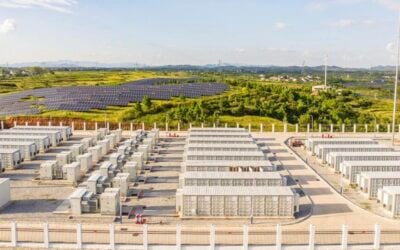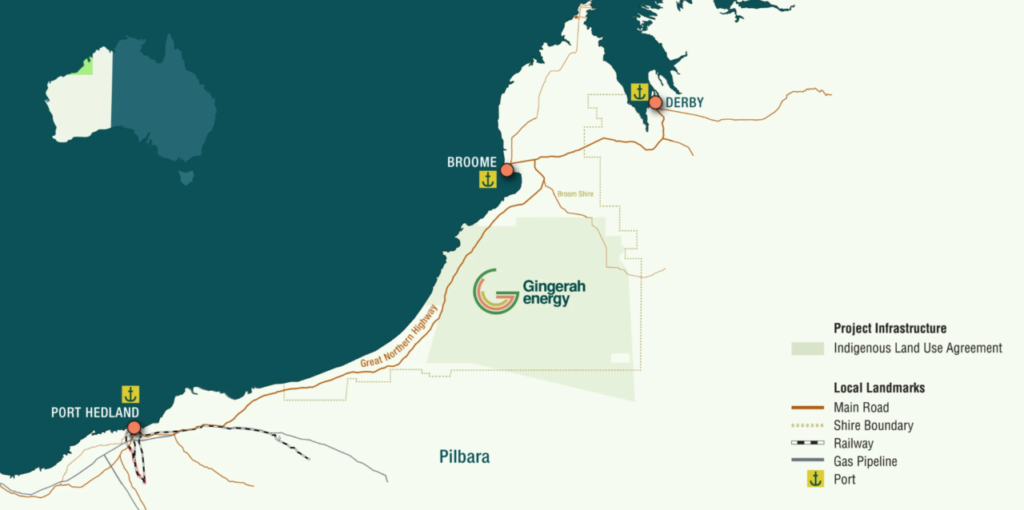
Gingerah Energy has referred a 1GW data centre complex with a 5,000MWh battery energy storage system (BESS) in Western Australia to the federal government under Australia’s EPBC Act.
The renewable energy hub and data centre, also known as Project Meridien, would be built about 100km south of Broome, in the Shire of Broome and within the Karajarri Native Title Determination Area in the state’s Kimberley region.
Alongside the BESS, the referral proposes about 5,200MW of solar PV and 1,500MW of wind from 250 turbines, which would sit within the solar PV plant area rather than on separate land.
Together they would power a data centre with an information technology (IT) load of up to 1,000MW, meaning the electricity drawn by its servers and computing equipment, plus its cooling and other auxiliary systems.
Try Premium for just $1
- Full premium access for the first month at only $1
- Converts to an annual rate after 30 days unless cancelled
- Cancel anytime during the trial period
Premium Benefits
- Expert industry analysis and interviews
- Digital access to PV Tech Power journal
- Exclusive event discounts
Or get the full Premium subscription right away
Or continue reading this article for free
The Environment Protection and Biodiversity Conservation (EPBC) Act is Australia’s main national environmental law. A referral asks the federal government to decide whether a project could affect matters of national environmental significance, such as threatened species, and so needs formal assessment and approval.
A referral is an early step in that process, and does not mean a project has been approved. Gingerah Energy said it referred the project because listed threatened species may be present on the site.
Gingerah Energy is a joint venture whose partners include the Karajarri Traditional Lands Association (KTLA), the registered native title body for the Karajarri people, and Fugro Exploration, the Australian arm of Dutch geodata company Fugro.
The referral does not describe a connection to an external grid. Power would instead flow through an internal microgrid of overhead transmission lines, on-site substations and underground electrical infrastructure.
The BESS would be supported by cold water energy storage for the data centre’s closed-loop cooling system, along with dispatchable firming facilities and fuel storage. The referral does not name the BESS technology, a supplier or a project cost.
The project would be built in stages defined by data centre IT load, at 48MW, 120MW, 240MW, 620MW and 1,000MW. The first stage, up to 240MW, would be built and commissioned over two to three years progressively. The referral covers both the first and second stages.
The project area covers about 27,520 hectares. A maximum disturbance footprint of up to 18,203 hectares, about 66% of the site, has been set aside for assessment, although Gingerah Energy expects the area actually cleared to be smaller.
The Karajarri Native Title Holders authorised KTLA on 11 October 2024 to sign an Indigenous Land Use Agreement (ILUA) with Gingerah Energy. The agreement, registered with the National Native Title Tribunal in March 2025, provides consent to native title for the project.
KTLA holds the Frazier Downs pastoral lease, which covers the site. An application to convert part of it to a tenure suited to renewable energy development was lodged with the Department of Planning, Lands and Heritage on 5 September 2025 and is under assessment.
The project will also need state environmental approval under Western Australia’s Environmental Protection Act, and development approval from the Shire of Broome. Gingerah Energy said it would consider whether the project qualifies for the State Development Act 2025 framework for projects of strategic significance.
The site was previously listed as a hydrogen and ammonia export project in CSIRO’s HyResource database, before Gingerah Energy repositioned it around data centre infrastructure.
Data centre energy rules take shape
The referral comes as Australian governments set rules for how data centres source their power. On 15 July, prime minister Anthony Albanese said large data centres would be legally required to put at least as much renewable energy into the grid as they draw.
At a meeting of the Energy and Climate Change Ministerial Council on 28 July, Queensland and the Northern Territory opposed the national framework, which the other states and territories backed.
In August, the Australian Energy Market Commission (AEMC), which makes the rules for the National Electricity Market (NEM), published a four-point framework for data centres and New South Wales moved to control grid access for large loads.
The AEMC’s recommendations cover certificates tied to new renewable energy generation, firming capacity contracts, NEM registration for data centres, and co-location of generation and storage. Western Australia sits outside the NEM.
Climate change and energy minister Chris Bowen said states could add more rigorous requirements for data centres but could not water down the national floor, with legislation targeted for early 2027.
The Australian Energy Market Operator (AEMO), which runs the NEM, forecasts that data centres could account for about 10% of NEM demand by 2050, up from about 2% today.
In September, the Victorian government said new data centres in the state must bring their own renewable energy and battery storage rather than rely on the existing grid, and pay their own connection and network upgrade costs.
Never miss an Australian energy storage story. Sign up for our Australia newsletter and get the latest project announcements, policy updates and market analysis delivered directly to you.