
As demand for battery storage soars, the European Union (EU) has tried to grow its local battery supply chain with mixed success so far, writes PV ESS analyst Charlotte Gisbourne.
European Battery Landscape
Europe was one of the early adopters of renewable energy, with significant deployment of wind and solar power across the region. However, as renewable penetration has increased, the limitations of existing grid infrastructure, periods of oversupply and growing pressure to balance intermittent generation have highlighted the need for greater flexibility.
Battery energy storage systems (BESS) are becoming increasingly important in addressing these challenges, supporting grid stability, improving the integration of renewables and creating new opportunities to optimise energy markets. In response, countries across Europe are introducing new regulatory frameworks and market mechanisms to accelerate battery storage deployment.
In addition to countries developing their own policies, alliances within the EU have produced shared goals and enabled access to funding to bolster individual battery markets. The European Commission states that 200 GW of energy storage is required by 2030, and while recent years have seen many developments to improve market opportunities, there remains a large gap between the stages that various countries are at.
Try Premium for just $1
- Full premium access for the first month at only $1
- Converts to an annual rate after 30 days unless cancelled
- Cancel anytime during the trial period
Premium Benefits
- Expert industry analysis and interviews
- Digital access to PV Tech Power journal
- Exclusive event discounts
Or get the full Premium subscription right away
Or continue reading this article for free
Strong policies and the creation of viable revenue streams for BESS are key to driving interest, as shown by the leading European battery markets in Germany and the UK. Both countries were early movers in creating commercial avenues.
In the UK, the Enhanced Frequency Response (EFR) tender was tailored to batteries’ fast-response nature, giving the technology a boost over traditional thermal generators.
Germany already had a mature Frequency Containment Reserve market, and the exemption from grid fees for energy storage (now extended to facilities commissioned before the end of August 2029) was another strong incentive. Across Europe, there have been further improvements in the ancillary service market, including new frameworks and products which can provide a clearer route to revenue.
However, as more battery projects come online, there is a risk of oversaturation in the frequency response market in individual countries, leading to a decline in returns. Pan-European balancing platforms such as PICASSO and MARI enable cross-border exchange, providing access to new markets and reducing the risk of single-market saturation.
While not every country is connected, more are being onboarded, including Hungary, which was only connected in October 2026. Wholesale electricity trading is a key component in revenue stacking, and the European electricity market is becoming increasingly linked through market coupling.
Differing electricity landscapes provide varying arbitrage opportunities, with high renewable penetration generally causing greater volatility in intraday pricing. Countries with high levels of solar generation, such as Spain, are actively seeking to boost battery deployment to aid with negative midday pricing. Some of the fastest-growing energy storage markets, such as Bulgaria, not only have a growing fleet of renewable energy sources but also lack abundant flexible generation like hydropower, leading to wide electricity price spreads and a more attractive market.
With battery storage seen as a crucial part of electricity infrastructure, countries across Europe are increasingly trying to incentivise developments by increasing bankability; one such way centralised revenue contracts. Strong interest was immediately displayed in Italy’s first MACSE auction last year, which awarded 10GWh of battery capacity, and Spain and Germany are among the countries actively planning to launch new capacity market auctions.
In addition to market mechanisms, across Europe, there has been the use of state aid schemes to jump-start the wider battery storage deployment. Most notably, the EU Recovery and Resilience Fund and Modernisation Fund, which helped financially support 14.5 GWh of energy storage projects in Poland and 13.7 GWh in Bulgaria. Approval for new schemes is still going strong, particularly in Central Europe; this year, the EU approved a €59 million and €150 million grant scheme for new energy storage installations in Slovenia and Romania, respectively. There are also other ways the EU has helped battery projects in regard to funding, such as the InvestEU programme, which provides financial guarantees to de-risk projects in the eyes of potential lenders.
New EU Policies
The uptick in the battery storage market has also led to increased scrutiny on the batteries themselves. The EU has announced new measures to ensure regulatory compliance and to build market resilience through a more localised supply chain. This has the potential to affect which suppliers are more favoured and the overall battery manufacturing landscape in Europe; however, the near-term impact looks to be minimal.
From 18 February 2027, the EU Battery Regulation will require batteries to carry a battery passport, placing greater emphasis on traceability and product footprint rather than requiring physical changes to the battery itself. The final battery product when placed on the market will need to present data ranging from materials and composition to power limits and even end-of-life handling. Cells and other components to be assembled later, however, will not require individual passports. While it may have taken effort to gather the necessary information, suppliers were given time before the policy came into effect, with details regarding the mandatory information released in August of this year. It is unlikely that this new regulation has severely impacted any company’s operations.
Local manufacturing
EU frameworks aimed at bolstering local manufacturing are more likely to shift the battery landscape, but the effects will take time to materialise, given the multi-year process of building new facilities.
In mid-2024, the Net-Zero Industry Act went into force, targeting domestic manufacturing of 40% of the EU’s net-zero technology deployment needs by 2030, and a 15% share of global production of these technologies by 2040. Batteries were earmarked as one of the key technologies. Rather than outright bans or strict content requirements, the act focuses on supporting domestic manufacturing by designating strategic projects with benefits such as faster permitting, in the hope that the resulting domestic products will replace existing competition. In addition, since 2026, countries have been required to consider non-price criteria for a portion of annual renewable energy auction volumes.
Stricter regulations are being drafted with the Industrial Accelerator Act. Although not yet finalised, phased ‘made in EU’ stipulations for publicly procured battery storage systems are being proposed, starting with assembly, battery management systems, and other components, before further incorporating EU-origin cells into the requirements. The eligibility of projects to receive support schemes also depends on these conditions. The scope of EU origin, however, goes beyond union members and covers countries with which the EU has relevant obligations under the GPA, a free trade agreement, or customs union.
The IAA further targets specific overseas manufacturers of strategic technologies (including batteries) by imposing conditions on foreign investments. This is aimed at dissuading overseas companies from simply relocating facilities to Europe and at reducing the dominance of a single country over a technology. Prior screening and conditions are imposed if the investment amount exceeds €100 million and if the foreign investor’s home country holds more than a 40% share of global manufacturing capacity, with four out of the six value-added test criteria needing to be fulfilled for approval to be granted. These conditions cover matters of ownership, intellectual property, and workforce, among others.
With these new regulations, there could be increased interest in establishing production in free trade zones where FDI rules will not be enforced. North Africa has the potential to become a larger hotspot given its proximity to Europe and its ability to serve the fast-growing MEA energy storage market. Gotion High-Tech, Sungrow, and Huawei are among the suppliers planning new factories in the region.
Battery manufacturing within Europe has been heavily weighted towards those for electric vehicles, reflected in the financial instruments the EU has in place, such as the new €1.5 billion Battery Booster Facility specifically targeting EV cell manufacturers. The previous IF24 Battery Call, part of the Innovation Fund, was awarded to five EV cell projects, helping fund over 54GWh of production capacity. Even as foreign cell manufacturers increasingly set up facilities overseas and energy storage gains more attention, the strong European automotive sector has kept electric vehicles the primary application. This is likely to continue, especially in light of the new import cap for Chinese hybrid vehicles of 350,000 units per year, set to be put in force this December. This is expected to increase demand for European-made batteries and further shift EV production to Europe, since cars produced there are not subject to this restriction, regardless of the company behind them. Sites focusing on energy storage products tend to be for assembly rather than cell production.
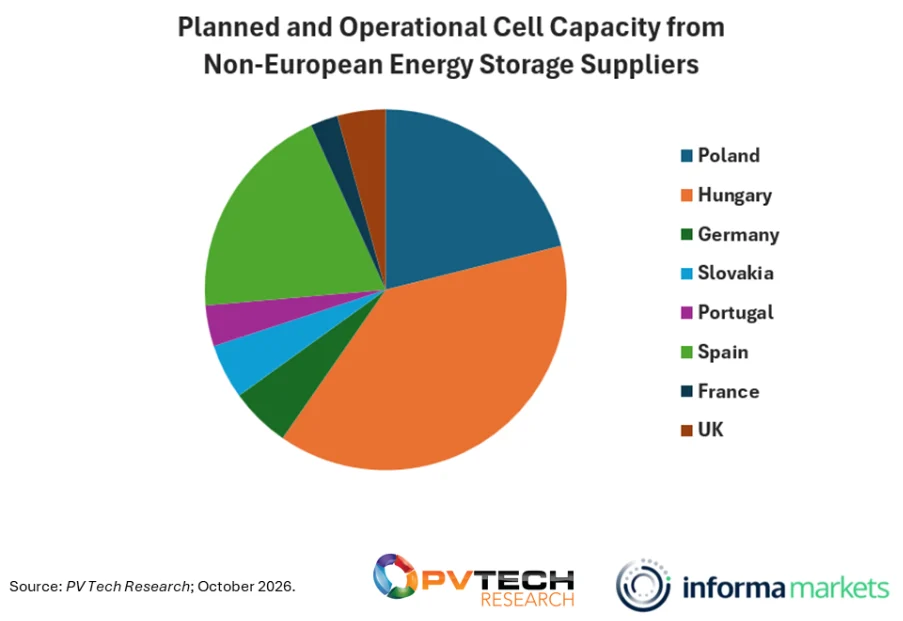
The graphic above covers cell production for both EV and ESS from leading energy storage suppliers. Hungary has been a key destination for new factories, possibly aided by the low corporate income tax rate. Countries have been aiding the establishment of these new facilities through state funding; over €3.8 billion has been awarded by EU members to the facilities featured in the graphic through tax allowances, subsidies, and other financial support. The Hungarian government contributed to over 47% of this while being the destination of around 40% of the final capacity.
Raw materials
The EU has extended its focus beyond end products with the Critical Raw Materials Act (CRMA), which includes several key battery materials, aiming to reduce reliance on a single country. Securing a strong upstream supply chain is crucial to the continued success of a battery manufacturing ecosystem, and increasing localisation could help secure the future stability of the overall battery storage landscape.
By 2030, the CRMA aims to have domestic extraction cover 10% of annual EU demand for all 34 critical materials, in addition to 40% of processing taking place domestically and 25% of consumption coming from recycled materials. To emphasise diversification, no more than 65% of the 17 strategic materials at any processing stage may come from any single third country. Projects covering these areas could apply for strategic project status, for which the EU said benefits would be granted such as faster permitting and easier access to finance. Numerous selected projects were related to battery materials; so far, 26 cover battery-grade lithium (including one outside the EU in Serbia), 14 cover battery-grade graphite, 11 cover battery-grade manganese, and 26 cover battery-grade nickel.
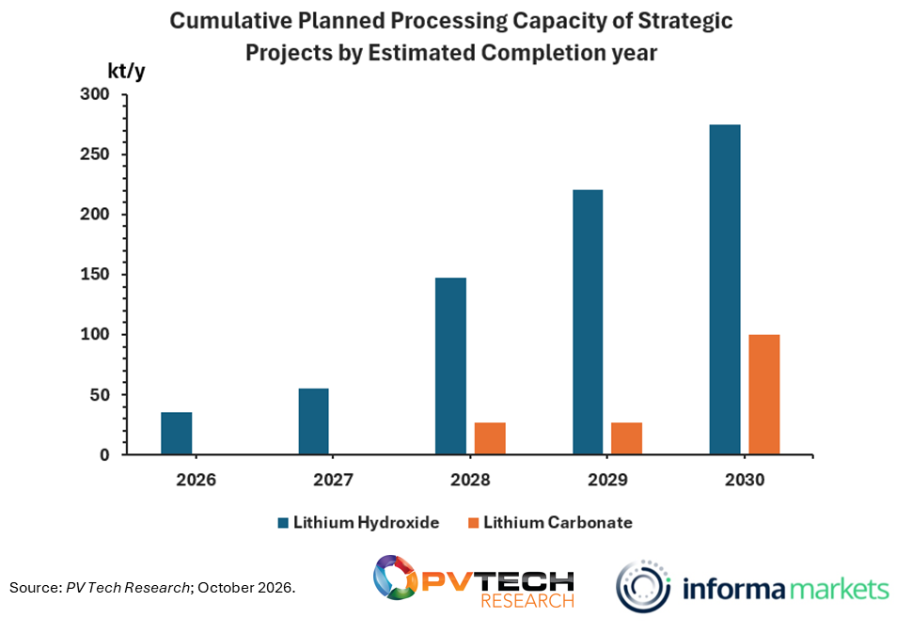
Looking at sites selected within the first two calls that focus on lithium extraction or processing, being designated a strategic project does not necessarily guarantee success.
Several of these projects have experienced delays, and of the 13 projects, seven are still awaiting full permitting. Two processing facilities have been cancelled, one due to a lack of financing and the eventual liquidation of the company, and the other due to a lack of an offtaker. Stronger support could be required to ensure the CRMA goals are met.
Developers are still seeking this designation, however. In the latest round of calls ending in October 2026 seven projects related to lithium, four of which deal with extraction or processing, were included. This new round added over 187,000 tonnes per annum of planned lithium salt output; however, some sites are unlikely to reach full commercial operation prior to 2030.
Conclusion
Overall, clean energy goals have stressed the need for energy storage in Europe, leading the EU to try to reduce its overseas dependency for key components in this vital industry.
So far, the measures put in place have been too soft to significantly increase domestic energy storage cell manufacturing; in recent years, numerous European companies in this field, such as Northvolt and Morrow, have gone bankrupt amid strong competition from often cheaper overseas suppliers.
The IAA has the potential to increase the appeal of European batteries, and supply chain localisation through the CRMA could help lower production costs. However, unless these products can become cost-competitive, foreign-produced batteries are likely to continue to dominate the European landscape.
For further insight into battery storage suppliers and potential risks, our BatteryStorageTech Bankability Ratings Report features detailed financial benchmarking, shipment analysis, bankability scoring, and supplier risk assessments across the global ESS market and can be found here.
