Chile’s operational battery energy storage system (BESS) capacity could triple in the next twelve months.
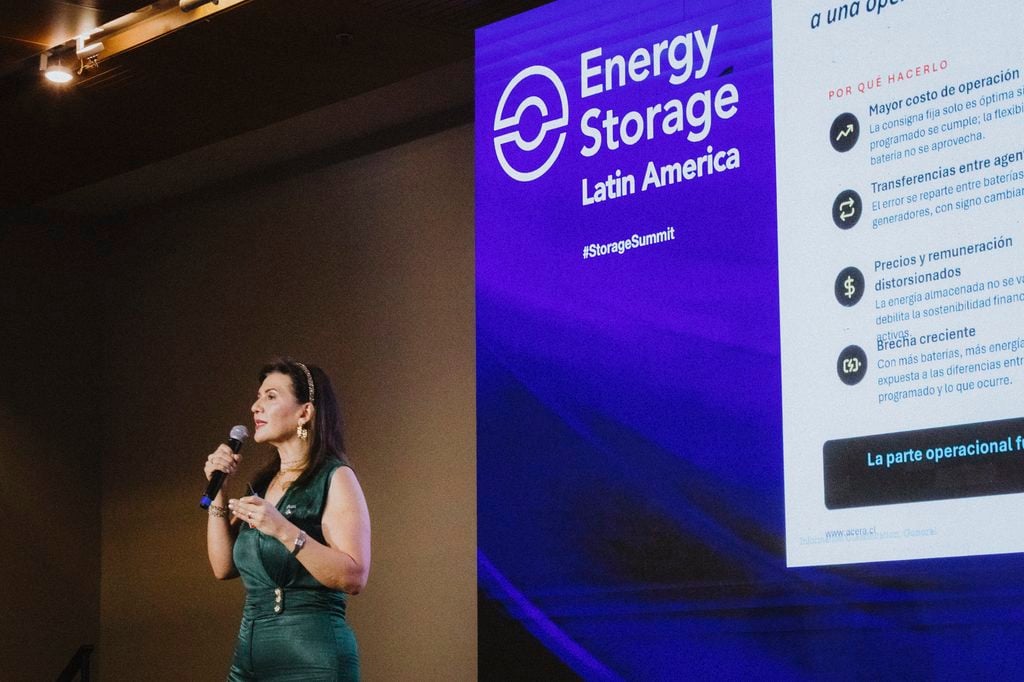
“There are very few markets in Latin America and in the world that have that [growth] curve,” said Ana Lía Rojas, executive director at the Chilean renewable energy and energy storage association (ACERA), during the opening keynote of Energy Storage Summit Latin America 2026 today in Santiago, Chile.
Rojas said that 3.1GW/13.5GWh of BESS is in operation in Chile, the majority of which (2.3GW/10.5GWh) is co-located with solar PV.
A further 3.7GW of BESS is in the testing phase, which is already dispatching energy to the grid. Three years ago, the operational BESS stood at only 84MW.
Try Premium for just $1
- Full premium access for the first month at only $1
- Converts to an annual rate after 30 days unless cancelled
- Cancel anytime during the trial period
Premium Benefits
- Expert industry analysis and interviews
- Digital access to PV Tech Power journal
- Exclusive event discounts
Or get the full Premium subscription right away
Or continue reading this article for free
Similarly to the operational capacity, the bulk of that in-testing portfolio is co-located with solar PV, with only 728MW of the BESS in the testing phase built standalone.
And what comes next is a “quantum leap”, said Rojas, with 5.1GW/22GWh currently in construction, while 19.9GW and 8.7GW have respectively received environmental approval and are under evaluation.
Combining both the portfolio of BESS projects in the testing phase and in construction could nearly triple the current installed capacity.
Of the nearly 20GW that have already received approval, about half (9.8GW) is expected to be co-located with solar PV.
Curtailment decreasing year-over-year in August 2026
Nearly all the 11.3GW operational, in construction or in development BESS capacity in Chile is located in the north between the Arica and Atacama regions, at 84%.
“The point is that we have a high concentration of projects in the north, less concentration in the centre, and a small presence of BESS projects in the south,” mentioned Rojas.
As a comparison, out of the 11.3GW of BESS projects in Chile, there are 5.4GW of projects located in the Antofagasta region, 2GW in Atacama, 1.6GW in Tarapacá, while the centre and south of the country combine 1.5GW between 58 projects.
Moreover, as a positive note of more BESS entering the grid, Chile has, for the first time in four years, witnessed a decrease in solar PV and wind curtailment in August 2026, compared with the data from the previous year. This comes after 2025 registered a record 6TWh of curtailed solar PV and wind, which had already shown signs of a slowdown in curtailment thanks to the added BESS capacity.
This is shown with the solar PV and wind capacity that has been added this year between January and August, with 70% of the 2,900GWh energy produced being charged by BESS. Without BESS, that energy may have been curtailed.
Rojas also highlighted how BESS works like a Swiss Army Knife (i.e., with multiple applications performed by a single asset), and how it helps in the ramp-up for peak hours with BESS currently providing 80% of peak energy demand. Four years ago it didn’t provide any.
“At 9pm the batteries are discharging on average nearly 1.7GW,” said Rojas. However, Rojas warned that “nowadays, the abundance of projects has some risks (for new projects coming online),” adding that current energy demand is not growing as fast as supply.
New projects should therefore focus on data centres, electric vehicles, desalination and other areas that may require BESS capacity.