Distributed energy storage company Viridi and developer and financier Good Carbon Co. have announced the deployment of a 3.75MWh energy storage project in Buffalo, New York.
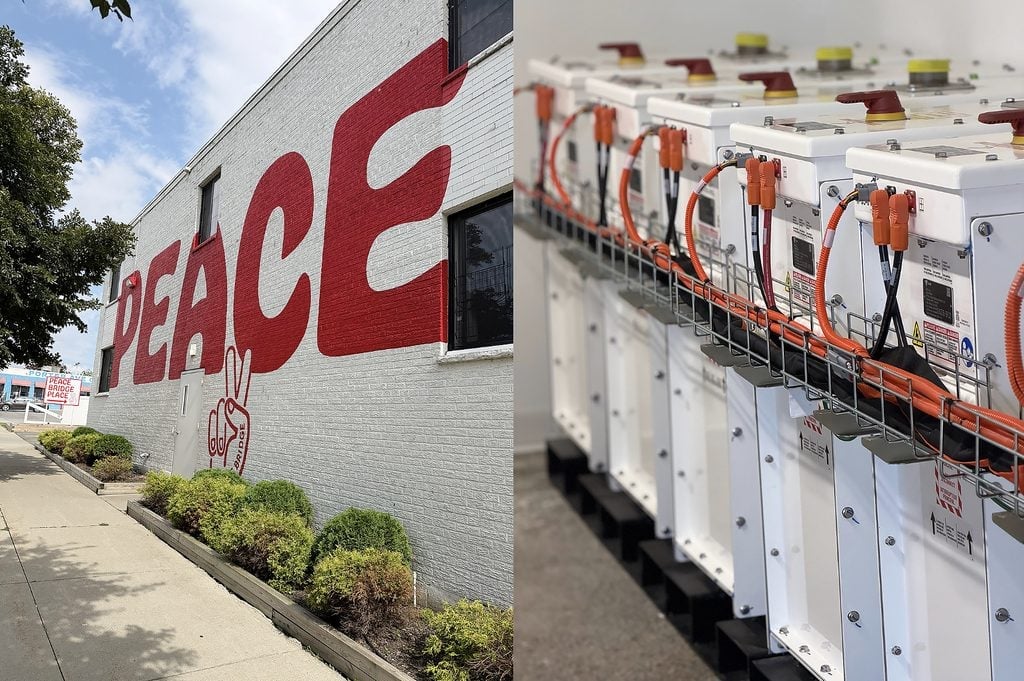
Announced 20 October, the lithium-ion (Li-ion) battery energy storage system (BESS) at Peace Bridge Place, a 105-unit affordable housing apartment building is described by the companies as one of the largest indoor Li-ion BESS installations in an occupied residential building in the US.
The system, known as RPSLinkIN, is distributed across seven battery rooms within the fully electrified building. It forms part of a wider clean energy strategy at the property that also includes geothermal heating and cooling, domestic hot water systems, and building envelope upgrades.
Good Carbon Co., which focuses on refurbishing multifamily properties across Western New York, selected the system with the aim of improving energy resilience for residents and enabling the building to participate in grid-responsive energy management.
Try Premium for just $1
- Full premium access for the first month at only $1
- Converts to an annual rate after 30 days unless cancelled
- Cancel anytime during the trial period
Premium Benefits
- Expert industry analysis and interviews
- Digital access to PV Tech Power journal
- Exclusive event discounts
Or get the full Premium subscription right away
Or continue reading this article for free
Viridi’s energy management system (EMS) controls when the BESS charges and discharges based on the building’s needs and conditions on the local grid. The company said this is intended to reduce electricity demand during peak periods and provide backup power during outages.
Two main functions are involved, peak shaving, where the battery discharges automatically as the building’s grid draw approaches a monthly peak, intended to reduce demand charges; and seasonal demand response, where dispatch signals from utility National Grid are relayed through EnergyHub’s Edge Distributed Energy Resource Management System (DERMS) to Viridi’s EMS.
The EMS coordinates a response across the BESS and other building systems. This can include adjusting smart thermostat setpoints to pre-cool or pre-heat apartments ahead of a demand event, with residents able to opt out of individual events.
The project is receiving support from the New York State Energy Research and Development Authority (NYSERDA) through its Future Grid Challenge, and is also a National Grid pilot focused on integrating flexible, grid-responsive technologies into its distribution network.
Safety architecture
Viridi manufactures its systems at a facility in Buffalo, New York, which the company said has the capacity to produce approximately 400MWh of BESS annually, and has previously said it has room to expand production.
The company also operates a facility in Richmond, California, acquired from the former Moxion Power site following Moxion’s 2024 bankruptcy, supported by a US$9.3 million grant from the California Energy Commission (CEC).
The Peace Bridge Place deployment follows a period in which large-scale Li-ion storage in New York State has generally been concentrated in less densely populated upstate areas, owing to the state’s fire safety regulations governing installations in dense urban environments.
Other projects aimed at addressing fire safety concerns for storage in occupied or urban settings in New York have included trials of alternative cell architectures and chemistries, such as Cadenza Innovation’s cell and pack design and Zinc8’s zinc-air battery system, both tested at New York Power Authority and NYSERDA-supported sites.
New York has separately set a target of 6GW of energy storage deployment by 2030 under its Climate Protection and Community Leadership Act (CPCLA), and launched its first Bulk Energy Storage request for proposals in 2025 to support grid-connected projects of 5MW and above.
Installing Li-ion BESS at this scale indoors, in an occupied residential building, requires addressing the risk of thermal runaway spreading between cells.
Viridi’s system uses what the company calls a Fail-Safe Anti-Propagation architecture, a passive safety layer designed to stop thermal runaway propagating from one cell to another without relying on active detection or connectivity.
Speaking at the 2026 US Battery Asset Management Summit in Garden Grove, California, Viridi project manager Tess Williams described how the mechanism works, “We contain the cell through what’s called phenolic plastic, and every module and every separated cell is covered by a pouch that’s encased in a liquid material. So, when that cell goes into thermal runaway, that heat is released, opens up that pouch, and the liquid within that pouch puts out the cell before it can spread to the next one.”
She contrasted this with active detection-based approaches used elsewhere in the industry: “We don’t try to stop thermal runaway. If someone claims to, they really can’t. You can detect thermal runaway, but that means you need to have a cell section, a cell connection, or a Wi-Fi connection, or something that we can’t always control. Our system is passive.”
According to the company, the system underwent UL 9540A testing, in which a cell was deliberately driven into thermal failure to assess whether the event would propagate to surrounding cells.
Viridi claimed the test recorded no cell-to-cell propagation and no detectable release of heat, sparks, smoke, gas or flames.
Williams also addressed the choice of cell chemistry. Viridi uses the LG 18650 cell, a nickel manganese cobalt (NMC) chemistry, rather than lithium iron phosphate (LFP).
“NMC is a lot more energy dense, and it has a lower point at which it goes into thermal runaway. However, because it’s less energy dense, the LFP cells tend to be a lot smaller. So, combined with our anti-propagation technology, it’s a lot easier to contain that cell that’s smaller than when you see those larger LFP cells. When you combine NMC with our anti-propagation technology, it actually becomes a lot safer to deploy and a lot more useful for the customer,” she said.