
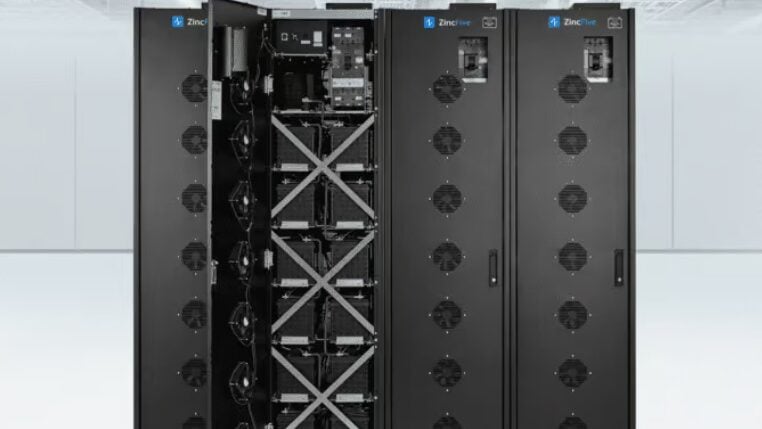
ZincFive, a manufacturer of nickel-zinc battery systems for data centre and AI infrastructure applications, announced on 11 June that it will become publicly traded through a merger with special purpose acquisition company (SPAC) Spark I Acquisition Corporation.
The transaction values ZincFive at approximately US$752 million on a pro forma enterprise value basis.
Upon closing, expected in the second half of 2026, the combined company will trade on Nasdaq under the ticker symbol ZFIV.
Commercial scale differentiates from 2021 SPAC wave
In 2021, a wave of energy storage companies went public via SPAC mergers, the largest four being zinc hybrid cathode battery maker Eos Energy Systems, energy storage developer and system integrator Energy Vault, iron flow battery company ESS Inc, and system integrator Stem.
Try Premium for just $1
- Full premium access for the first month at only $1
- Converts to an annual rate after 30 days unless cancelled
- Cancel anytime during the trial period
Premium Benefits
- Expert industry analysis and interviews
- Digital access to PV Tech Power journal
- Exclusive event discounts
Or get the full Premium subscription right away
Or continue reading this article for free
In 2023, ESN Premium reported that since going public, those four companies had seen share prices fall by an average of 80%, with one source calling them “unmitigated disaster for investors.”
Stem and ESS’ share prices have since fallen even lower, and while Eos and Energy Vault have increased value, neither company is near their 2021 share value.
ZincFive CEO Tod Higinbotham emphasises that his company enters the public markets from a fundamentally different position.
“The previous wave of SPAC transactions was largely coloured by companies going public on the promise of future revenue. ZincFive is a different story,” Higinbotham says.
“We have already achieved commercial scale – nearly 2GW of systems deployed or contracted globally, revenue that more than doubled in 2025 to US$66.9 million, and an US$81 million contracted backlog entering 2026. These are formal purchase orders from blue-chip customers, not projections.”
As of 31 December 2025, ZincFive had 1.15GW of systems deployed and operational, with an additional 717MW under contract. The company’s backlog grew 70% year-over-year.
Technology targets AI infrastructure demands
ZincFive’s proprietary nickel-zinc chemistry is positioned as an alternative to traditional valve-regulated lead-acid (VRLA) and lithium-ion (Li-ion) batteries for uninterruptible power supply (UPS) and short-duration backup applications in data centres.
The company claims its technology eliminates thermal runaway risk, delivers higher power density, requires less floor space, and offers lower total cost of ownership over a 15-year evaluation period.
The company recently launched an energy storage solution designed to support both backup power and real-time AI dynamic power loads, targeting the emerging requirements of next-generation data center infrastructure as AI workloads drive unprecedented power density demands.
Transaction structure and capital deployment
The business combination is expected to deliver at least US$100 million in gross proceeds from a committed private investment in public equity (PIPE), which fully satisfies the minimum cash condition in the business combination agreement. An additional US$25 million may be available depending on shareholder redemptions.
Existing ZincFive shareholders will roll 100% of their equity into the public company, a structure Higinbotham says reflects confidence in future value creation rather than an exit opportunity.
“Our existing shareholders are not looking for an exit, they are investing in the next chapter,” he explains. “The rollover eliminates exit overhang at closing and ensures full alignment between our existing shareholders and new investors from day one.”
ZincFive has entered into a US$35 million bridge loan facility, of which US$28.5 million is expected to be repaid at closing. Net proceeds will fund growth investments, commercial deployment, and expansion of US manufacturing capacity.
Higinbotham says gross margins have improved significantly as the company scaled and transitioned to higher power-density products. On total cost of ownership, he claims that ZincFive’s BC Series UPS product line delivers lower 15-year costs than both VRLA and Li-ion alternatives.
“These advantages are driven by higher power density – fewer cabinets required, lower installation costs, fewer service visits – and a 15-year design life that eliminates the costly mid-life replacements VRLA systems require.”
He continues, “Add in the floor space savings, which are significant in a hyperscale environment, and the financial case is clear. That analysis doesn’t even capture the avoided cost of the specialised fire suppression infrastructure that Li-ion deployments typically require.”
The company did not disclose a specific timeline for achieving positive EBITDA, directing investors to review the full investor presentation and forthcoming S-4 filing with the SEC.
Market positioning
While ZincFive declined to break out individual customer percentages, Higinbotham confirms the US$81.2 million backlog comprises formal purchase orders from “a diversified set of blue-chip operators and hyperscalers.”
“What this transaction delivers is the growth capital needed to meet demand we are already winning,” he states. “Becoming a public company also gives us broader, more efficient access to capital as AI infrastructure buildout continues to accelerate.”
James Rhee, CEO and Chairman of Spark I, said the transaction aligns with the SPAC’s strategy to bring late-stage technology companies to US public markets. “We believe ZincFive’s proven commercial relationships, recently launched AI power solutions, and scalable manufacturing position the Company to capture significant value from the AI infrastructure build-out.”
The boards of directors of both ZincFive and Spark I have unanimously approved the transaction, which remains subject to Spark I shareholder approval and regulatory review.
