Heron Power and NiSource have separately announced US data centre-focused deals involving battery energy storage systems (BESS) in recent days.
Heron Power and Vantage announce deal to accelerate AI infrastructure
Digital infrastructure provider Vantage and US-based startup Heron Power have announced a GW-scale manufacturing capacity agreement.
Announced 21 October, Vantage has secured over 1GW of manufacturing capacity of Heron Link, Heron’s solid-state transformer (SST), to deploy in its hyperscale data centre campuses.
The companies stated that the collaboration is designed to give AI and cloud customers a more efficient and scalable way to deploy the high-density infrastructure required for AI computing.
Try Premium for just $1
- Full premium access for the first month at only $1
- Converts to an annual rate after 30 days unless cancelled
- Cancel anytime during the trial period
Premium Benefits
- Expert industry analysis and interviews
- Digital access to PV Tech Power journal
- Exclusive event discounts
Or get the full Premium subscription right away
Or continue reading this article for free
The companies further stated that AI rack densities are approaching MW-class power requirements and the grid needs additional flexible and interactive loads. Further, customers are facing growing constraints related to power availability, electrical equipment, deployment timelines and cost.
Heron Link is designed to address those challenges by converting medium-voltage grid power directly to 800 VDC with integrated BESS, reducing the number of conversion stages and simplifying the path from the grid to the rack.
Conventional data centre electrical systems depend on several stages of conversion, BESS and distribution to carry power from the grid to the rack. As rack densities rise, this multi-stage approach can demand more equipment, cabling, floor space, installation labour and commissioning time, adding cost and complexity for customers trying to bring AI capacity online quickly.
By contrast, this architecture intends to shorten the electrical critical path by reducing equipment dependencies and installation steps, helping customers bring AI capacity online more quickly.
Heron claims it improves energy efficiency by minimising the number of power-conversion stages, with Heron Link targeting over 98.5% efficiency from medium voltage through to 800 VDC.
It is also designed to support increasingly dense computing requirements, including MW-class racks, through 800 VDC distribution. Infrastructure requirements are lower too, as the simplified electrical design reduces the equipment, floor space, materials and labour needed compared with conventional 480-volt alternating current (480 VAC) systems.
Finally, integrated BESS enhances energy flexibility, buffering variable AI loads to make better use of grid assets and allowing data centres to function as more adaptable partners to the grid.
Heron raised US$200 million in two funding rounds since February, and recently hired former Tesla CFO Zachary Kirkhorn to its board. Last month, the company announced that RWE Americas would pilot the deployment of Heron Links at a renewable energy and storage project in Texas.
NiSource’s long-term agreement with Microsoft data centre in Indiana
Major US regulated utility company NiSource has announced a long-term energy agreement with Microsoft for its Indiana data centre.
Announced 16 October, the agreement covers a previously disclosed northwest Indiana campus which the companies claim will expand customer savings while supporting economic growth across the region.
Through subsidiary NiSource Generation Company LLC (GenCo), the company serves large-load customers under a structure designed to shield existing Northern Indiana Public Service Company LLC (NIPSCO) electric customers from incremental costs, while returning value from large-load customers’ use of the existing electric system.
Under this model, large-load customers fully fund the generation and infrastructure required to serve their own needs.
The agreement builds on a previously disclosed US$1.4 billion in expected customer savings over the life of NiSource’s data centre customer contracts, pushing total expected NIPSCO electric customer savings to approximately US$1.75 billion, equivalent to as much as US$140 per customer annually.
Under the agreement, Microsoft is expected to begin taking electric service under a 20-year term starting in 2028. The GenCo-owned pool portfolio will expand by approximately 1,100MW, with NIPSCO and GenCo providing transmission and generation infrastructure to serve both Microsoft’s data centre and NIPSCO’s wider customer base.
Microsoft is fully funding all generation and transmission infrastructure required to serve its own load, which NiSource said will also upgrade NIPSCO’s electric transmission system and improve grid reliability and resilience for customers across Indiana.
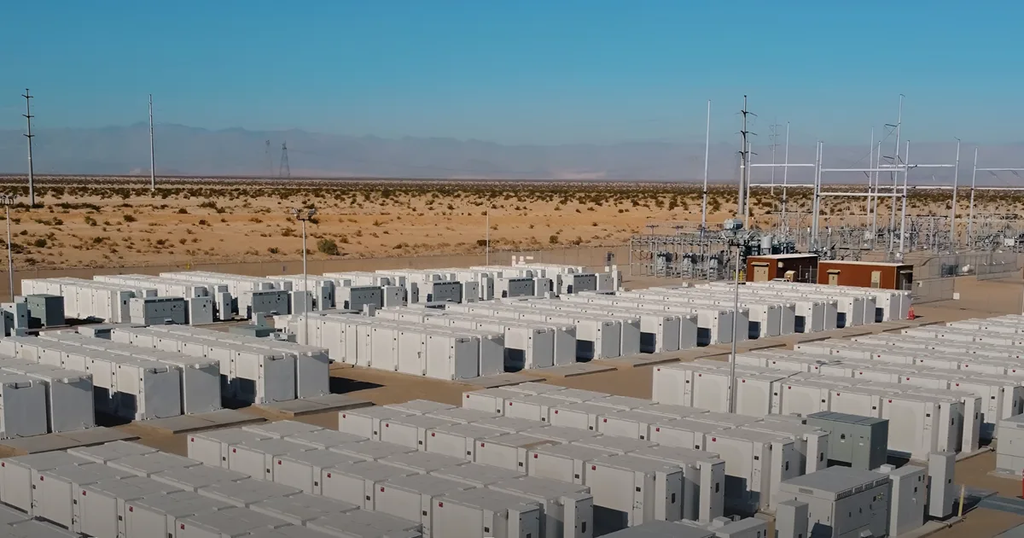
As part of the agreement, GenCo has contracted 600MW of BESS under a long-term tolling agreement. The facility will be developed and constructed by an affiliate of AGP Group, adding to the pool of resource assets GenCo is building to serve its growing roster of large-load customers.
The Microsoft agreement follows a similarly structured deal NIPSCO struck with Amazon last year, details of which emerged in filings with the Indiana Utility Regulatory Commission (IURC).
That agreement saw NIPSCO commit to building 3GW of new dispatchable capacity to serve Amazon’s data centre expansion in the state, comprising a 400MW/1,600MWh BESS facility alongside two new 1.3GW fossil gas turbines, which NIPSCO has said will eventually be converted to combined-cycle gas turbines (CCGTs).
The BESS component is being built at the site of NIPSCO’s former coal-fired Mitchell Generating Station in Gary, Indiana, which was decommissioned in 2013 and has since been demolished.
Under that deal, Amazon funds the construction of the new generation and transmission infrastructure via a “special contract” with GenCo, while NIPSCO separately purchases the power needed to serve Amazon’s load from GenCo under a power purchase agreement (PPA). Amazon’s data centre demand from NIPSCO is expected to reach a peak of 2.4GW in 2032.
The creation of GenCo as a “generation-only” subsidiary was approved by the IURC in September 2025. Unlike NiSource’s other utility subsidiaries, GenCo does not sell power to retail customers, instead procuring energy on behalf of NIPSCO to serve its largest customers.
The structure has drawn criticism from clean energy advocates, who have argued it is anti-competitive and undermines the regulatory process, despite NiSource’s claims that it will save NIPSCO customers up to US$1 billion over 15 years.