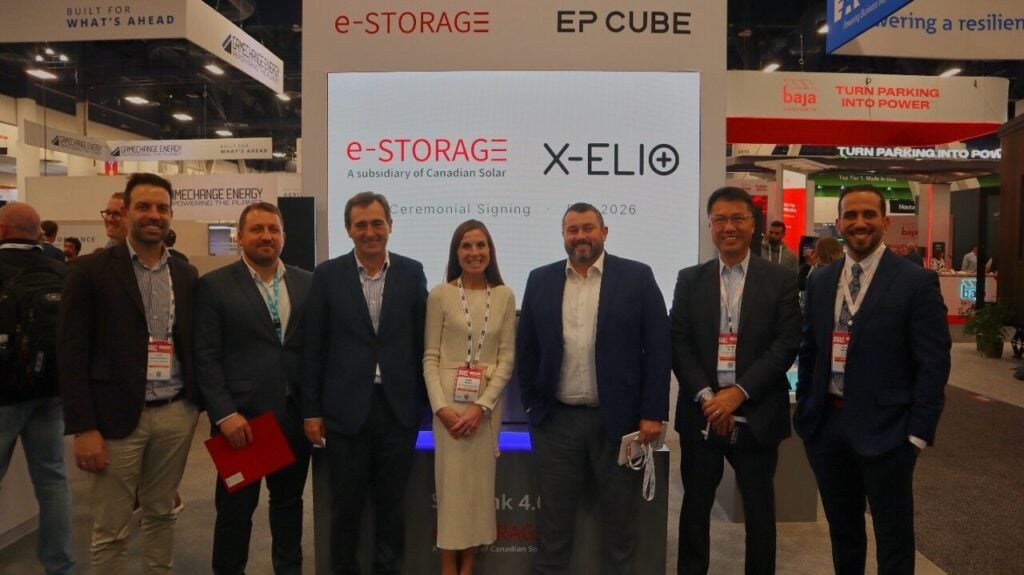
Deals and acquisitions were announced this week as RE+, the biggest clean energy trade show in the US, takes place in Las Vegas, Nevada.
Samsung SDI seals 16GWh BESS supply deal
On the first day of RE+ (16 November), Samsung SDI announced its latest multi-year lithium iron phosphate (LFP) battery supply deal.
The Korean battery manufacturer’s US subsidiary has signed a 16GWh agreement with battery energy storage system (BESS) project developer-owner-operator Jupiter Power. The deal to supply Jupiter Power for its large-scale project in the US is worth an “estimated several trillion Korean Won,” Samsung SDI said. It runs for three years, starting in 2029.
Samsung SDI is establishing UD domestic content-compliant LFP production lines for BESS applications in the US, through repurposing electric vehicle (EV) battery lines. Batteries supplied to Jupiter Power will be made in Indiana, where Samsung SDI has two factories: one wholly owned after the battery company bought out automaker General Motors’ (GM’s) share in a joint venture (JV), the other co-owned through a JV with auto OEM Stellantis.
Try Premium for just $1
- Full premium access for the first month at only $1
- Converts to an annual rate after 30 days unless cancelled
- Cancel anytime during the trial period
Premium Benefits
- Expert industry analysis and interviews
- Digital access to PV Tech Power journal
- Exclusive event discounts
Or get the full Premium subscription right away
Or continue reading this article for free
Customer Jupiter Power is owned by global asset manager BlackRock’s Global Infrastructure Partners (GIP) investment platform. The developer raised US$1.4 billion a couple of months ago to support 10 BESS projects in Texas and Michigan, with a total output of 1,500MW and 3,600MWh of storage capacity.
The deal brings Samsung SDI’s booked BESS orders from returning customer Jupiter Power to around 27GWh, the battery manufacturer said.
Samsung SDI released its Q3 2026 financial results in late October, noting that it had, to that point, received 60GWh of energy storage battery orders in the first nine months of this year, and in its previous quarterly release said the company’s US LFP production had reached 30GWh annual capacity, which it continues to ramp.
The manufacturer announced US-based production of two BESS solutions at the 2025 edition of RE+, SBB 1.7, based on nickel cobalt oxide (NCO) cells, and the LFP-based sister product, SBB 2.0.
EQT’s energy transition infrastructure fund buys Flatiron Energy
Tuesday (17 November) saw the announcement of the acquisition of US utility-scale BESS developer Flatiron Energy by private equity firm EQT’s energy transition infrastructure arm.
Like Jupiter Power, Flatiron Energy develops BESS projects to build, own and operate. Flatiron recently broke ground on a 250MW/1,200MWh project in Massachusetts that it claimed will be the biggest battery storage facility in the Northeastern US when it begins commercial operation in Q4 2027.
Sweden-headquartered EQT has acquired the developer through its EQT Transition Infrastructure, which the company describes as providing “industrial, technological and operational expertise” to scale businesses in the low-carbon and climate-resilience sectors.
EQT entered a definitive agreement to acquire Flatiron from its owner Hull Street Energy, another private equity firm that invested in the developer in 2022, a year after Flatiron was established. Financial terms of the deal were not disclosed, but EQT said it is expected to close in Q4 of this year.
Flatiron’s total portfolio is claimed to total 24GWh in New England, New York and Mid-Atlantic US regions, although this is thought to largely comprise its development pipeline. The EQT announcement referenced 2GWh of BESS projects under construction and 6GWh awarded long-term contracts.
The company’s strategy is to target markets where the retirement of thermal power plants and adoption of renewables present opportunities.
EQT’s other energy storage investments include its 2024 acquisition of the UK-based energy storage and flexible generation (gas) developer Statera and its 2025 acquisition of German developer Ju-niz Energy.
EQT just sold a minority stake in Statera to fellow private equity firm Ares Management, while Ju:niz Energy’s 442MWh grid-forming BESS order placed with Envision was recently covered by this site.
Canadian Solar’s BESS subsidiary signs 1.43GWh US and Australia deal
E-Storage, the BESS integration and manufacturing subsidiary of vertically integrated PV company Canadian Solar, signed a deal with global renewable energy developer X-Elio at RE+.
Announced this morning, e-Storage will supply and service integrated 590MW/1,430MWh DC of BESS solutions for five projects: four in Texas, US, and one in New South Wales, Australia.
In addition to providing its SolBank 3.0 BESS solution, e-Storage has signed 22-year long-term service agreements (LTSAs) for each project. SolBank 3.0 is a 20-foot containerised BESS, integrated with Canadian Solar’s in-house battery cells, power conversion systems (PCS) and power plant controls (PPC). Meanwhile, the largest of the five projects, a 200MW/482MWh facility in Texas, will operate on e-Storage’s proprietary energy management system (EMS), called EQ-S.
X-Elio, is, as you may have guessed, also owned by a private equity firm. Brookfield acquired the developer in 2023 after investing in a JV with previous owner KKR. X-Elio is likely better known to readers of sister site PV Tech, given its track record in solar projects in Europe, North America and APAC regions.
Canadian Solar has expanded its presence in the energy storage space over the past few years. In late August, it reported significant quarterly and year-on-year growth in its energy storage shipments.
In its Q2 2026 financial results, Canadian Solar said BESS shipments had surged 82% from the previous quarter and 73% from the same period in 2025, making 3.7GWh of shipments recognised as revenue, including 471MWh to its own development pipeline.
This happened while the company’s PV module shipments conversely saw a 60% year-on-year decline for the quarter, with 3.1GW shipped in Q2, PV Tech reported. Canadian Solar’s next results, for Q3 2026 earnings, are due 3 December.