Floors are increasingly the offtake structure of choice in the UK market, and the contracting for them is beginning to standardise, industry experts said.
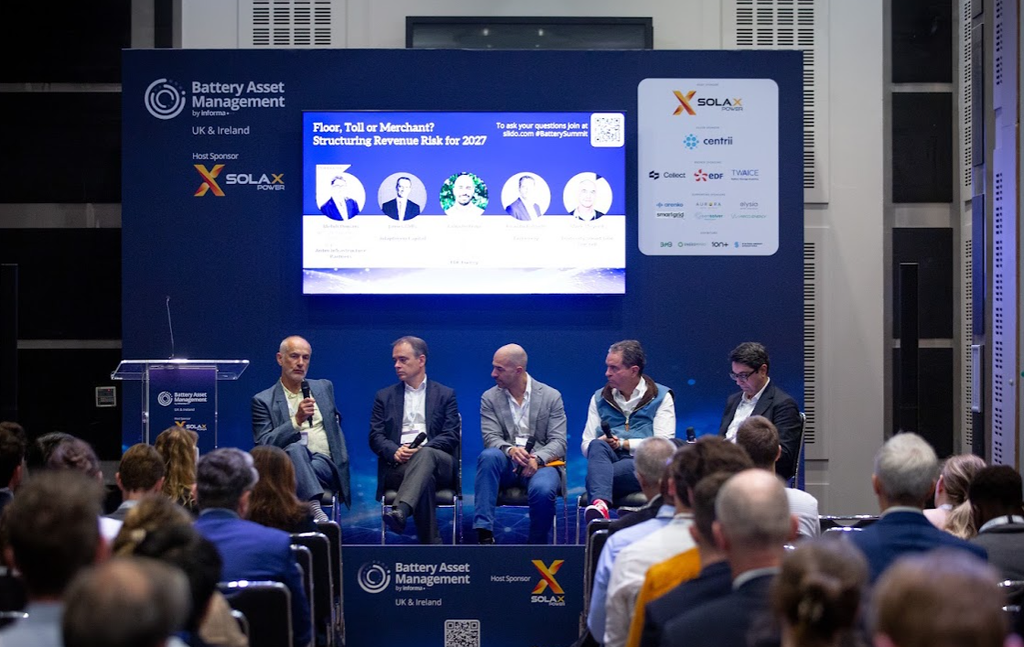
Panellists from investors and optimisers discussed the topic on the ‘Floor, Toll or Merchant? Structuring Revenue Risk for 2027’ panel discussion at last month’s Battery Asset Management Summit UK & Ireland 2026, held in London (pictured above). It is followed by the Battery Asset Management Summit Europe in Rome in a few weeks on 2-3 December.
The topic of how much volatility and revenue risk to keep on your books and how much to offload to an offtaker is a key one in the UK and European battery energy storage system (BESS) market right now. Offtake structures have soared in popularity in the past few years, helping to unlock project financing and attract risk-averse capital. While some owners still go merchant, most large-scale projects across the continent now at least consider some sort of contracted revenue.
The panel was primarily centred around the UK market, but it can to some extent be seen as a bellwether for what trends will come further down the line in continental Europe as it quickly catches up on deployments.
Try Premium for just $1
- Full premium access for the first month at only $1
- Converts to an annual rate after 30 days unless cancelled
- Cancel anytime during the trial period
Premium Benefits
- Expert industry analysis and interviews
- Digital access to PV Tech Power journal
- Exclusive event discounts
Or get the full Premium subscription right away
Or continue reading this article for free
The toll has made way for the floor
The panellists generally agreed that, in the UK market, floors increasingly make sense ahead of a toll. A full toll would be where the offtaker rents part or all of the BESS from the owner for a more-or-less fixed fee in return for all the volatility, risk and upside or downside. A floor meanwhile is where the offtaker optimises the BESS and shares the revenues with the owner, but guarantees the owner a minimum level of revenues (a floor).
The largest UK BESS player Gresham House signed a two-year toll with Octopus for the bulk of its portfolio in 2024 following a downturn in UK revenues. A year later it signed floor deals with offtakers Statkraft and Markel Bermuda, partially replacing the Octopus tolls once they reached expiration.
Ricardo Folgado, managing partner of BESS owner-operator TagEnergy, explained it: “The UK market, probably more than any other in Europe, is now very sophisticated, deep, and liquid. There’s no shortage of banks — NatWest, Siemens, all the usual suspects — and they’ve become very comfortable with floors. So the original need for tolling isn’t really there anymore, because banks can gear quite aggressively on a decent floor.”
“We don’t see the benefit of a toll because ultimately you lose the volatility and the upside, and that’s the whole point of a battery. There’s a place for tolls for someone wanting a de-risked asset, or as a subset of a bigger battery, but it defeats the whole point of the asset.”
Tolls still make sense for some investment cases where the owner wants the project completely de-risked, panellists agreed. James Mills, managing director of Adaptogen Capital, which owns UK BESS owner-operator Varco Energy added that partial tolls are becoming popular in Europe.
Availability and contractual challenge of tolls
Mills also pointed out that tolls can actually create new risk. Instead of revenue risk, you have new operational and availability risk. That turns some owner-operators off tolls entirely.
Mills: “I’d add that a big difference between a toll and a floor is that with a floor, availability is a slightly less stressful issue. With a toll, by writing that commitment to the person offering you the financial toll, you are making the asset management operational availability question that much more serious financially, and so a toll can become a liability.”
“As an owner, if you suffer extensive availability problems on your site — or on National Grid’s side — you could then face legal questions over fault and what you owe under the toll. They’re not the simple panacea some asset owners may think.”
Fabrizio Fenu, head of business development & account management services, EDF Business & Wholesale, part of energy major EDF, agreed.
“That’s actually one of the main reasons that’s kept us away from that product — it makes negotiation and communication between the parties quite contentious at times. We prefer an approach where we’re aligned: we generate the money, take a revenue share, rather than getting into detail over whether you were off for the single week that was making the whole month’s money, and how to price that for the next 10 years.”
Adding to that point, Mills said the toll conversation is more contentious because the UK market is changing in real time and the trading conditions in 3-5 years will be materially different so locking in a hard absolute number for both sides is hard.
In a recent ESN Premium interview, Angus Gordon Lennox, chair of the Gore Street Energy Storage Fund (GSF), described taking a toll in the current market as “locking in poor performance”.
Contracting is complex, but starting to standardise
Mark Meyrick, general manager at the optimisation arm of green utility Ecotricity, pointed out that all this meant that contracting for both floors and tolls is very complicated: “You end up needing fairly detailed formulae to address technical aspects in the contract, and we’ve had to think hard about what makes sense practically for running an asset.”
However, contracting for floors is approaching standardisation, EDF’s Fenu said: “Negotiations can be extensive, but we’ve arrived at something close to standardised. We’ve offered floors for seven years now. The area that still takes the most time is change-of-law provisions, because ultimately a route-to-market provider covers market risk — we’re there to absorb market risk if the rules of the game change materially, up to the point where it would significantly impact what can be generated. There’s different legal wording for that, and that’s where we spend the most time, along with liability clauses.”
Change-of-law is a contractual term that defines how parties will handle new, amended, repealed, or re-interpreted legislation, regulations, or court rulings that take effect after the contract is signed.
Ecotricity’s Meyrick agreed and added that the change-of-law provisions need to cut both ways, as a modification might make the BESS perform better, and the owner should get a fair deal reflecting that too.
Fenu continued: “Another is adjustment terms relative to the asset term sheet — in theory you’re promised an asset that performs a certain way, and when you test it, it’s not always perfectly aligned, so you need adjustment clauses. Our approach is to set those out clearly in the agreement up front, so there’s less conversation once you’re in operation.”
Meyrick said it’s better to get all the complex stuff resolved at the heads-of-terms (beginning) stage of a contract “so there isn’t a protracted gap before contract signing, because a lot can change in that time”.