Spain-headquartered power conversion system (PCS) manufacturer Power Electronics is supplying grid-forming inverters and DC/DC converters for Edify Energy’s Smoky Creek and Guthrie’s Gap solar-plus-storage projects in Queensland, Australia.
Power Electronics said it has signed an agreement with DT Infrastructure, the construction contractor, to supply an integrated package for the 600MW projects in Banana Shire, Central Queensland.
The order covers 164 GEN 3 2.0 PCSM inverters, 536 Freesun DC/DC converters, medium-voltage transformers and power plant controllers, alongside engineering and on-site commissioning support.
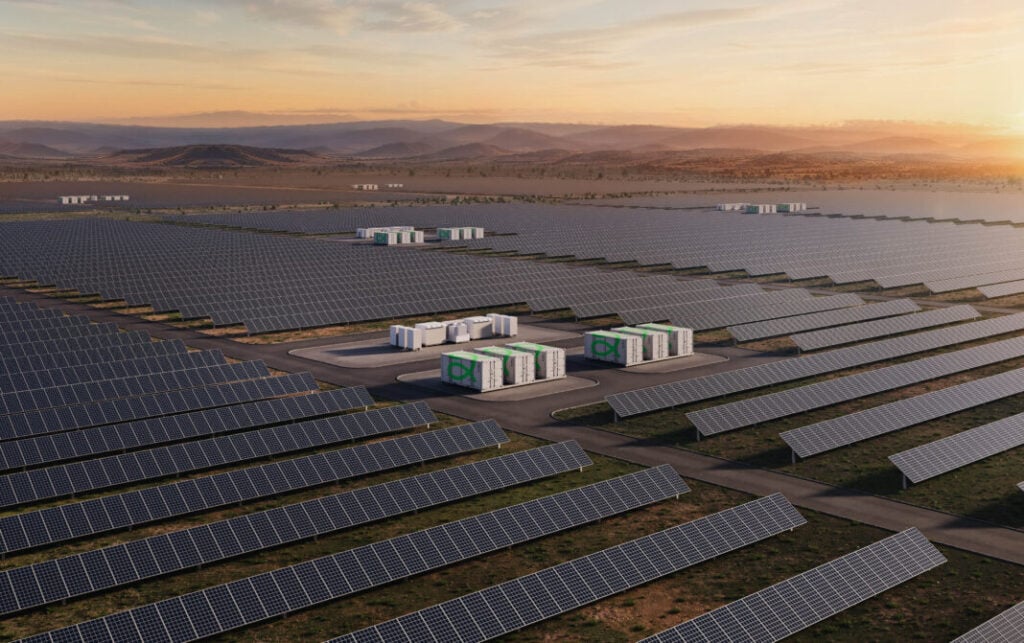
Edify, an Australian renewable energy developer, is building 720MWp of solar PV with co-located battery energy storage systems (BESS) totalling 600MW/2,400MWh across the two adjacent sites, a 4-hour duration. It reached financial close with support from shareholder La Caisse and a syndicate of 14 lenders.
Try Premium for just $1
- Full premium access for the first month at only $1
- Converts to an annual rate after 30 days unless cancelled
- Cancel anytime during the trial period
Premium Benefits
- Expert industry analysis and interviews
- Digital access to PV Tech Power journal
- Exclusive event discounts
Or get the full Premium subscription right away
Or continue reading this article for free
The PCS order sits alongside a cell and container supply deal, with CATL supplying the 2,400MWh of BESS for the two 300MW units, which will connect to Powerlink’s 275kV network through a new terminal station. Commercial operations are targeted for 2028.
DT Infrastructure, a subsidiary of Malaysian engineering group Gamuda, was named in March as Edify’s preferred engineering, procurement and construction (EPC) contractor for 3.6GWh of solar-plus-storage, which also includes the 300MW/1,200MWh Ganymirra & Majors Creek project near Townsville.
The output is largely contracted. Mining group Rio Tinto signed two 20-year hybrid services agreements in March 2025 to procure 90% of the power and storage capacity for its Gladstone aluminium operations, saying the 2,160MWh it secured would provide about 30% of the firming needed to repower its Boyne smelter.
Both sites also won long-term revenue underwriting in Tender 4 of the federal Capacity Investment Scheme (CIS), in which 12 projects with BESS totalling 3.5GW/11.4GWh were awarded contracts. Edify took three of those slots, adding its Nowingi project in Victoria, each pairing 300MW of solar PV with a 300MW/1,200MWh BESS.
DC-coupled design with one set of grid-forming inverters
Power Electronics describes the plant as a “BESS leading DC-coupled architecture.” Its Freesun DC/DC converters route solar output to the BESS before final conversion to AC, so a single set of grid-forming inverters serves both the solar PV and storage.
The inverters use the company’s Virtual Synchronous Machine (VISMA) function to reproduce the behaviour of synchronous generation, and the plant will provide Frequency Control Ancillary Services (FCAS) and other network support, Power Electronics said.
Edify has used a different supplier’s approach before. It developed and managed construction of Sosteneo’s 185MW/370MWh Koorangie BESS in Victoria, which runs 100 Tesla Megapack units in Tesla’s Virtual Machine Mode and entered full operations in July 2025.
Other DC-coupled hybrids are moving ahead in the National Electricity Market (NEM). Wärtsilä has said its 64MW/128MWh system for Octopus Australia’s Fulham solar-plus-storage project in Victoria will be the NEM’s first utility-scale DC-coupled hybrid BESS.
Rival inverter makers are targeting the same configuration. Germany’s SMA launched a DC-coupled grid-forming solar-plus-storage solution for Australia, Germany and the UK at All-Energy Australia in October, where Power Electronics was also exhibiting.
Grid-forming is becoming the default for new NEM projects. Market operator AEMO data shows about 74% of the 33.2GW standalone BESS pipeline in the first quarter of 2026 had confirmed grid-forming inverters.
“Grid-forming projects require technology, engineering capabilities and local experience to work together from the earliest stages of grid connection,” said Glenn Clark, business development director at Power Electronics Australia.
The company said its local team supports network model validation, Hold Point testing and SCADA testing during connection, and that it has more than 50 operations and maintenance staff in Australia, with engineering, spare parts and training run from Brisbane.
Power Electronics said its Australian BESS installations range from 100MW to 700MW. It is supplying 89 inverters for Alinta Energy’s 250MW/1,000MWh Reeves Plains stage one in South Australia, where CATL is supplying 194 BESS units.
The company also sells PCS into the data centre market, which draws on the same power conversion supply chains as BESS. Power Electronics broke ground in September on a Houston, Texas factory with 40GW of annual capacity when fully ramped up, and reports 170GW of installed AC capacity across 36 countries.
Never miss an Australian energy storage story. Sign up for our Australia newsletter and get the latest project announcements, policy updates and market analysis delivered directly to you.