US energy storage deployments have increased year-on-year by a fifth, underpinned by utility-scale activity and state-level targets that have translated into installed capacity.
According to the Q4 2026 edition of the US Solar Energy Industries Association (SEIA) US Energy Storage Market Outlook report, 48.3GWh of new battery energy storage systems (BESS) went into operation during the first three quarters of 2026, including 40.9GWh of utility-scale BESS.
The total is a 20% increase over the same 9M period last year, the report, published by SEIA in partnership with market intelligence firm Benchmark Mineral Intelligence, found.
It highlighted that US installed capacity to date exceeds 200GWh and forecast continuing growth. Earlier this year, the SEIA-Benchmark report predicted US cumulative installs would reach 683GWh by 2030.
Try Premium for just $1
- Full premium access for the first month at only $1
- Converts to an annual rate after 30 days unless cancelled
- Cancel anytime during the trial period
Premium Benefits
- Expert industry analysis and interviews
- Digital access to PV Tech Power journal
- Exclusive event discounts
Or get the full Premium subscription right away
Or continue reading this article for free
In the latest report, published today, the authors upped their forecast by 3.7% to 708GWh of installs across both grid-scale front-of-the-meter (FTM) and distributed behind-the-meter (BTM) systems by the end of the decade.
Q3 sees gigawatt-scale utility BESS completions and data centres breathing life into C&I segment
In terms of the quarter just gone, 14.3GWh of new capacity was added between June and September, which was around the same as Q3 2025, but down 33% from Q2 of this year, during which SEIA-Benchmark counted a record 21.5GWh of new installations.
Again, utility-scale FTM installations comprise the largest share of the Q3 2026 numbers, with 12.2GWh across 45 projects reaching COD during the quarter.
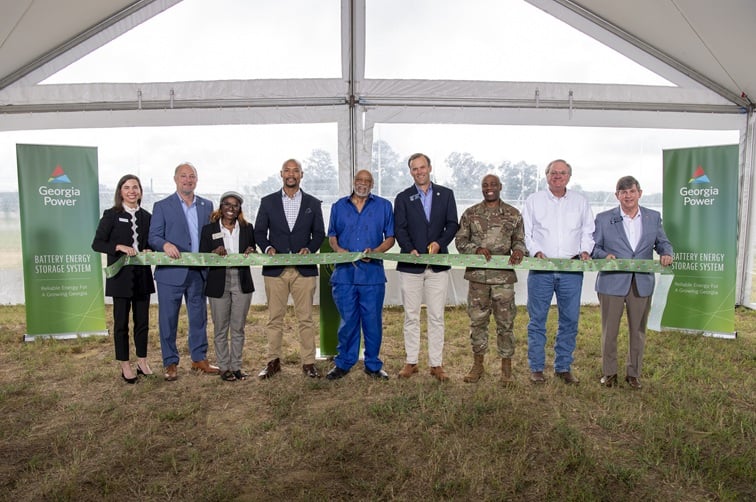
Three gigawatt-scale projects went online during the quarter, the authors said, including utility Georgia Power’s McGrau Phase I & II BESS projects, together totalling 530MW/2,120MWh of output and capacity on land close to the southern US state’s Moody Air Force Base.
The majority of FTM projects were either 20MWh or below, or 45MWh and above. The vast majority (88%) were standalone BESS projects, with just 11% co-located or hybridised with solar PV, while wind-plus-storage accounted for the remaining 1% of the market.
The commercial and industrial (C&I) market segment, traditionally the weakest performer by far, has just seen two consecutive quarters of strong performance, with 1.3GWh of new deployments in Q3 2026 and 1.8GWh recorded in Q2. Unsurprisingly, data centres are driving that demand, the authors said, and it remains to be seen if C&I will take off in other business sectors.
The SEIA-Benchmark report only began in Q1 of this year, making direct comparison difficult. However, the rival US Energy Storage Monitor report from analysts at Wood Mackenzie and the American Clean Power Association (ACP) previously found that in the whole of 2025, the US installed just 95.6MW of BTM installs, including C&I and community-scale BESS projects.
The residential segment hit 2.7GW of installations in 2025, according to Wood Mackenzie. SEIA-Benchmark found that 746MWh of new residential systems were deployed in Q3 of this year, which, assuming most systems are 4-hour duration, would imply that, in megawatt terms, the market will have contracted into this year.
Last year saw a rush to install as the Trump administration removed 25D tax credits. The market has recovered faster than expected, the report said, and SEIA-Benchmark analysts predicted 3GWh of residential battery installs in 2026, meaning a decline of just 8% from 2025.
Continued tax credit availability for third-party-owned (leased) systems, net-metering programme changes and state-level incentives contributed to buoy the residential market, while California’s new virtual power plant (VPP) laws are expected to provide a further boost.
Illinois, New York ‘codifying importance of energy storage’
Staying on the theme of state-level legislation, moves by lawmakers in Illinois to enact the state’s first 600MW procurement and New York’s start of annual 1GW competitive solicitations, both intended to help the states meet ambitious policy targets, were examples of states codifying the importance of energy storage, the report claimed.
At federal level, the policy landscape continues to be a “balancing act” of three aims: domestic manufacturing support, the immediate needs of the grid and energy security. The Federal Communications Commission (FCC) ban on foreign inverters and Trump’s Executive Order 14421 blocking the import of BESS, inverters and other bulk power equipment from countries deemed US adversaries were significant policy moves within that context.
Rules pertaining to Executive Order 14421 are expected to be issued by Christmas Eve, 24 December 2026, while in the case of the FCC ban, SEIA-Benchmark noted that previously approved models and those meeting domestic content requirements are exempt. Regarding domestic content rules, the industry is still awaiting precise methodologies for calculating Material Assistance Cost Ratio (MACR).
In terms of technologies, 97% of all installations in 2026 will be lithium-ion (Li-ion) battery-based, with lithium iron phosphate (LFP) accounting for 92% of those. The report highlighted the US-based manufacturing strategies of several key players, including Panasonic’s push into data centre batteries and the ongoing conversion of electric vehicle (EV) cell production lines to serve BESS applications by LG Energy Solution and Samsung SDI.
The new report comes out as the RE+ clean energy trade show takes place in Las Vegas, Nevada, this week and on the heels of the midterm elections in which Democrats inflicted heavy defeats on Republicans, taking majorities in both Houses. To date, energy storage has been relatively unscathed by federal policies aimed at curbing the growth of renewable energy. In the previous edition of the US Energy Storage Market Outlook report this summer, SEIA and Benchmark noted that US BESS installed capacity nearly doubled during the first 18 months of Trump’s second term.
In a press release announcing the Q4 2026 edition of the report, SEIA emphasised its advocacy for the passing of the bill to accelerate permitting, the Bipartisan American Affordability and Jobs Act (BAAJA).