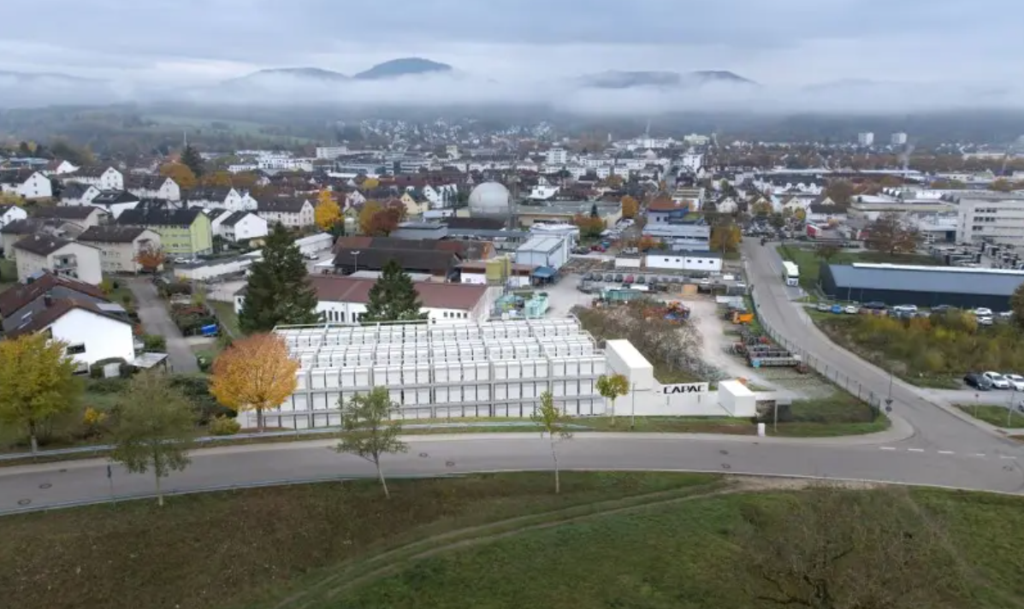
Stadtwerke Gaggenau, a municipal utility in Germany, has hired a general contractor to build a 4-hour BESS project using the zinc-bromide technology from US firm Eos Energy Enterprises.
Contractor Capac AG plans to start construction on the 7.5MW/30MWh battery energy storage system (BESS) project next year, for commissioning in 2028.
It will be built on the site of a former gas plant operated by Stadtwerke Gaggenau, a utility that provides power to customers in Gaggenau, Baden-Württemberg, southwestern Germany.
Stadtwerke Gaggenau and investor JP Holding are together investing €15.2 million (US$16.8 million) into the project.
Try Premium for just $1
- Full premium access for the first month at only $1
- Converts to an annual rate after 30 days unless cancelled
- Cancel anytime during the trial period
Premium Benefits
- Expert industry analysis and interviews
- Digital access to PV Tech Power journal
- Exclusive event discounts
Or get the full Premium subscription right away
Or continue reading this article for free
Capac AG will handle technical planning, procurement, system integration, and construction up to commissioning. It describes itself as an infrastructure company that develops, builds and operates zinc-based BESS as the exclusive partner of Eos Energy Enterprises (presumably in Germany or Europe).
Nasdaq-listed Eos offers a stackable, zinc-bromine battery energy storage system (BESS) solution designed for commercial, industrial, and utility-scale energy storage and applicable for long-duration energy storage (LDES) applications.
Benjamin Henecka, CEO of Capac AG, said the stackable design allows them to use the space particularly efficiently.
The units can be arranged side-by-side and stacked on top of each other within a steel support structure. Its non-flammable nature enables the units to be placed closer and vertically in a way that lithium-ion BESS units cannot.
Stadtwerke Gaggenau said the batteries function between -20 and +50°C without active cooling, reducing operating costs and technical complexity and will lose just 3.6% of their capacity over a 25-year lifespan. Lithium-ion BESS comparatively would lose 1-3% of their capacity every year.
The news comes just as a solar-plus-storage project using 10MW/100MWh of Eos’ tech plus lithium-ion batteries progressed in West Virginia, US, with system integrator FlexGen chosen to put the project together. It will provide power to Google.
The Gaggenau project may be Eos’ first firm project in Europe which is to enter construction but it is also making moves into the UK in partnership with Frontier Power, a purpose-built company tasked with developing and operating a portfolio using its technology.
Frontier has developed a portfolio of UK projects, one of which (Frontier Legacy) looks set to receive cap-and-floor support from the government’s LDES financial support scheme.
Eos was one of four SPAC-listed energy storage technology firms we wrote about in late 2023 whose share prices had plummeted since going public. It reached the point where Eos’ listed status was in jeopardy a year later. However, since then its various projects in the US and Europe have helped it recover, and financial results have started to improve.