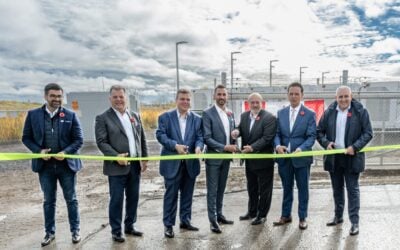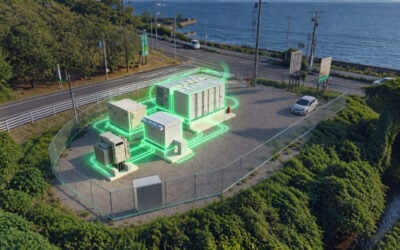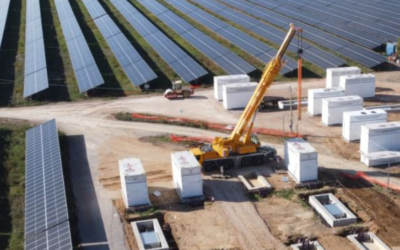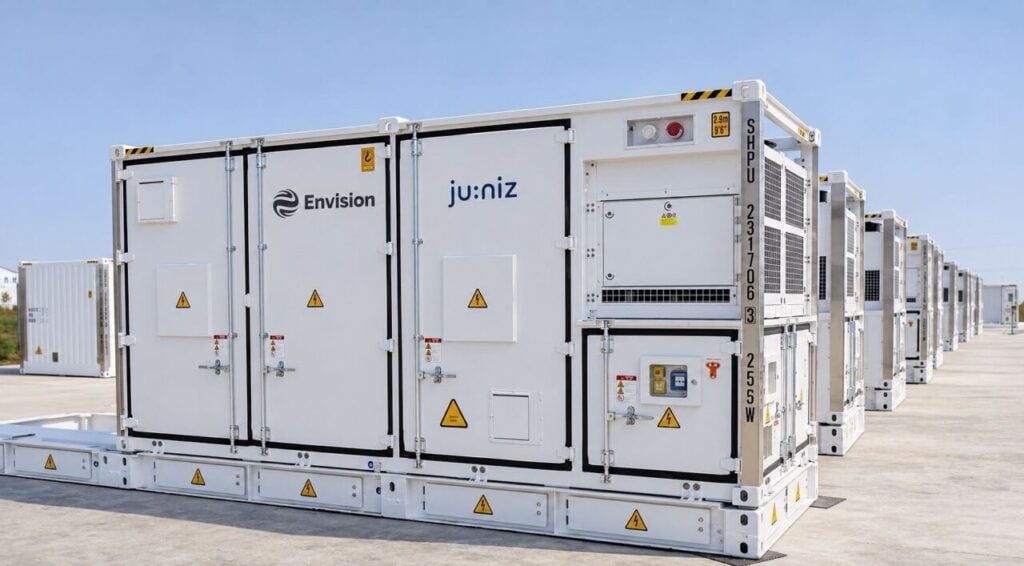
Envision Energy will supply its Gen 8 BESS platform for ju:niz Energy’s 442MWh Smareg 13 project in Bavaria, Germany.
The project, also known as Vöhringen II, will be built next to ju:niz’s operational Smareg 12 battery energy storage system (BESS) in Vöhringen. It will have a 4-hour duration and grid-forming (GFM) capability.
ju:niz, a German developer and operator of large-scale BESS owned by private equity firm EQT, is responsible for development, financing and construction, and will operate the system over the long term. Envision is supplying the technology and handling project delivery.
The companies did not disclose the project’s MW output, cost, financing or expected commissioning date.
Try Premium for just $1
- Full premium access for the first month at only $1
- Converts to an annual rate after 30 days unless cancelled
- Cancel anytime during the trial period
Premium Benefits
- Expert industry analysis and interviews
- Digital access to PV Tech Power journal
- Exclusive event discounts
Or get the full Premium subscription right away
Or continue reading this article for free
Smareg 13 is the third project the pair have worked on together, taking their combined volume to nearly 600MWh. The first two were announced at Intersolar Europe earlier this year: the 88.4MWh S10 project in Baindt, southern Germany, and the 52.2MWh S15 project in Schöningen, northern Germany, which were Envision’s first Gen 8 deployments in Germany.
Henry Peng, senior vice president at Envision Energy and president of its EU & LATAM regions, noted that the companies had agreed the latest project “before our first two projects have completed delivery”.
“With Smareg 13, we are bringing together our Gen 8 BESS technology and expanding local capabilities in Germany to help build the flexible, resilient energy infrastructure required for the country’s next phase of renewable energy growth,” Peng said.
Vural Oezcan, COO at ju:niz Energy, said the project “combines a very advanced development status” with 4-hour storage, adding: “Envision has proven to be a strong technology partner in our existing cooperation.”
The release said Gen 8’s low-noise design addressed “one of the key site challenges for Smareg 13,” enabling deployment in an acoustically sensitive location.
When Envision launched the modular Gen 8 platform in October 2025, it quoted noise levels of 55-58dB for its 10-foot DC blocks, which use 750Ah-plus lithium-ion cells and come in 6MWh to 12MWh-plus configurations.
The release did not say whether Envision is also supplying the power conversion system (PCS) equipment, the inverters on which a BESS’s grid-forming capability depends.
Envision has been pushing to supply more of the system itself: Michael Koller, its solutions director for Europe and the UK, said in a video interview on integrating solar, storage, grid-forming and AI recorded at Smarter E Europe that this was the reason for its recent launch of its own solar inverter.
Kevin Huang, senior vice president and president of Envision’s energy storage product line, said in a separate video interview at Smarter E that storage competition would no longer be won on “cost or container size alone”, as the company positions itself as a system-level energy infrastructure provider.
The deal comes days after Envision agreed to supply Kallista Energy’s 193MW/386MWh Neuilly-en-Thelle BESS in France, which it said would be backed by its 10GWh gigafactory in Douai. In Germany, Envision is also supplying Gen 8 for developer Elements Green’s 400MW/1,600MWh Stadorf BESS.
ju:niz has been building out its German portfolio with debt finance, securing funding from Hamburg Commercial Bank for three BESS totalling around 100MWh in late 2025.
Grid-forming revenue and a capacity market won by gas
Germany has around 24GWh of energy storage connected, but large-scale systems above 1MWh account for only around 3.5GWh, according to Frederik König, managing director of Berlin public affairs consultancy CC: Collective, in an opinion piece on the 2026 regulatory agenda for large battery storage in Germany.
The country’s four transmission system operators (TSOs) have received nearly 700 grid connection requests totalling 250GW.
Grid-forming BESS such as Smareg 13 can earn revenue from a market for inertia, known as Momentanreserve, which the TSOs began procuring in January 2026 through long-term contracts. The contracts last 2-10 years and pay a fixed price per unit of registered capacity.
Germany’s new capacity market has been less favourable to battery storage so far. The Federal Network Agency (BNetzA) set an 8 September deadline for the first capacity market auction, offering 15-year contracts for 4.5GW of de-rated capacity, with no technology specified.
All of the capacity in that first auction went to gas, at prices nearly eight times higher than in Belgium’s latest auction, where BESS won nearly 40% of capacity, Energy-Storage.news reported last week on the vastly different fortunes for BESS in Belgium’s and Germany’s capacity market auctions.