Samsung SDI to start US BESS manufacturing from 2026

LinkedIn
Twitter
Reddit
Facebook
Email

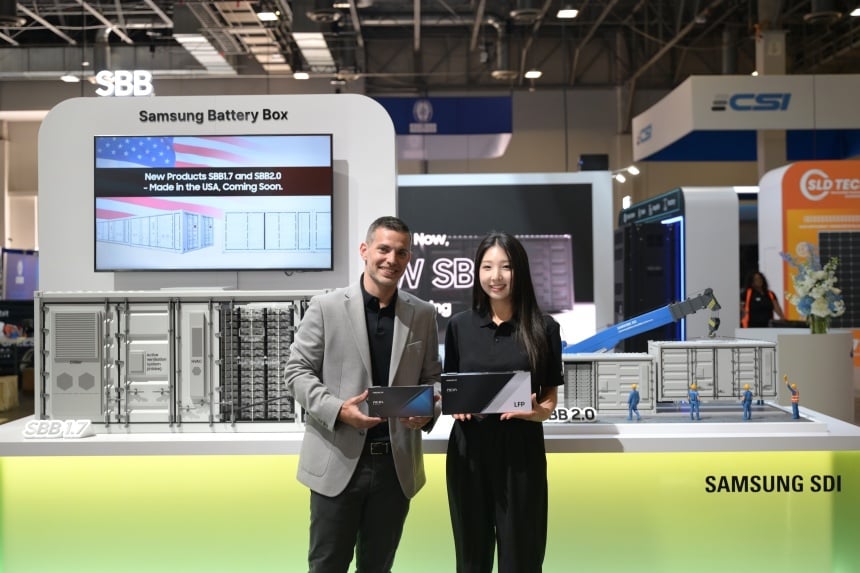
South Korean battery and electronics materials manufacturer Samsung SDI debuted its new battery energy storage system (BESS) products at the RE+ trade show in Las Vegas, US.

Samsung’s Battery Box (SBB) 1.7 and SBB 2.0 are scheduled to begin US-based production next year.

The 6.14MWh SBB 1.7 uses high-nickel nickel cobalt aluminium oxide (NCA) cells, delivering approximately 17% higher energy density than the SBB 1.5.

The SBB 2.0, meanwhile, uses lithium iron phosphate (LFP) cells. Samsung says that for the first time, SBB 2.0 features the company’s “proprietary prismatic form factor and differentiated material, electrode technologies, which help overcome low energy density of LFP cells and maximise advantages such as safety and low price.”

This article requires Premium SubscriptionBasic (FREE) Subscription

Try Premium for just $1

  • Full premium access for the first month at only $1
  • Converts to an annual rate after 30 days unless cancelled
  • Cancel anytime during the trial period

Premium Benefits

  • Expert industry analysis and interviews
  • Digital access to PV Tech Power journal
  • Exclusive event discounts

Or get the full Premium subscription right away

Or continue reading this article for free

Both models incorporate Enhanced Direct Injection (EDI) technology, providing improved safety and reliability. They are also built with the company’s AI-based predictive maintenance and durability prediction algorithms.

SBB houses battery cells, modules and racks in a 20-foot container, and was awarded a CES Innovation Award earlier this year.

Samsung SDI intends to launch the new SBB products through local production in response to increasing US demand, despite the challenges of local production and growing supply chain risks resulting from US tariff policies.

The company also unveiled its new uniterruptible power supply (UPS) solution U8A1.

According to Samsung, U8A1 boasts a 33% improvement in space efficiency compared to previous models, thanks to its high-power, high-energy density cells. This enables data centre customers to react more quickly to power outages, using fewer cells.

The UPS cells utilise lithium manganese oxide chemistry and have passed the UL9540A US fire safety standard zone.

These batteries feature Samsung’s proprietary “No TP (No Thermal Propagation)” technology, which stops heat from spreading to nearby cells in case of a fire.

In March, Samsung SDI confirmed it had made a deal to supply ESS to US energy holding company and project developer-owner NextEra.

That deal, worth KR437 billion (US$301 million), is for supplying ESS equipment to a NextEra Energy BESS project in the US and retrospectively covers 15 April 2024 to 20 November 2025.

Samsung SDI was one of several South Korean companies announcing US domestic BESS at RE+, following the likes of LG Energy Solution and SK On.

Although more affecting Chinese companies, the US’ domestic battery and BESS manufacturing sector looks set to benefit from Foreign Entity Of Concern (FEOC) restrictions on procured technology imposed by the Republicans when seeking clean energy tax credits.

8 September 2026
Barcelona, Spain
Battery & Energy Storage Tech Europe (BESTE) is Europe’s industrial scaling platform for stationary and industrial battery applications — not EVs. Taking place 8–9 September 2026 at Fira de Barcelona, BESTE brings together utilities, IPPs, energy-intensive industries, data centres, ports, rail, maritime, defence and aerospace OEMs — all deploying or integrating battery storage at scale. Over 100 companies already confirmed — including EDP Renewables, Acciona, Endesa, Naturgy, Neoen, Galp, Basquevolt and Veolia — alongside 40+ expert speakers and international institutional support from BEPA, BVES, LDES and Volta Foundation. Where Europe’s battery & ES ecosystem turns projects into reality.
15 September 2026
San Diego, USA
You can expect to meet and network with all the key industry players again in 2025 from major US asset owners, operators, RTOs and ISOs, optimizers, software and analytics providers, technical consultancies, O&M technology providers and more.
15 September 2026
Berlin, Germany
Launching September 2026 in Berlin, Energy Storage Summit Germany is a new standalone event dedicated to Germany’s energy storage market. Bringing together investors, developers, policymakers, TSOs, manufacturers and optimisation specialists, the Summit explores the regulatory shifts, revenue models, financing strategies and technology innovations shaping large-scale deployment. With Germany targeting 80% renewables by 2030, it offers a focused platform to connect with the decision-makers driving the Energiewende and the future of utility-scale storage.
6 October 2026
Warsaw, Poland
The Energy Storage Summit Central Eastern Europe is set to return in September 2025 for its third edition, focusing on regional markets and the unique opportunities they present. This event will bring together key stakeholders from across the region to explore the latest trends in energy storage, with a focus on the increasing integration of energy storage into regional grids, evolving government policies, and the growing need for energy security.

Read Next

Premium
July 3, 2026
Energy-Storage.news Premium speaks with energy storage market experts Raafe Khan of Camelot Energy Group and Oliver Kerr of Aurora Energy Research on FERC’s recently issued show cause orders.
Sponsored
July 3, 2026
As hardware margins compress and consolidation accelerates, smart appliance brand’s energy division argues that intelligent software—not just batteries—will determine who survives
July 3, 2026
Australia’s 55 grid-scale BESS generated a combined AU$17.98 million in estimated gross energy and FCAS market revenue during June 2026.
July 3, 2026
AGL has delivered a solar and battery microgrid described as “one of the largest privately owned non-mining microgrids in Australia”.
July 2, 2026
US sodium-ion (Na-ion) battery startup Alsym Energy and consulting organisation for the mining and energy sectors, Erity, have signed a 9GWh strategic relationship agreement (SRA) for global mining use-cases.