South Korean battery manufacturer Samsung SDI has released its Q3 2026 financial results, highlighting a 52.6% year-over-year rise in revenue and a return to profitability.
The company said in its announcement yesterday that it had seen revenues “surge” 52.6% year-over-year to KRW4.69 trillion (US$3.5 billion), from KRW3.05 trillion in the same quarter of 2025. It also represented a 20.9% quarter-on-quarter increase in revenue, up from KRW3.77 trillion in Q2 2026.
Operating profit for the three-month period was KRW407.8 billion. This marked its continued return to profitability, which Samsung SDI achieved in the previous quarter when it reported KRW203.8 trillion in operating profit.
Prior to that, the company had last been profitable in Q3 2024, before implementing a turnaround strategy in Q3 2025 that included increased focus on its energy storage system (ESS) business, particularly in the US.
Try Premium for just $1
- Full premium access for the first month at only $1
- Converts to an annual rate after 30 days unless cancelled
- Cancel anytime during the trial period
Premium Benefits
- Expert industry analysis and interviews
- Digital access to PV Tech Power journal
- Exclusive event discounts
Or get the full Premium subscription right away
Or continue reading this article for free
At that time, the company also said it would aim to capitalise on continued electric vehicle (EV) uptake in Europe, while EV sales in the US declined off the back of the end of federal subsidies and other changes in the federal policy landscape.
Indeed, in Q3 2026, Samsung SDI’s main business segment, its ‘Battery Business’ saw a 55.3% revenue increase year-over-year to KRW 4.41 trillion and hit KRW361.9 billion in operating profit. This, the company said, was driven by growth in ESS and battery backup unit (BBU) sales, tied in part to the AI data centre (AIDC) boom.
Continuing US ESS ramp-up, European EV demand continues growth
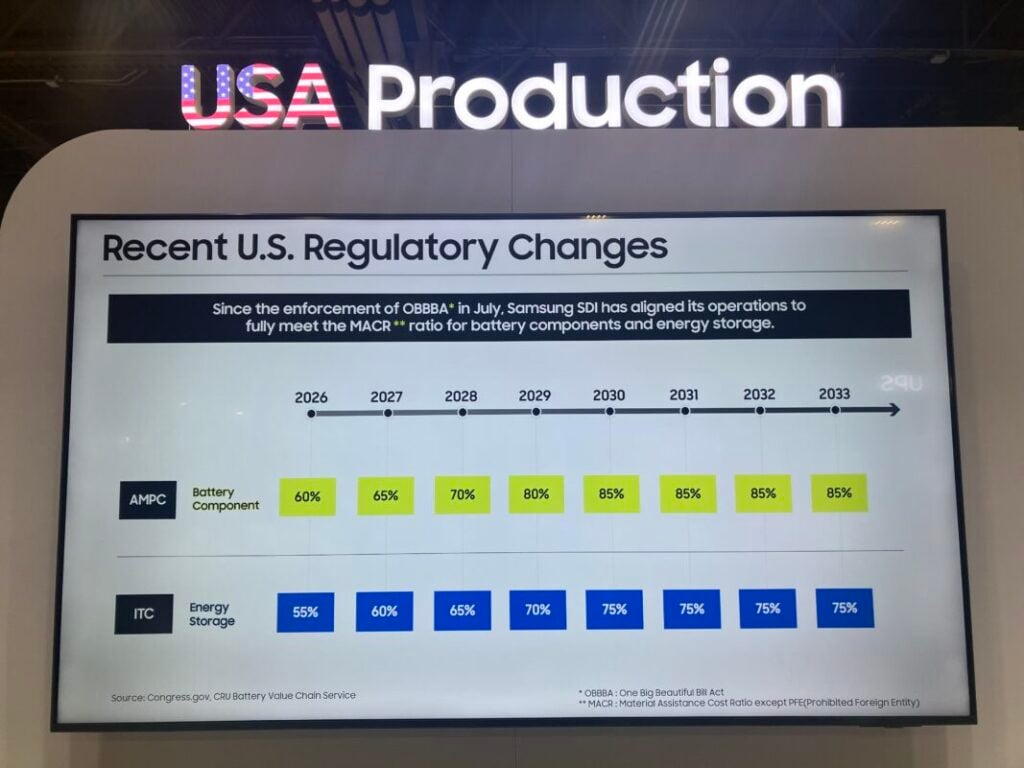
The company said it has received 60GWh in ESS battery orders in the first nine months of this year. Its ramp-up of US-based lithium iron phosphate (LFP) cell manufacturing, again driven by changes in the country’s federal policy landscape continues.
Much like fellow South Korean battery manufacturers LG Energy Solution (LG ES) and SK On, Samsung SDI has adapted production for EV cells, including nickel manganese cobalt (NMC) cell production lines, to produce LFP, which is now used in the majority of grid-scale battery energy storage system (BESS) applications globally.
In its Q2 results, Samsung SDI said US LFP production had reached 30GWh annual capacity. Yesterday, the manufacturer said it would be making LFP cells at its SynergyCells production plant in Indiana, US. The plant had originally been a joint venture (JV) with US carmaker General Motors (which has since established its own ESS business), but Samsung SDI became the Indiana factory’s 100% owner in August.
Mass production of high-capacity prismatic LFP cells recently began at Samsung SDI’s StarPlus Energy (SPE) factory. The SPE plant is a JV facility with auto OEM Stellantis and is also in Indiana.
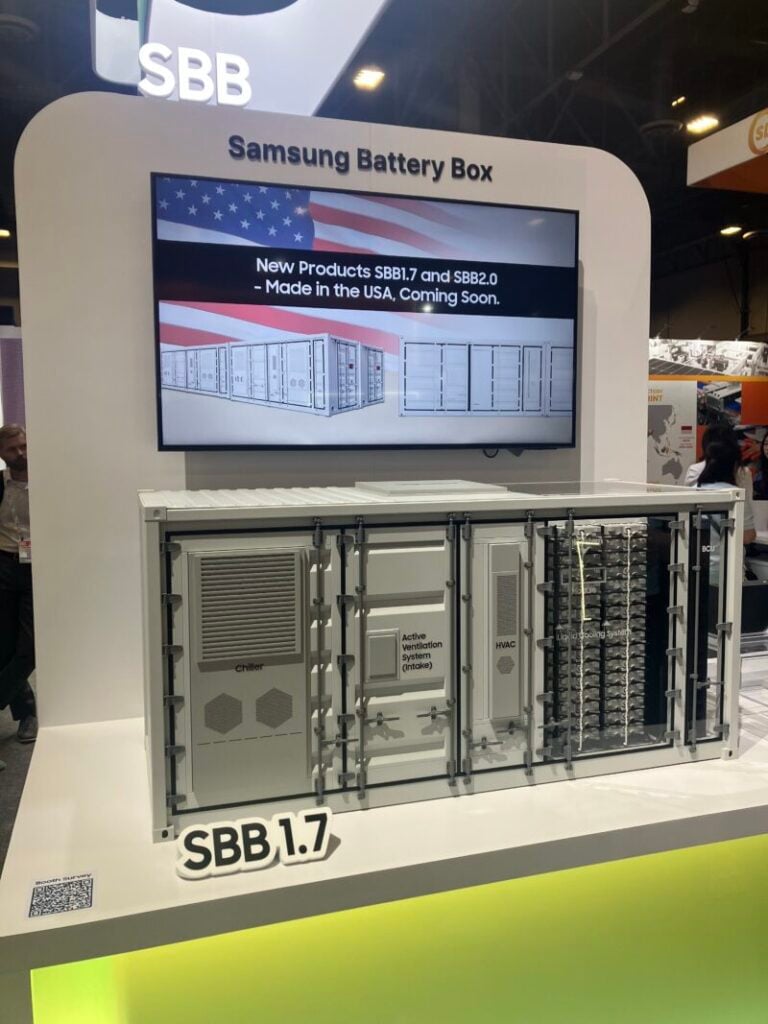
A few days ago, Samsung SDI announced a 1GWh supply agreement with US independent power producer (IPP) Alpha Omega Power for the Samsung SDI US-made Samsung Battery Box (SBB) 1.7 BESS solution.
All cells and modules covered by that deal will be manufactured at the SPE factory. SBB 1.7 is one of two US domestic content BESS solutions the company launched in September 2025 at the RE+ US trade show. While SBB 1.7 is based on nickel cobalt oxide (NCO) cells, its sister product, SBB 2.0, utilises LFP.
LFP also continues to be adopted for some EV applications. Samsung SDI alluded to an LFP battery secured with a European car industry player in Q3 and said it will continue to pursue additional orders on the continent, where it anticipates continued demand growth even as US EV demand remains sluggish.
The ESS market will “maintain momentum” in Q4 2026, Samsung SDI believes, and additional EV-to-ESS cell conversions of LFP lines will continue in the US. In its home country, Samsung SDI will continue participating in central tenders for ESS capacity. South Korea’s government recently unveiled a KRW1,000 trillion (that’s 15 zeroes – Editor) Korean Green Transformation (K-GX) industrial strategy.
The company is also progressing technology innovation, including solid-state battery R&D tied to humanoid robots. Other updates yesterday included expanded production and sales efforts in the Small Battery and Electronic Materials business segments, while in EV, Samsung SDI will expand prismatic battery mass-production lines and supply chain procurement for its European base in Hungary. The company will also leverage a “diversified product portfolio” of high-nickel, LFP and mid-nickel batteries.