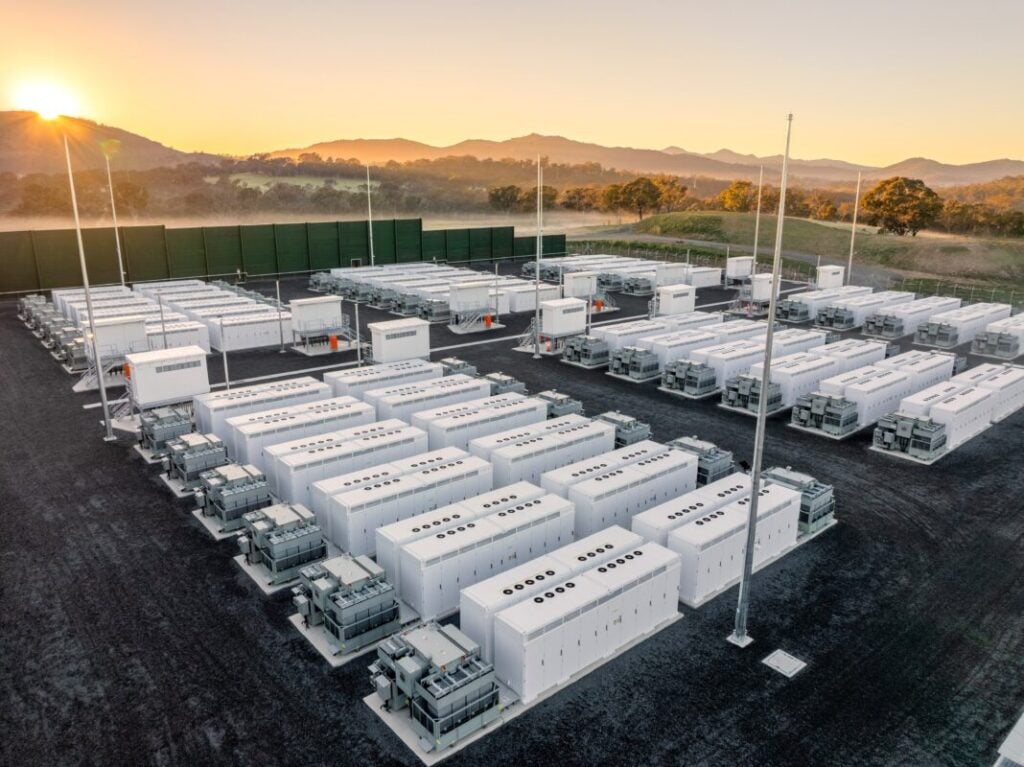
Energy held in battery energy storage systems (BESS) across Australia’s National Electricity Market (NEM) reached a record 20.17GWh on 6 November.
The figure is an instantaneous record of the highest amount of energy stored across the NEM’s BESS at a single point in time, according to analysis by energy transition adviser Geoff Eldridge, published via GPE NEMLog, a NEM data platform run by Global Power Energy, on LinkedIn.
Compared with the previous year’s record of 6.66GWh, set on 5 November 2025, it represents an increase of 203%. New South Wales (NSW) also set a state record of 8.36GWh, up 188% on the 2.90GWh recorded on 8 October 2025.
The pace of growth is visible in Eldridge’s earlier data. In September 2025, NEM-wide stored energy passed 6.5GWh for the first time, reaching 6,591.5MWh on 27 September, up 11.7% on a record set 10 days earlier.
Try Premium for just $1
- Full premium access for the first month at only $1
- Converts to an annual rate after 30 days unless cancelled
- Cancel anytime during the trial period
Premium Benefits
- Expert industry analysis and interviews
- Digital access to PV Tech Power journal
- Exclusive event discounts
Or get the full Premium subscription right away
Or continue reading this article for free
Discharge records have followed a similar path. On 11 August 2026, NEM BESS discharge peaked at 4,325MW, supplying 14.42% of NEM consumption in that interval, Eldridge’s figures showed at the time.
The same day as the stored energy record, utility-scale solar PV output in Victoria reached a record 1,588MW, up 35% year-on-year. NEM-wide solar PV availability peaked at 10,561MW, up 12% on the 9,410MW record set on 17 October 2025.
Curtailment rises alongside storage
Eldridge’s analysis also estimated that 41.36GWh of renewable energy was curtailed across the NEM on 6 November, made up of 26.67GWh of solar PV and 14.69GWh of wind. In NSW, curtailment totalled 15.68GWh, almost entirely from solar PV.
NSW set a new daily mean record for curtailment during positive-price intervals of 646.82MW, equivalent to 15.52GWh over the day. That exceeded the previous 635.47MW (15.25GWh) record from 10 January 2026.
Across the NEM, the 365-day rolling mean of positive-price curtailment reached a record 246.76MW, equivalent to 2.16TWh. Eldridge said transmission constraints, local dispatch conditions and the location of storage all affect how much generation can be absorbed.
“The question is increasingly not just how much generation and storage capability we have, but how effectively the NEM can utilise it,” he wrote on LinkedIn.
Revenue for the fleet also remains uneven. In the third quarter of 2026, 59 grid-scale BESS earned a combined AU$88.91 million (US$61.35 million), with five days delivering 15% of the quarter’s total revenue, according to analytics platform NEMPulse.
The Australian Energy Regulator (AER) has reported that installed BESS output in the NEM rose from 261MW at the start of 2021 to 6.1GW by the end of 2025, with BESS setting the wholesale price 16.3% of the time in 2025.
Industry body the Clean Energy Council (CEC) has said that Australia became the world’s third-largest utility-scale battery storage market, behind the US and China, with 4.3GW reaching financial close in 2025. A further 2GW/5.1GWh of BESS was commissioned that year, up 233% year-on-year.
More capacity is on the way. The Australian Energy Market Operator (AEMO) connected a record 9.1GW of renewables and storage to the NEM in FY26, with its connections pipeline growing to 75.4GW. AEMO said battery storage made up 52% of pipeline capacity, and AEMO CEO Daniel Westerman has said that “beyond 2030, the next wave of investment will be critical to maintaining reliability.”
Investor appetite for revenue exposed to wholesale prices remains comparatively strong in Australia. A DLA Piper survey found that 53% of Australian respondents viewed standalone merchant BESS as attractive, compared with 22% in Japan, while 79% targeted an equity return of 11% to 12%.
Never miss an Australian energy storage story. Sign up for our Australia newsletter and get the latest project announcements, policy updates and market analysis delivered directly to you.