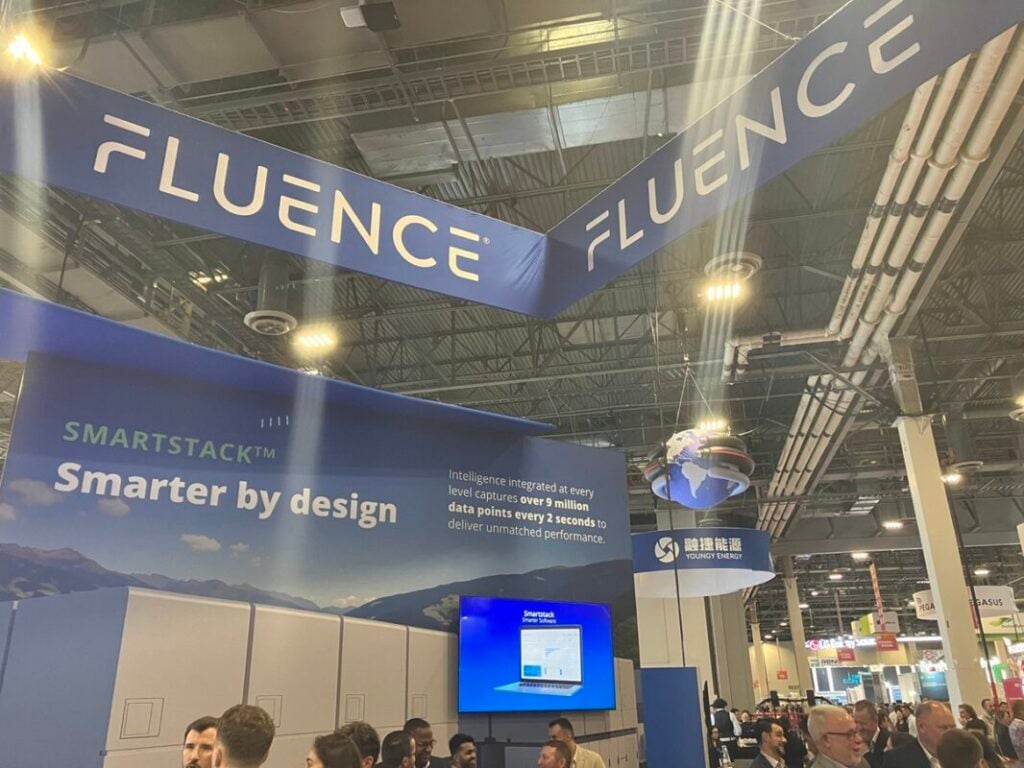
Fluence’s interim management team has provided details of the battery storage integrator’s transformation plan, following recent challenges and setbacks.
The NASDAQ-listed company reported its fourth quarter (Q4) and full-year financial results on 23 November and held an earnings call with analysts the following day. Fluence’s financial year ends 30 September.
While reporting significant increases in order intake on both a quarter-on-quarter and year-on-year basis and a commensurate growth in backlog, full-year revenue growth was flat and quarterly revenues were down year-on-year. Similarly, GAAP-adjusted gross profit margins were considerably lower in both instances, while net loss and EBITDA performance were also poorer by some distance.
None of that will likely be a surprise to regular readers of Energy-Storage.news. Fluence’s performance this year has been impacted by delays in ramping up production at a US battery energy storage system (BESS) assembly facility and the knock-on effects that have resulted.
Try Premium for just $1
- Full premium access for the first month at only $1
- Converts to an annual rate after 30 days unless cancelled
- Cancel anytime during the trial period
Premium Benefits
- Expert industry analysis and interviews
- Digital access to PV Tech Power journal
- Exclusive event discounts
Or get the full Premium subscription right away
Or continue reading this article for free
In September, the company cut 2026 revenue guidance by US$600 million, with its new contract manufacturing facility in Houston, Texas, falling behind the targeted levels of production due to issues with a “customised automated welding process,” then-CEO Julian Nebreda said.
What may be of more immediate interest are the explanations and discussion by the company’s recently appointed interim management team of the situation and the transformation plan it is putting in place. A summary of these follows the tables below:
Results at-a-glance
| Metric | Q4 (US$) | FY2026 (US$) |
| Order intake | 3.5 billion | 6.2 billion |
| Revenue | 744 million | 2.3 billion |
| Adjusted EBITDA | -112 million | -203 million |
Backlog and other figures
| Item | Value (US$) |
| Backlog | 8.9 billion (up 68% YoY) |
| Backlog conversion | ~1/3 each in FY2027, FY2028, FY2029 |
| Delayed delivery penalties | ~90 million |
| New-product/manufacturing cost overruns | ~85 million |
| Year-end liquidity | 855 million |
| — of which cash | 379 million |
| Inventory | 970 million (mostly equipment/materials awaiting assembly) |
New management from Siemens and AES
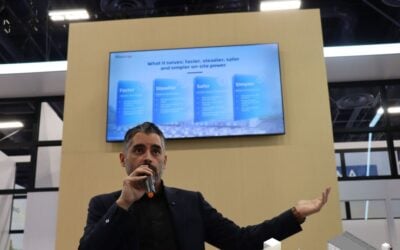
Fluence interim CEO Axel Meier, interim CFO Ricardo Roizen and EVP & COO Bernerd Da Santos all appeared on the earnings call, which took place at 8:30am EST yesterday (24 November).
Meier comes from a previous role with Siemens, while Roizen and Da Santos were appointed from AES Corporation, the two companies being the founders and shared majority owners of Fluence, which they launched in 2018 before going public in October 2021.
Meier said this background reflected “strong support from our controlling shareholders, Siemens and AES, and their confidence in Fluence’s potential and significant market opportunities.”
The new management’s role is to “strengthen production systems and processes, improve execution, and reinforce financial discipline,” Meier said.
Fluence declined to offer fresh guidance on the call but the interim CEO said the company expected to provide 2027 financial guidance in its Q1 2027 call, in February of next year.
Meanwhile, this year’s performance did not create profitability for shareholders and did not deliver on commitments made to customers and suppliers, he said, with the new management team “committed to the transformation of our business,” and to converting the record US$9 billion backlog into profitable EBITDA-measured growth.
Meier highlighted growth in demand for energy storage generally and good market reception for its Smartstack BESS platform, and pointed out that its Q4 2026 orders included a US$586 million deal with a data centre hyperscaler.
“We do have a healthy mix of both new and repeat customers, and orders continue to be concentrated in our core markets: the US, Europe, and Australia,” Axel Meier said.
Houston facility’s output is now ‘sufficient to satisfy 2027 orders’
Fluence interim CEO Ricardo Roizen admitted that the performance was “disappointing” but emphasised that “the transformation strategy is structured to address its impact.”
Inventory, at US$970 million, is more than double a year ago and ~75% of that is equipment and materials waiting to go into finished product, while remaining inventory is finished products as of the end of Q4.
“These materials are expected to fulfil customer delivery commitments that would then convert to revenue and cash in fiscal year 2027,” Roizen said.
“Our intent is to recycle this working capital into new projects in our budget, supporting our expectation for no external capital needs during fiscal year 2027.”
Arguably the most important of the three new appointments was chief operating officer Bernerd Da Santos, who was appointed a little earlier than the other two, in mid-September.
Having previously led an operations transformation at AES, Da Santos now has a similar remit at the energy storage company.
The COO said that falling equipment prices and increasing applications have created a “one in a generation opportunity” for battery storage and its accelerated growth. While Fluence is a “leading participant” and well-positioned in the industry, the challenge now is to deliver execution that drives profitability, Da Santos said on the earnings call.
To deliver projects on time and on budget, Fluence has been expanding manufacturing capacity in both the US—where it is headquartered—and overseas. Production at the Houston facility has been running at 10 units per day “over the past few weeks,” up from three per day in September.
In response to a later question from an analyst following the executives’ prepared remarks, Da Santos said this output is sufficient to satisfy customer orders booked for 2027. While the next step is to increase that output, any improvement made will be “steady and progressive” to maintain execution discipline, he said.
‘Four pillars’ of transformation strategy
COO Da Santos explained the transformation strategy and its ‘four pillars’:
- Delivering on commitment to customers
Fluence now has 25GWh of annual production capacity across its suppliers to serve customers globally, including a “wide range of domestic content configurations,” supporting its ability to deliver on 2027 and 2028 budgets.
Improvements in the Houston facility and elsewhere will enable it to grow backlog into 2028, Da Santos claimed, including in its digital services segment, which, according to PV Tech Research’s Battery StorageTech Bankability report, represents less than ~2% of annual revenues.
“As we carry projects from 2026 to 2027, we are looking at the timing of expected production against our delivery committee; in some cases, we will revisit timelines with customers who may have flexibility in order to mitigate potential failures,” Da Santos said, adding that in other cases, Fluence will discuss whether contract pricing reflects “the value of customisation adjustment requested by the board.”
- Improving financial and operational execution
“We are working on putting systems and processes in place to enhance commercial, operational, and financial discipline,” Da Santos said.
This includes implementing a “more robust pricing model with a strong internal control,” and strengthening of integrated planning processes across material, production and delivery. This would help mitigate the potential for cost overruns, he claimed.
- Prioritising profitable growth
“There are a few components: prioritising customers. segments and markets in order to most effectively allocate our resources, improving pricing decisions, particularly for customisation adjustments, strengthening project execution to achieve gross margins and profit targets on a project-by-project basis, and reviewing and right-sizing our cost structure,” Da Santos said, adding that given the size of Fluence’s backlog, it anticipates achieving economies of scale in costs of goods sold, “over time.”
- Strengthen cash generation and avoid accessing capital markets
Fluence will protect its liquidity by assessing cash commitments and expenditures, recycling existing working capital into new projects, and generating positive cash flow over the longer term by improving profitability, the COO said.
Complexity of doing business in US market
The company was given a BB rating in PV Tech Research’s most recent bankability pyramid, released in the market research group’s Q3 report in October, holding that position quarter-on-quarter.
At that time, the report’s authors highlighted Fluence’s cash flow position as ‘medium risk’ and debt as ‘low risk’. The report did also note, however, that the company has experienced net losses annually since its establishment, although fiscal 2024 saw significant improvement, including a profitable quarter. Had it not been for the ramp-up delays, this year was expected to see a “large increase in revenue” for the company.
The fact that the company has been driven to change revenue guidance or has missed it for the past three years is largely due to “how complex doing business in the US market is, especially when importing key materials,” according to PV Tech Research.