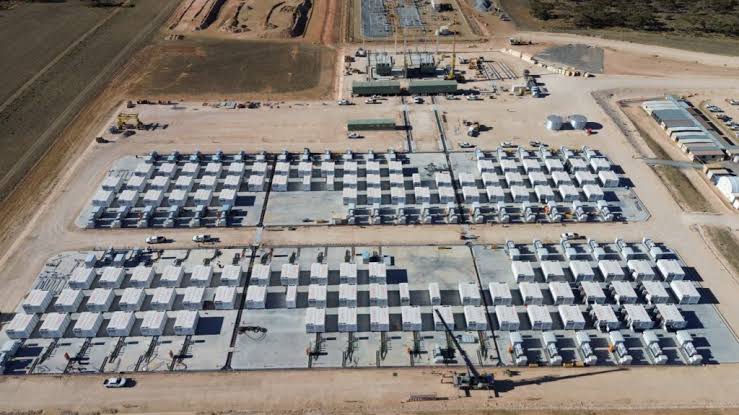
DLA Piper recently advised on Palisade Investment Partners’ acquisition of the 240MW/960MWh Summerfield BESS in South Australia (pictured). Image: Palisade Investment Partners.
A new report released by DLA Piper has found that 63% of Singapore respondents and 53% of Australian respondents see standalone merchant battery energy storage systems (BESS) as attractive, compared with 22% in Japan.
The report, titled Energy Storage Investment Outlook: Japan, Singapore and Australia, was released by DLA Piper, a global law firm that advises developers, investors and lenders on energy storage projects, including Palisade Investment Partners’ acquisition of the 240MW/960MWh Summerfield BESS in South Australia in April.
Peter Armstrong, a partner at DLA Piper in Tokyo, said: “Our research shows that revenue certainty, bankability and market design are increasingly influencing investment decisions, particularly in Japan and Singapore.”
Predictable market rules were a key investment factor for 59% of respondents in Singapore and 44% in Japan, compared with a global average of 31% and only 18% in Australia.
Try Premium for just $1
- Full premium access for the first month at only $1
- Converts to an annual rate after 30 days unless cancelled
- Cancel anytime during the trial period
Premium Benefits
- Expert industry analysis and interviews
- Digital access to PV Tech Power journal
- Exclusive event discounts
Or get the full Premium subscription right away
Or continue reading this article for free
DLA Piper linked the Singapore result to a small, more centrally planned market in which storage earns value from ancillary services, grid support and participation rules, so investors place a premium on regulatory consistency, as Vincent Seah, DLA Piper’s country managing partner, explained.
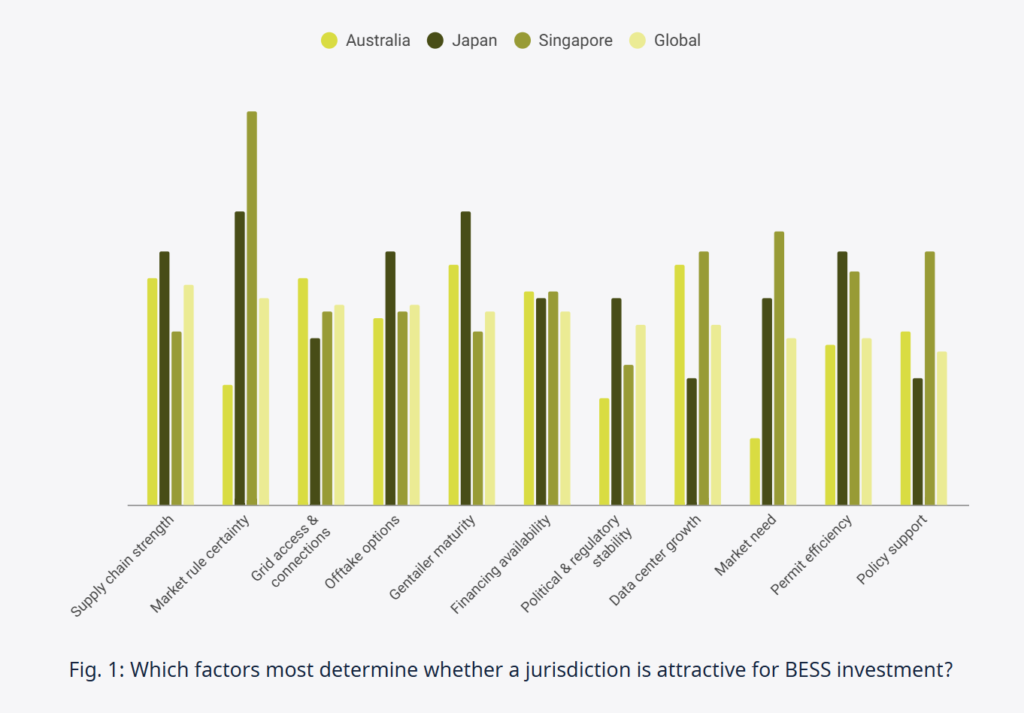
Singapore respondents also gave more weight than their peers to a clear use case for storage (41%, against 31% in Japan and 10% in Australia) and to targeted policy and revenue support (38%, against 26% in Australia and 19% in Japan).
In Japan, 44% pointed to the maturity of its gentailers, the utilities that both generate and retail power and can offer trading, balancing and offtake access, compared with 36% in Australia and 26% in Singapore.
Japan’s recent experience explains some of that caution, according to Jun Kasamatsu, head of Japan at advisory firm Green Giraffe Advisory, who is quoted in the report.
He said changes to price caps in Japan’s capacity market have reduced returns and made investors more careful, and that Japanese infrastructure investors will accept modest returns in exchange for revenue visibility and downside protection.
Return targets followed the same pattern. No Japanese respondent required an equity internal rate of return above 15%; half aimed for 11% to 12%, and a quarter accepted 8% to 10%. In Singapore, half targeted 8% to 10%, and a third demanded more than 15%.
Meanwhile, in Australia, 79% targeted 11% to 12%, compared with a global figure of 50%, which the report described as the strongest consensus among the three markets.
Kasamatsu said Japan’s lower return thresholds reflect a historically low domestic cost of capital, although sustained inflation is now pushing required returns up.
Merchant exposure and grid access split the markets
The widest gap was in merchant revenue, with 63% of respondents in Singapore and 53% in Australia rating standalone merchant BESS as attractive or highly attractive, compared with 22% in Japan and a global average of 68%.
Respondents in Japan preferred contracted revenue structures, co-located storage and hybrid platforms, which 44% rated as attractive.
Kasamatsu said Japan’s grid-scale BESS market is still young, so investors and lenders want a longer operating record, and that lenders are cautious on merchant revenue because forecasting power and ancillary service prices over 15 to 20 years is difficult.
That can lead to more conservative revenue assumptions, higher debt service coverage requirements and lower leverage, he said.
In Australia, 71% of respondents rated behind-the-meter storage serving data centres and commercial and industrial customers as attractive, and 68% rated contracted or regulated grid-connected storage the same.
Chris Mitchell, a partner at DLA Piper in Australia, said: “One of the most striking findings is the degree of divergence between these markets.”
Grid access also shaped financing, particularly in Japan, where 75% of respondents said congestion, connection terms or curtailment were a source of disagreement between sponsors and lenders, compared with 36% in Singapore, a global average of 29% and 13% in Australia.
The report attributed Japan’s result to its archipelago geography and regional grids, each run by one main provider, and said these constraints tend to be priced into negotiations early, so they rarely resurface at execution.
Singapore and Australia showed a different effect, with 50% of respondents in Singapore and 40% in Australia saying uncertainty over grid connection led to re-trading or extra conditions precedent, which are conditions that must be met before financing closes, against 17% globally.
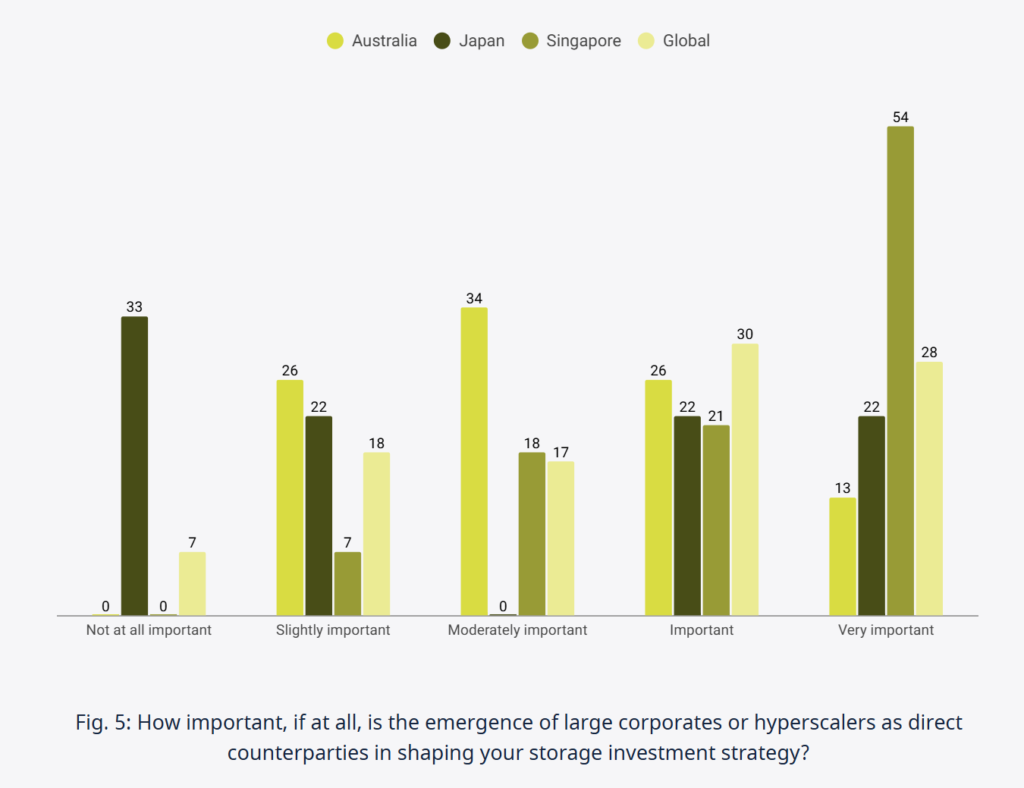
Data centres were most prominent in Singapore, where 54% of respondents rated hyperscalers, large data centre operators, and other large corporate users as very important counterparties, compared with 22% in Japan and 13% in Australia.
The report said Japan’s flat or falling power demand, driven by demographics, is reversing as AI, data centres and semiconductor manufacturing grow, while in Australia investors still treat utilities, retailers and wholesale markets as the main sources of storage revenue.
Australian respondents also pointed to data centre growth and gentailer maturity (each 36%), grid access and connection terms (34%) and the depth of the supply chain (34%) as important factors.
The report concluded that successful strategies depend less on technology selection than on how local market structures shape risk, returns and bankability.
The market backdrop differs in each country. Japan’s third long-term decarbonisation auction, run by the grid coordinator OCCTO, awarded 1.25GW of storage across 19 projects, after the rules excluded storage of less than 6-hours, and storage bids fell from nearly 7GW in the previous round to 2.73GW.
In Southeast Asia, a joint white paper from the ASEAN Centre for Energy, the Jakarta-based regional energy body, and the International Energy Agency said the main barriers to storage are policy and market rules, not technology.
It said liberalised markets in Singapore and the Philippines allow storage to earn from several revenue streams, while single-buyer models dominate most other ASEAN countries, and that Singapore reached its 200MW storage target for 2025 two years early.
Australia’s energy-only market, with five-minute settlement, has prices ranging from -AU$1,000/MWh (-US$716/MWh) to AU$20,300/MWh.
Kashish Shah, senior strategy lead at Finnish technology group Wärtsilä, told ESN Premium that the Australian market is well suited to storage because of that volatility, and that frequency control revenue has “completely collapsed”, leaving energy arbitrage as the main source of income.
He said most other Asia-Pacific markets are dominated by regulated, government-owned utilities with capped revenues, which limits the extent of volatility storage can capture.
Incidentally, Shah was speaking just a few weeks before the relaunch of Wärtsilä’s energy storage business under a new brand, ownership structure and financial reporting. The new entity, called Valo, launched under the new name on 1 October as a 50:50 joint venture with German solar PV manufacturer RCT Solutions.
The Clean Energy Council, the Australian industry body, ranked Australia as the third-largest utility-scale BESS market in the world in 2025, behind the US and China, with 4.3GW reaching financial close that year.
It counted AU$31.4 billion across 20.6GW invested in utility-scale storage between 2017 and December 2025.
Never miss an Australian energy storage story. Sign up for our Australia newsletter and get the latest project announcements, policy updates and market analysis delivered directly to you.