
BESS assets deployed for a long lifetime of service require careful strategic decisions to be made around augmentation from the beginning, writes Sergey Syrvachev, director of product engineering at BESS integrator HyperStrong and founder of BESS.courses.
Every lithium-ion battery energy storage system (BESS) loses usable energy over time. The commercial question that many BESS site operators ask is when to buy the capacity needed to compensate for it. A developer can install extra megawatt-hours at the beginning of the project, often called ‘overbuild’ or ‘oversizing,’ or add battery capacity later through planned augmentation.
Neither strategy is automatically cheaper. Overbuild pays today to reduce future risks and lock the technology. Augmentation accepts that risk in exchange for deferred capital, newer equipment and flexibility. The winner is the strategy with the lower risk-adjusted lifecycle cost based on specific site constraints of maintaining the required usable energy at the point of connection, not the lowest cell price.
Start with the performance obligation
‘Capacity’ must be defined before the two strategies can be compared. A 100MW/400MWh nameplate BESS does not necessarily deliver 400MWh to the grid. Its usable AC energy depends on the permitted state-of-charge (SOC) window, state of health, auxiliary loads, availability, and all conversion losses up to the point of interconnection (POI). The governing obligation may also be four hours of time at full power, annual throughput, capacity accreditation or simply merchant revenue with no fixed energy floor.
Try Premium for just $1
- Full premium access for the first month at only $1
- Converts to an annual rate after 30 days unless cancelled
- Cancel anytime during the trial period
Premium Benefits
- Expert industry analysis and interviews
- Digital access to PV Tech Power journal
- Exclusive event discounts
Or get the full Premium subscription right away
Or continue reading this article for free
This distinction matters because degradation can create a revenue cliff. A small loss of usable energy may have limited value impact for a flexible merchant project, but it can trigger penalties or a lower capacity payment if the plant falls below a contracted duration. Augmentation may therefore be defensive, preserving a guarantee, or offensive, adding duration because market value has increased.
The design model should forecast usable energy under expected and downside operating cases. Procurement must begin before the lower-bound forecast crosses the required floor, allowing time for manufacturing, permitting, construction and commissioning.
Operating profile changes the answer
Lithium-ion batteries age in two overlapping ways. Calendar ageing occurs while the battery is present, even when it is barely used; cycling ageing results from charging and discharging. Temperature, average SOC, depth of discharge (DoD), C-rate, throughput and chemistry all affect the result.
High SOC and temperature can accelerate parasitic reactions, while deep cycling increases mechanical stress; the dominant mechanisms vary by chemistry and cell design. NREL’s battery-lifespan work therefore treats lifetime as a product of storage conditions and duty cycle, not a fixed annual fade percentage.
| Operating profile | Main degradation exposure | Strategic implication |
| Daily arbitrage or solar shifting | High throughput, relatively deep cycles and sustained thermal load | Extra initial energy can reduce DoD and C-rate per cell, but a long-life project may still need later capacity. A hybrid is often strongest. |
| Frequency regulation and ancillary services | Frequent shallow reversals, current pulses, heat and resistance growth | Very dependent on frequency of activations. Warranty should be planned based on Energy throughput rather than pure cycles. |
| Capacity, backup or resilience | Few cycles but long dwell periods, sometimes at high SOC; calendar aging can dominate | A large day-one reserve may age before it is needed. Limited initial margin plus deferred capacity is often more efficient, unless outages are unacceptable. |
| Merchant or stacked services | Future dispatch, throughput and revenue are uncertain | Augmentation has high option value: it can be advanced, resized, postponed or cancelled as the market develops. |
| Remote microgrid or access-constrained site | Mobilisation, outage and constructability risks may dominate electrochemistry | Overbuild becomes attractive when a later construction campaign would be costly or operationally impossible. |
What it means:
Depending on the operational scenario, batteries can degrade differently, and this should affect your augmentation strategy. Stepping from 1 cycle per day to 2 cycles greatly increases degradation and capacity loss because of many cycles, while keeping the system’s energy throughput at the same level. Stepping down from 1 cycle per day to 0.5 cycles per day doesn’t bring much benefit since calendar degradation starts to dominate, and overall capacity loss stays quite heavy, especially at high average SOC levels. At the same time energy throughput reduces 2 times.
Let’s see the graph below:
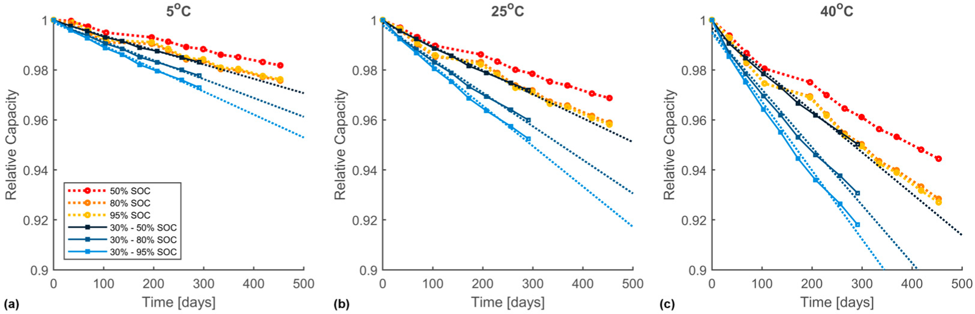
It compares:
- Standby/storage: held at 50%, 80%, or 95% SOC.
- Regular cycling: within 30–50%, 30–80%, or 30–95% SOC.
- Temperatures: 5°C, 25°C in the middle, and 40°C.
The vertical axis is remaining capacity; the horizontal axis is days. Shallow cycling between 30–50% produced similar degradation to sitting at 80–95% SOC in this study.
These results apply to the tested nickel manganese cobalt (NMC) cells.
(Source: Experimental Investigation of the Impact of V2G Cycling on the Lifetime of Lithium-Ion Cells Based on Real-World Usage Data by George Darikas *ORCID, Mehmet Cagin Kirca ORCID, Nessa Fereshteh Saniee ORCID, Muhammad Rashid, Ihsan Mert Muhaddisoglu ORCID, Truong Quang Dinh ORCID and Andrew McGordon ORCID Warwick Manufacturing Group (WMG), University of Warwick, Coventry CV4 7AL, UK)
The head-to-head trade-off
Overbuild increases Day One CapEx and financing because the owner buys capacity before it is strictly needed. It can nevertheless win when the extra capacity earns immediate revenue, qualifies for a secured construction-linked incentive, or avoids severe performance penalties.
In the United States, current federal incentives can materially change that comparison. For qualifying storage placed in service after 2024, Internal Revenue Code Section 48E provides up to 30% credit on qualified investment when prevailing-wage and apprenticeship requirements are met; domestic-content and energy-community bonuses can add up to 10 percentage points each. A larger day-one build can therefore receive more credit, but ‘30% of total engineering, procurement and construction (EPC) cost’ is not a safe assumption.
The credit is earned when qualifying property is placed in service, not as an equipment rebate; a taxable owner may transfer it for negotiated cash with partial loss. For storage beginning construction after 2025, current IRS instructions also apply prohibited foreign entity (PFE) and material assistance cost ratio (MACR) restrictions. A compliant supply chain may narrow vendor choice or increase price and lead time, so compare the credit’s present value with that premium and execution risk. Treat each later augmentation as a separate tax case under the law then in effect.
Augmentation at the other hand spreads expenditure over time and preserves cash. Later battery systems may also be cheaper, better or both. The 2025 NREL cost study projects further cost reductions but also shows a wide range of future outcomes. Future cell price is therefore not a bankable saving by itself. Tariffs, freight, labor, balance-of-system equipment and remobilization can offset hardware reductions.
Construction and operating continuity
Initial overbuild normally requires one engineering, installation and commissioning campaign. Later augmentation may require new foundations, containers, cables, switchgear, protection studies, controls integration, fire safety review, and recommissioning. Work can sometimes be staged by block, but partial or full outages may still be required. The EPRI Energy Storage Implementation Guide recommends planning major replacements and augmentation around service obligations and recommissioning the system afterwards.
Electrical and permitting impacts depend on topology. NERC’s BESS modelling guideline explains that an AC-coupled addition is modelled as a separate inverter-based resource, whereas a DC-coupled plant’s AC fault contribution is dictated by the common inverter.
Adding or replacing power conversion systems (PCS) can therefore increase short-circuit contribution even if the POI export limit is unchanged. That may require renewed short-circuit, breaker-duty and protection-coordination studies, including relay settings and arc-flash results. A DC-only addition behind the same current-limited PCS may leave POI fault contribution substantially unchanged, but its DC protection, equipment ratings, thermal limits and controls still require review.
Revised one-lines, inverter data, short-circuit and dynamic models, settings and study reports may need resubmission to the utility, ISO and authority having jurisdiction. CAISO’s generator-management procedures, for example, evaluate post-COD changes to MW output and electrical characteristics and can require a technical package and updated models. The actual material-modification threshold follows the applicable tariff and utility process. Codes and listings also evolve, so a retrofit may need renewed fire-safety approval.
Technology compatibility
The original battery model—or its original equipment manufacturer (OEM) support—may be unavailable when augmentation is due. Connecting new and aged strings directly to the same DC bus can constrain operation or create imbalance unless the architecture and controls were designed for mixed states of health via the DC/DC converters. DC Augmentation also restores energy headroom behind the power conversion system, and available discharge power might be limited by the PCS rather than augmented batteries and balance-of-plant equipment; see image below.
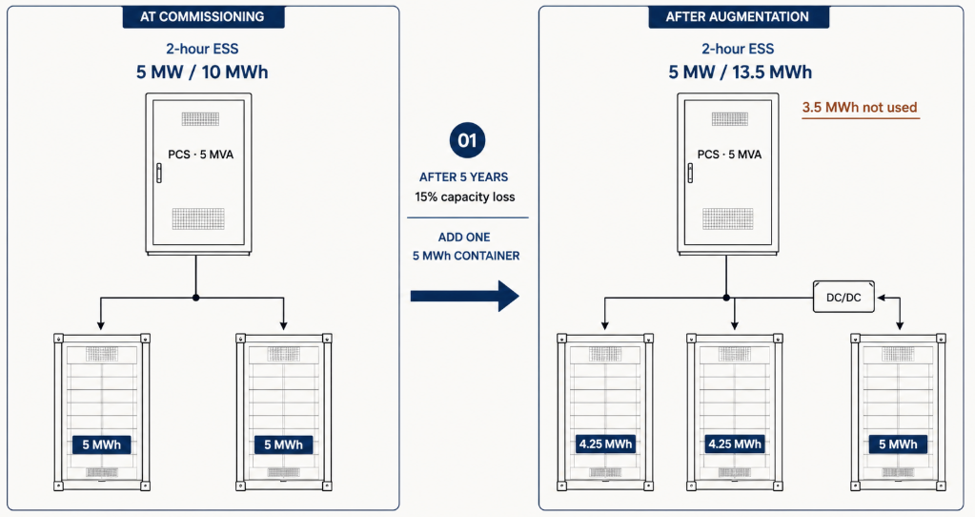
Three practical options are common:
- AC augmentation: add complete battery-and-PCS blocks at the AC bus. This provides the greatest independence but duplicates conversion and AC equipment.
- DC augmentation through DC/DC converters: can reuse existing PCS capacity while allowing different battery voltages or operating windows, provided PCS voltage/current limits, fault duty, protection coordination and thermal headroom permit it. The trade-offs are converter cost, losses, added control complexity and often impossible to extract capacity.
- Swap of battery modules: shuffling old DC containers to one PCS and installing new one to another. Complex procedure that must be planned in advance and can result in long outage of site.
Warranty and responsibility
Overbuild creates a more uniform equipment configuration, but all its cells have begun calendar ageing before commissioning; the warranty start date is contract-specific and may be tied to shipment, delivery, acceptance or commercial operation. Augmentation creates multiple warranty vintages and possibly multiple suppliers.
The owner should therefore secure, before financial close, the right to augment; approved interfaces or suppliers; capacity-test methods for mixed vintages; controls and data ownership; responsibility for plant-level performance; and rules for how new equipment affects the original warranty. A ‘capacity guarantee’ without a defined duty cycle and measurement boundary is not an augmentation plan.
Compare lifecycle value, not purchase price
A fair model compares the same required AC energy, availability and project life. For overbuild, include the extra initial net CapEx, financing, O&M, insurance, early calendar ageing and end-of-life cost, then credit additional revenue and avoided retrofit, outage and penalty costs.
For augmentation, calculate the present value of enabling works at the start plus future batteries, EPC, mobilisation, permitting, integration, commissioning, downtime and contingency. Add the expected cost of a delayed addition or performance shortfall. The DOE/PNNL storage cost assessment explicitly includes augmentation and replacement timing in lifecycle cost, because future expenditure, cycle life, calendar life and DoD interact.
At minimum, sensitivity cases should cover dispatch, degradation, installed battery cost, discount rate, incentive eligibility, lead time, outage value, contract penalties, project-life extension and residual value. A single ‘2% fade per year’ line is not adequate.
So, which strategy wins?
Overbuild is favoured when:
- firm MWh delivery or duration carries severe penalties or step-change revenue loss;
- future outages, land access, permitting or remobilisation are difficult;
- current incentives and supply terms are secured;
- the additional day-one capacity can reduce cell stress or earn revenue; and
- long-term technology compatibility is a greater risk than carrying extra capital.
Augmentation is favoured when:
- capital is expensive or constrained;
- dispatch and future duration value are uncertain;
- the site has reserved pads, electrical headroom and practical outage windows;
- the project is lightly cycled, so unused day-one capacity would mainly calendar-age; and
- the owner values access to later technology and can manage integration risk.
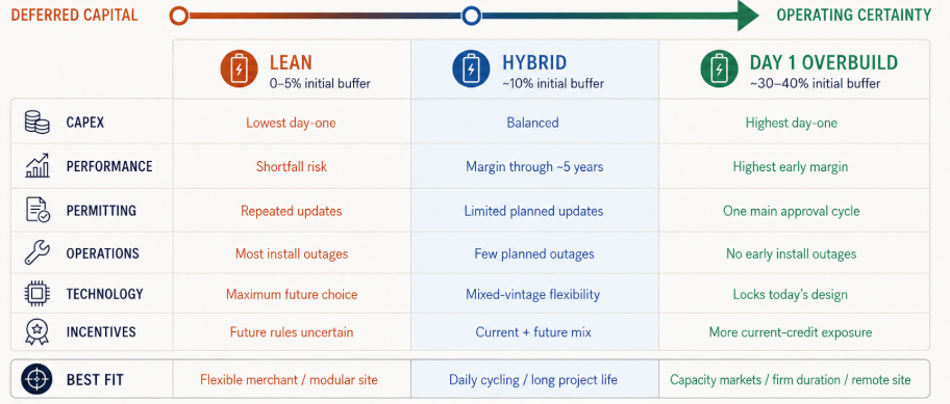
For many daily-cycling, long-life projects, the most resilient answer is a hybrid: install a project-specific initial energy margin but make the plant augmentation-ready. Reserve land, fire access, trenches, switchgear positions, transformer or AC-bus headroom, PCS inputs where appropriate, auxiliary and cooling capacity, communications capacity and energy management system (EMS) functionality. Pre-agree the warranty and certification path. Then trigger procurement from measured state of health and forecast time-to-breach, not from a generic anniversary.
The final rule is simple: overbuild wins when the expected cost of future shortfall and construction risk exceeds the value of deferring capital. Augmentation wins when financial flexibility and later technology outweigh outage and integration risk. When both pressures are material, a modest initial buffer plus engineered expansion capability usually delivers the best balance but its size and timing must come from the project’s actual duty cycle, contract and risk tolerance.
About the Author
Sergey Syrvachev is director of product engineering at BESS integrator HyperStrong and also the founder of BESS.courses. He has worked in battery storage since 2020, developing grid-scale battery systems, PCS products and overall eco system around. He also founded BESS.courses, where he teaches engineers practical skills required for BESS.
ESN Premium readers may enjoy our deep dive articles into augmentation topics: BESS augmentation: what owner-operators need to know from 20 October 2026 and AC and DC augmentation in BESS: the differences between the two approaches, from 19 May 2026.