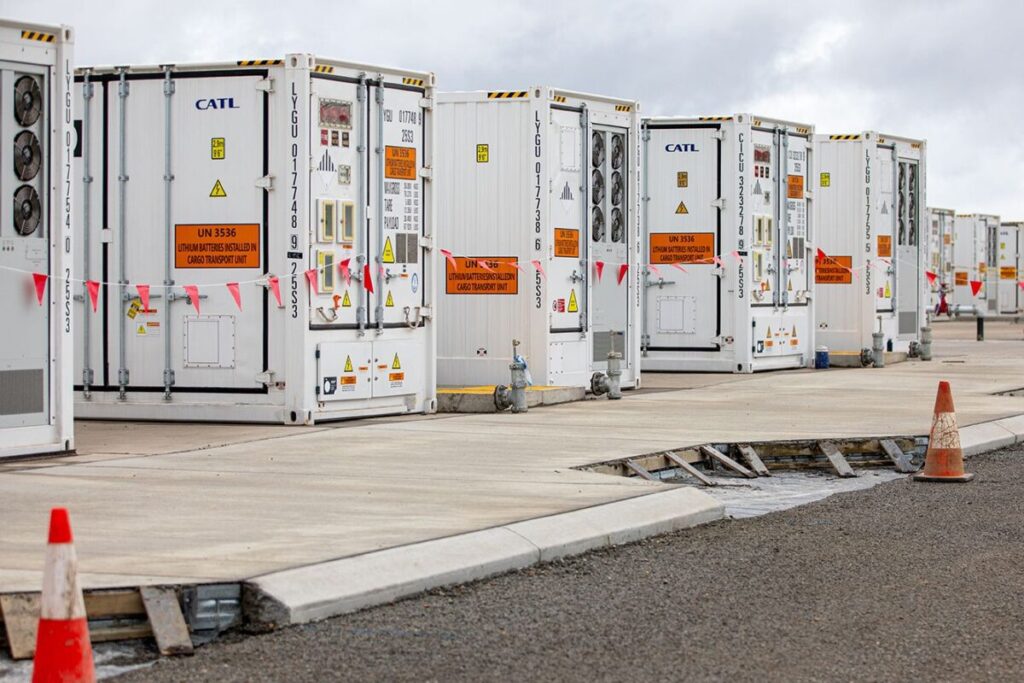
Australia has emerged as the world’s third-largest utility-scale battery energy storage market, with 4.3GW of large-scale battery storage systems reaching financial close in 2025.
This is according to the ‘Clean Energy Australia Report 2026’, published by the Clean Energy Council (CEC), a trade association.
The milestone positions Australia behind only the US and China in utility-scale battery storage deployment. Investment in storage remained robust throughout 2025 despite a broader slowdown in renewable energy generation commitments, with battery storage reaching financial close at a level comparable to the previous two years.
Indeed, in terms of battery storage, the CEC said that 2GW/5.1GWh of battery energy storage systems (BESS) were commissioned in 2025, representing a 233% year-on-year (YoY) increase.
Try Premium for just $1
- Full premium access for the first month at only $1
- Converts to an annual rate after 30 days unless cancelled
- Cancel anytime during the trial period
Premium Benefits
- Expert industry analysis and interviews
- Digital access to PV Tech Power journal
- Exclusive event discounts
Or get the full Premium subscription right away
Or continue reading this article for free

CEC added that renewables now comprise approximately 43% of Australia’s grid, creating an urgent need for technologies capable of managing system security in an increasingly asynchronous network.
A growing share of the battery storage pipeline now includes grid-forming capability, enabling battery storage systems to provide synthetic inertia and support system strength, capabilities previously supplied by synchronous coal and gas generators.
Unlike traditional grid-following inverters that require a stable voltage reference from synchronous generators, grid-forming systems can independently establish and maintain voltage and frequency, effectively acting as virtual synchronous machines.
This capability becomes increasingly valuable as coal-fired generation exits the system and the proportion of inverter-based resources grows.
As previously reported by Energy-Storage.news, roughly 74% of battery storage projects in Australia’s National Electricity Market (NEM) pipeline are confirmed to be equipped with grid-forming inverters.
Long-duration energy storage shifts solar into the evening peak
A key shift observed by the CEC in 2025 was the move toward longer-duration storage systems, allowing large volumes of solar energy to be shifted into the evening peak demand period.
The economics of longer-duration storage have improved as the price differential between daytime solar generation and evening peak demand has widened, creating stronger revenue opportunities for battery storage systems capable of multi-hour discharge.
However, this growth in long-duration energy storage capabilities has primarily been spearheaded by lithium-ion systems. In an interview with ESN Premium at the Energy Storage Summit Australia 2026 in March, Keith Lovegrove of ITP Thermal said that Australia’s energy storage sector risks over-reliance on lithium-ion batteries.
Instead, Lovegrove advocates diversifying into long-duration technologies such as solar thermal, pumped hydro, and hydrogen storage to ensure grid stability as coal plants retire.
“The developments are this enormous juggernaut of lithium-ion battery storage systems in the home, in the car and everywhere – it’s incredible, and it’s transformative,” Lovegrove said.
“But there is a risk with that, and that is that we miss some benefits of diversification.”
State-by-state investment of energy storage in Australia
The state-by-state investment breakdown reveals the geographic distribution of Australia’s energy storage buildout.
Between 2017 and December 2025, projects with financial commitments totalled AU$31.4 billion (US$22.53 billion) across 20.6GW of capacity.
Victoria led with AU$8.4 billion invested across 4,256MW, followed by New South Wales with AU$7.3 billion across 6,100MW, and Queensland with AU$7.1 billion across 4,910MW.
Western Australia committed AU$4.6 billion to 2,246MW, while South Australia invested AU$3.4 billion in 2,769MW of capacity.

Tasmania achieved a renewable energy penetration of 98.3%, up 3% YoY, demonstrating the potential for high renewable energy integration when supported by adequate storage and transmission infrastructure.
The state’s performance provides a template for other jurisdictions seeking to maximise renewable energy penetration while maintaining grid reliability.
It is also worth noting that several states in Australia have reached major milestones in scaling up their utility-scale energy storage systems.
For instance, in April 2026, Queensland became the first NEM state to discharge over 100GWh from battery storage in a single month.
According to Rystad Energy, NEM intraday spreads collapsed during the month as installed battery storage systems ramped up. The average 2-hour intraday spread was less than AU$110 per MWh across all states except South Australia, which recorded AU$154 per MWh.
Meanwhile, Queensland’s southerly neighbour, New South Wales, saw its battery storage systems capture 11.9% of state consumption and reach 1,240MW of charging power on 2 May.
According to energy market analyst Geoff Eldridge of consultancy Global Power Energy, the records marked a 72.5% YoY increase in charging capacity and a 68% rise in the charge share of consumption compared to the same period in 2025, when NSW batteries charged at 341MW and accounted for 3.8% of consumption.
On the other side of the country, in Western Australia, the state’s battery storage supplied a record 37.2% of peak demand on 9 May, marking one of the highest battery storage penetration levels recorded in an isolated grid globally.
Policy challenges threaten momentum
Despite the storage sector’s resilience, broader renewable energy investment declined sharply in 2025.
Total generation and storage capacity reaching financial close fell to 2.3GW, down from 4.4GW in 2024. Wind investment dropped 59% YoY to 900MW, while solar investment declined from 2GW to 1.4GW.
The CEC attributed the slowdown to challenges within the Capacity Investment Scheme, where too many contracted projects failed to reach financial close.
Assessment processes have not sufficiently screened for project deliverability, while inflationary costs and difficulties securing power purchase agreements to complement CIS support have stalled progress.
The result has been a large portion of apparently awarded capacity failing to proceed to financial close and construction, with wind projects particularly affected despite a substantial contracted pipeline.
Australia now has 64GW of generation and storage awaiting grid connection, yet the gap between pipeline and committed investment continues to widen.
Even when combined with rooftop solar growth, current investment levels fall well short of the pace needed to meet future energy demand and system requirements, the CEC claimed.
The disconnect between project announcements and financial commitments has created uncertainty in the supply chain and made workforce planning more difficult.
Transmission delays compound the problem. The CEC estimates that a one-year delay to a transmission project could increase household electricity prices by up to 20%.
Despite the AU$19 billion ‘Rewiring the Nation’ plan, transmission buildout is not keeping pace with the scale of renewable energy generation and storage seeking connection. This mismatch is delaying generation projects, weakening investment signals, and limiting the system’s ability to utilise low-cost renewable energy fully.
As a result, the CEC has called for stronger deliverability assessments in the remaining CIS tenders, greater transparency in tender outcomes, and commercial terms that better reflect the realities of renewable energy projects.
The organisation also welcomed recent changes to the tender process that place greater weight on project deliverability, though it will monitor closely whether these translate into higher rates of financial close.
Interested in Australia? Read Energy-Storage.news’ Energy Storage Summit Australia coverage and related content.