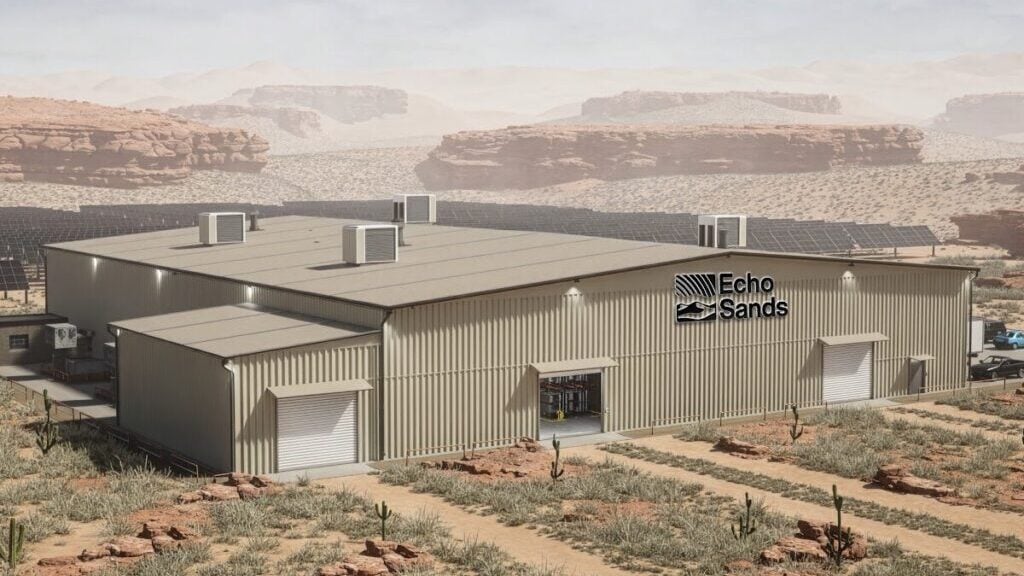
Flow battery company CMBLU Energy and California public utility Imperial Irrigation District (IID) have announced a 10MW/100MWh energy storage project that will mark IID’s first deployment of a non-lithium battery system.
Announced on 18 November, the Echo Sands Community Resilience battery energy storage system (BESS) project will be located at IID’s Pilot Knob Hydro Power Plant in Winterhaven, California, US.
It will provide ten hours of stored energy to serve the Fort Yuma Quechan Indian Tribe and nearby desert communities, including during extreme heat events and other grid disruptions.
Echo Sands will be built in two phases, with the initial 1MW/10MWh deployment backed by a US$7.2 million grant from the California Energy Commission (CEC), awarded under the agency’s Community Energy Reliability and Resilience Investment (CERRI) Programme.
Try Premium for just $1
- Full premium access for the first month at only $1
- Converts to an annual rate after 30 days unless cancelled
- Cancel anytime during the trial period
Premium Benefits
- Expert industry analysis and interviews
- Digital access to PV Tech Power journal
- Exclusive event discounts
Or get the full Premium subscription right away
Or continue reading this article for free
That funding, approved at the CEC’s board meeting the day before the announcement, will lay the groundwork for the full 10MW/100MWh build-out.
Speaking with Energy-Storage.News at the RE+ 2026 trade show in Las Vegas last week, Julie Royes, vice president of corporate affairs at CMBLU Energy, said the award moved from “selected” to officially “awarded” status that same week, closing out a process that began with a joint grant submission developed with IID, PNNL, EPRI, and a local community benefits organisation alongside the tribe.
Echo Sands background
The CEC’s CERRI round split funding between large and small entities; IID qualified as a small entity, competing against 14 applicants for just three awards in that category.
Royes explained that the project’s name draws directly from the character of the site itself, a stretch of desert roughly two hours’ drive from San Diego covered in dune-like sand that, on closer inspection, is composed largely of shell fragments.
“It’s said that if you stop and close your eyes, you can hear the echoes of the ancestors from the tribal land,” Royes said, describing how the team arrived at the name after visiting the location, which sits on already-disturbed land adjacent to, but not connected to, IID’s existing hydro facility.
Beyond the name, Royes framed Echo Sands as fundamentally a story of community resilience. The Fort Yuma Quechan Tribe’s casino currently relies on generators, and residents have historically gathered there during power outages caused by extreme heat or wildfire risk to preserve food or simply be together as a community. Royes said IID recognised the need to provide the area with a more reliable power source.
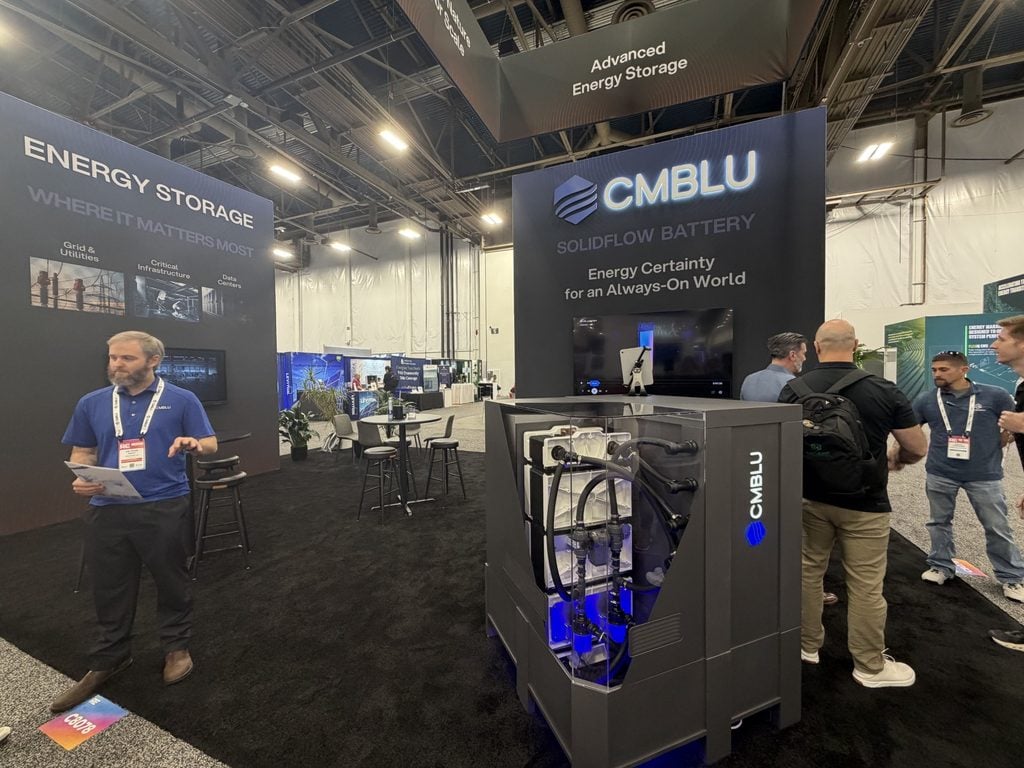
On why CMBLU’s SolidFlow technology was chosen over IID’s existing lithium-ion (Li-ion) storage experience, Royes pointed to both technical and cultural fit.
SolidFlow’s non-toxic, non-flammable composition and quiet operation, she said, aligned with the tribe’s values and connection to the land. This, Royes said, was likely a factor in the shift toward a non-lithium, non-vanadium technology, even if not every stakeholder would frame it in exactly those terms.
“The community’s voice has been louder than ever,” she said, noting that developers, data centre operators, utilities, and critical infrastructure operators are increasingly having to listen to local concerns about battery safety.
CMBLU’s strategy
Royes also used the conversation to lay out CMBLU’s broader US strategy. The company’s SolidFlow technology, she said, combines the scalability and architecture of a flow battery with solid-state energy storage materials, positioning it, in energy-density terms, between conventional Li-ion and vanadium redox flow batteries (VRFBs), while retaining a 10-hour-plus duration and a 20-year calendar life rather than a cycle-based lifespan.
On supply chain, Royes said SolidFlow production will be fully sourced and built in the US starting in late 2028 or early 2029, with CMBLU targeting four domestic manufacturing facilities of 4GWh each, for 16GWh of total US manufacturing capacity, drawing on lessons from its existing 1GWh capacity facility near Frankfurt, Germany, and a second facility under development in Greece.
CMBLU’s SolidFlow BESS is based on a patented combination of redox flow technology and solid-state storage materials.
CMBLU North American president Giovanni Damato previously told ESN that the design’s carbon-based component means the company is “not reliant on conflict materials or rare earth elements,” avoiding the geopolitical issues tied to battery metals, while the solid component, held stationary in the tank rather than cycled through pumps, “dramatically improves” energy density.
That positioning has taken on added relevance amid tightening restrictions on foreign entities of concern (FEOC) in the US.
Damato has said the restrictions “introduced real procurement and compliance uncertainty, which initially slowed some decisions, but they’ve also accelerated demand for FEOC-safe supply chains and domestic manufacturing,” adding that CMBLU has seen “growing interest precisely because our technology does not carry FEOC concerns.”
The company’s momentum has been building through 2026. In April, CMBLU closed a €50 million (US$58.76 million) Series C round with participation from Samsung Ventures, pushing its valuation above US$1 billion; existing investors including Strabag SE also joined that round.
In February, CMBLU entered a conditional supply agreement with German utility Uniper for up to 5GW of its technology, valid through 2037, with deliveries in batches of at least 100MWh starting in 2027.
Damato has also pointed to data centres as a growing market for SolidFlow and similar long-duration storage technologies, as utilities and hyperscalers contend with surging AI-driven load growth alongside the retirement of older generation assets. “The fastest path forward is pairing renewables with energy storage and firm generation,” he said.
Royes said Echo Sands is part of a wave of momentum for CMBLU, with several additional project announcements expected over the coming weeks and into the first quarter of 2027.
She framed the company’s broader push into non-lithium chemistries as a matter of portfolio diversification. “Let’s support lithium projects, but let’s have that diversification that’s so important, and really use all of the different chemistries to meet the need that we’re seeing right now,” she said.
CMBlu won the LDES Company of the Year award at last week’s Energy Storage Awards 2026 in London, UK, hosted by our publisher Solar Media (part of the Informa Group).