Australia has finished trialling grid-forming-equipped battery storage for system security services and needs contracts signed within two years, an executive at Akaysha Energy told an All-Energy Australia 2026 panel.
Emma Fagan, general manager, policy and regulatory affairs, Akaysha Energy, said in Melbourne that procurement frameworks for these services already existed in the National Electricity Rules (NER), but very few contracts were being signed.
“We’ve done all the trials. We’ve got all of the information,” Fagan said. “So we don’t have another five years or 10 years to continue along these trials.”
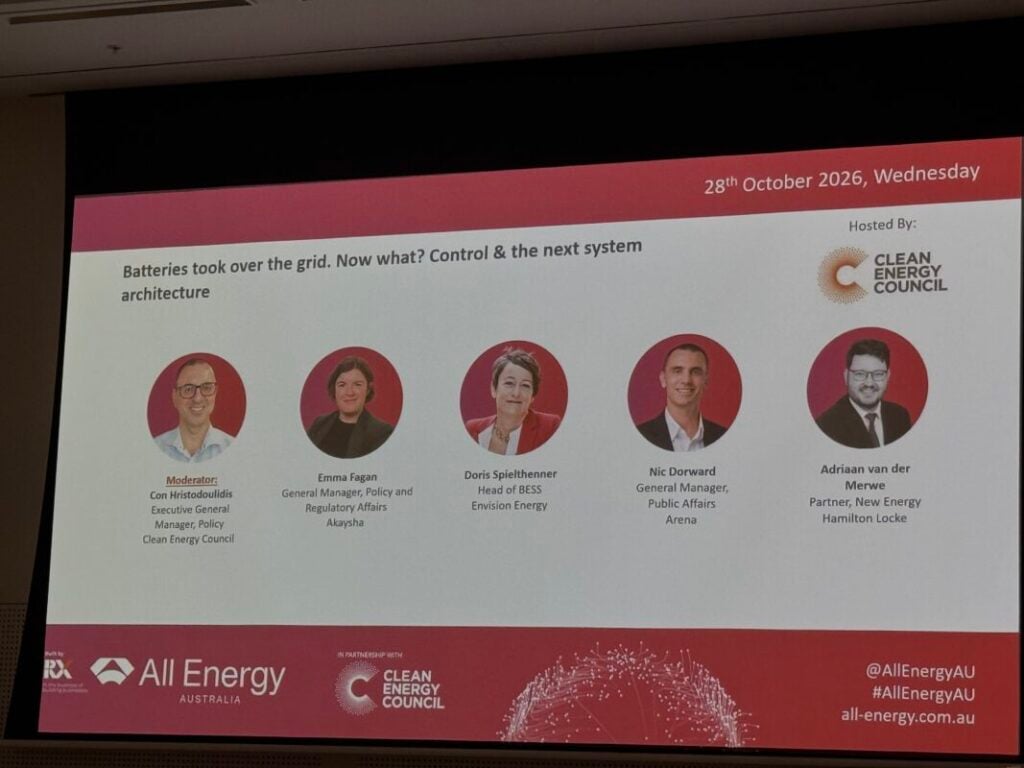
“What we need to do, though, is frankly get our skates on because we have been talking about this,” she added, speaking on the panel “Batteries took over the grid. Now what? Control and the next system architecture”.
Try Premium for just $1
- Full premium access for the first month at only $1
- Converts to an annual rate after 30 days unless cancelled
- Cancel anytime during the trial period
Premium Benefits
- Expert industry analysis and interviews
- Digital access to PV Tech Power journal
- Exclusive event discounts
Or get the full Premium subscription right away
Or continue reading this article for free
Fagan listed four changes she said were needed: service specifications recognised within the rules, jurisdictional consistency “so a service in Victoria looks the same as a service in New South Wales”, structured and transparent procurement, and clearer accountability across the market bodies’ governance frameworks.
Several of these topics were being debated by the Australian Energy Market Commission (AEMC) through rule change processes, she said. The aim should be that “by the middle of next year, we’re starting to demonstrate that these services can be provided at scale.”
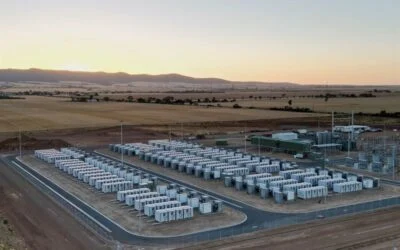
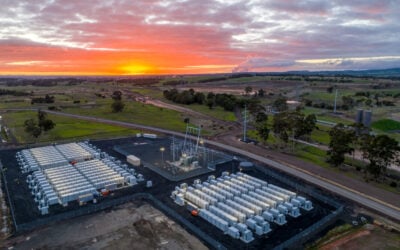
She cited Akaysha’s Waratah Super Battery in New South Wales, which is linked to the NSW System Integrity Protection Scheme (SIPS) and discharges when grid operator Transgrid needs it to, as an example of using storage to “increase transmission line output without building new transmission lines.”
That would be a live issue in Victoria after the state election, as debate over the future transmission build-out continued, Fagan said.
Fagan said she began working in energy storage policy in 2016, when the Australian Energy Market Operator’s (AEMO) transmission plan of the time, the predecessor to the Integrated System Plan (ISP), anticipated 3MW of utility-scale battery storage operating in 2026. Australia now has about 8GW, more than 2,600 times that figure, she said.
That fleet needs to reach 40GW to 50GW by 2040, Fagan said. AEMO’s own 2026 ISP calls for almost 40GW of storage by 2050, including 5GW of long-duration energy storage (LDES), with most remaining coal withdrawing by 2038.
Her first request was for the Electricity Services Entry Mechanism (ESEM), the replacement for the Capacity Investment Scheme (CIS), to pass into law, which she said would provide an “excellent entry signal”. The federal government has opened consultation on draft legislation for the ESEM and a market-making obligation.
Her second was an exit signal, through state-level plans to manage coal closures. Softening price spreads were “in no small part” due to new capacity coming online while expected coal closures had been delayed, Fagan said.
AEMO data showed Victoria’s average BESS price spread fell 41% to AU$86/MWh (US$60/MWh) in the first quarter of 2026 as more capacity came online.
Speaking at the same event, Matt Grover, director, energy markets APAC at Fluence, argued that algorithmic bidding was not the “boogeyman” of the National Electricity Market (NEM), saying more competition for dispatchable peaking capacity was part of the reason for current wholesale prices.
Fagan’s third request was confidence that grid-forming BESS could deliver the system security services needed before coal units closed. Grid-forming inverters feature in around 74% of the 33.2GW NEM BESS pipeline, according to AEMO data.
Progress on procurement has been uneven. Transgrid has opened a pathway for up to 900MW of grid-forming BESS to count towards New South Wales’ minimum system strength, while AEMO has said grid-forming BESS has not yet been confirmed to provide protection-quality fault current and is running a trial.
Revenue gaps for longer-duration battery storage
Doris Spielthenner, head of battery energy storage systems (BESS) at Envision Energy, said that in recent months, fewer power purchase agreements (PPAs) had come through and financial close had been delayed, in part because developers had no system security market to value-stack against.
Spielthenner said she wanted stronger market mechanisms for both 4-hour and 8-hour BESS, as the extra capex for longer durations needed incremental revenue to support it.
“And I think the market mechanisms are simply not there yet,” she said, adding that it was unclear whether current schemes would work and that “the best test is always going to be the banks.”
Shane Bannister, head of business development & sales, energy APAC, Tesla, made a similar point at the conference, saying demand for 8-hour BESS in Australia was “completely artificial” and relied on government underwriting, although asymmetric registration could add revenue for such projects.
Envision’s response to policy uncertainty was to offer developers flexibility, Spielthenner said, including performance guarantees that can change over 25 years if the value stack changes, designs that can start at 4-hour and move to 6-hour or 8-hour duration, and augmentation after commercial operation.
The company launched its modular Gen 8 BESS platform, using 750Ah-plus cells in configurations from 6MWh to 12MWh or more per 10-foot unit, in October 2025.
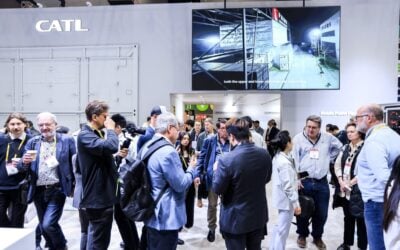
Other manufacturers also used the event to pitch to Australian developers, with CATL holding the global launch of its 9MWh TENER+ BESS and signing an agreement with Hitachi Energy to pair its DC-side BESS products with Hitachi Energy’s power conversion systems (PCS).
On cybersecurity, Spielthenner said that, as a Chinese OEM, Envision takes incoming regulations seriously and uses a third-party cybersecurity assessor.
She said a mandate for third-party assessment was still missing from the regulations, and that rules should apply equally to Chinese and European OEMs because “the threat can come from anywhere around the world.”
Adriaan van der Merwe, partner, new energy, Hamilton Locke, said arbitrage gains had changed “completely over the last couple of months”, and that developers needed contracts with enough flexibility to respond to the market, as the project eventually built would differ from the one first designed.
Van der Merwe said the CIS had created “a class of assets that stands out above the others”, which become “the low-hanging fruit, which go first”.
For a client seeking to build a standalone BESS, bankability depended on a clear monetisation plan, he said. “Back in the day you used to build solar that’s BESS ready. Now you build BESS that’s solar ready.”
Community support was “probably the most important thing” when developing a generation or storage asset, van der Merwe added, as opposition could delay a project until it was no longer financeable.
Matt Baumgurtel, partner and new energy lead at Hamilton Locke, has previously described social licensing as “the next frontier” for BESS in Australia.
Nic Dorward, general manager, public affairs at the Australian Renewable Energy Agency (ARENA), said 138 community-scale battery storage systems funded by the agency had been installed, with just under 200 expected by the end of the year.
Knowledge sharing is mandatory for every ARENA grant, Dorward said, describing it as “the return on investment that ARENA gets, and thus the taxpayer gets.”
He said the agency’s large-scale battery storage round had shown BESS could provide system services traditionally supplied by synchronous generation.
That round included a AU$35 million (US$24.4 million) grant for AGL’s 500MW/1,000MWh grid-forming Liddell BESS in New South Wales, where lessons from the project covered island commissioning, BESS oversizing and generator performance standards.
Never miss an Australian energy storage story. Sign up for our Australia newsletter and get the latest project announcements, policy updates and market analysis delivered directly to you.