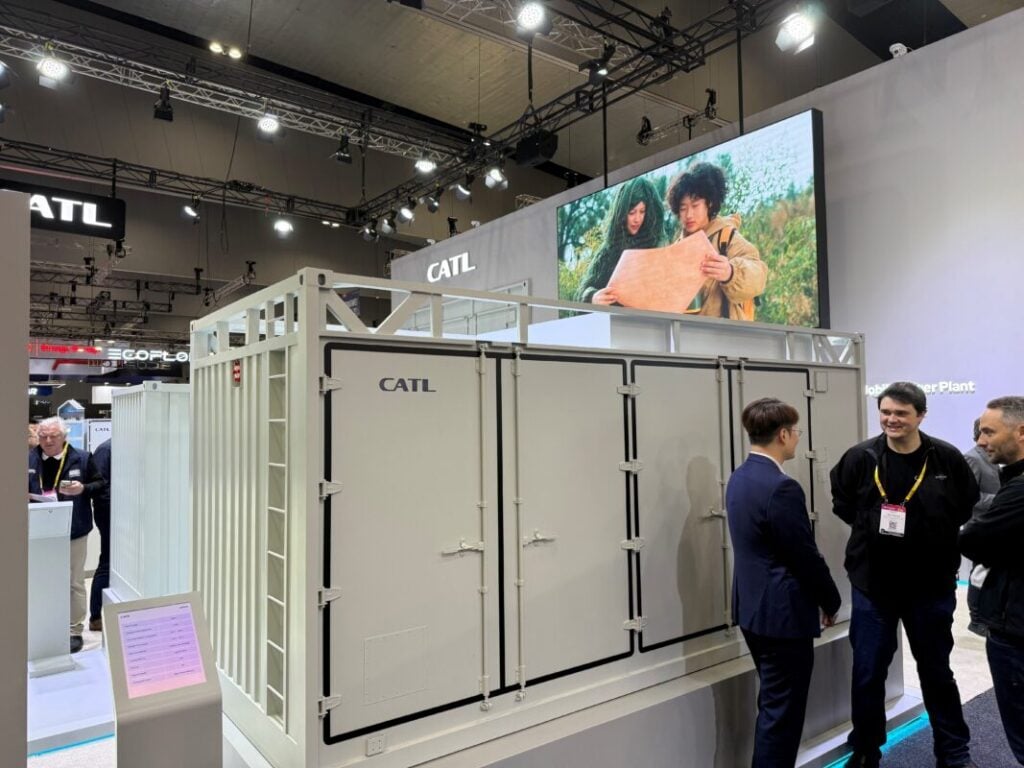
CATL has launched its 9MWh TENER+ battery energy storage system (BESS) at All-Energy Australia 2026 and signed three memorandums of understanding (MoUs) with Australian partners.
The company unveiled TENER+ at a global launch event in Melbourne today (28 October), where it also showcased TENER Sodium, its sodium-ion BESS. The MoUs are with Hitachi Energy, EPEC Group and UNSW Sydney and cover project delivery, grid connection and skills.
Zane Zhou, general manager of CATL Australia and New Zealand, spoke exclusively with Energy-Storage.news at the launch today, commenting on Australia’s financing and development landscape, including the need to develop talent in Australia to work on battery storage as an integral pillar of the energy system.
CATL claims it has more than 3,000 energy storage projects worldwide and over 17GWh of projects installed in Australia. CATL was upgraded to AAA, the highest tier, in the Q2 update of the Battery StorageTech Bankability Ratings Report, on the back of strong growth in its energy storage business.
Try Premium for just $1
- Full premium access for the first month at only $1
- Converts to an annual rate after 30 days unless cancelled
- Cancel anytime during the trial period
Premium Benefits
- Expert industry analysis and interviews
- Digital access to PV Tech Power journal
- Exclusive event discounts
Or get the full Premium subscription right away
Or continue reading this article for free
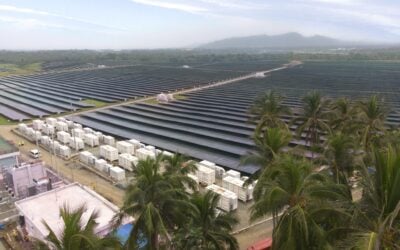
Its Australian projects include the 500MW/2,400MWh Collie BESS in Western Australia, a 4.8-hour system that state-owned utility Synergy completed in February, using 640 CATL EnerC containerised lithium iron phosphate (LFP) units, making it Australia’s largest operational BESS at the time.
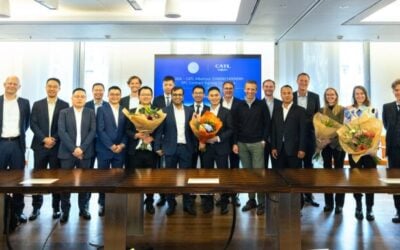
Under the Hitachi Energy MoU, CATL’s DC-side BESS products and Hitachi Energy’s power conversion systems (PCS), which convert the direct current stored in the cells into alternating current for the grid, would form the basis of a proposed integrated offering for Australia and the Asia-Pacific region.
The two companies aim to improve compatibility between their equipment, standardise project delivery and reduce integration risk. A second MoU sees CATL work with EPEC Group and the Xiamen Empirical Energy Storage Research Institute (ESVL) on Australian projects.
That partnership combines CATL’s technology with EPEC’s grid integration and engineering delivery expertise and ESVL’s full-scale system validation to speed up delivery of bankable, grid-compliant energy storage projects in Australia.
The third MoU, with UNSW Sydney, covers joint development of the Centre for Integrated Renewable Energy Training and Innovation (CIRETI) in Western Sydney, New South Wales. Its initial focus will be skills and talent development for battery energy storage, technology demonstration and collaborative research.
“The next generation of Australia’s clean energy workforce will be centred around the integration of batteries and how they deliver reliable energy and system security to our grids,” said Zane Zhou, general manager of CATL Australia and New Zealand.
The MoUs build on CATL’s existing Australian customer base, which includes developer Birdwood Energy. Birdwood has selected CATL to supply BESS units for the 400MW/1,860MWh Baranduda Electrical Energy Reserve near Wodonga in Victoria, with a duration of around 4.65 hours.
“Following a rigorous process that reviewed cost, product suitability and delivery requirements, CATL was selected to provide the project’s battery units,” said Alex Marriott-Smith, Birdwood’s Australian managing director.
The announcements come as BESS takes a larger role in Australia’s National Electricity Market (NEM), the grid serving the eastern and southern states.
Citing the Australian Energy Market Operator (AEMO), CATL said renewables supplied a record 44.3% of NEM generation in the September quarter, when the NEM’s 59 grid-scale BESS earned an estimated AU$88.91 million (US$61.99 million), according to analytics platform NEMPulse.
Grid-scale BESS supplied 8% of evening peak generation in the same quarter, overtaking gas-powered generation for the first time, according to AEMO figures cited in the release.
CATL said that as coal plants retire, the grid needs more storage with grid-forming (GFM) capability, meaning inverters that can set voltage and frequency rather than follow the grid.
Lithium-ion and sodium-ion options for Australian projects
TENER+ is a 9MWh lithium-ion system that CATL says reduces the number of containers needed by 40% and the project footprint by 35%, which the company pitches at sites with limited land.
It is designed for a 25-year lifespan, uses liquid cooling and operates below 65dBA, a noise level CATL says makes it suitable for deployment near residential communities. Multiple units can be commissioned simultaneously with a single click, according to the company.
The first CATL TENER BESS solution was launched in 2024 at ees Europe in Germany. It had, at the time, an industry-leading 6.25MWh of capacity in a standard 20-foot ISO container form factor. A year later, at the same show, CATL presented TENER Stack, which established the 9MWh capacity configuration, comprising two half-height units that weigh less than 36 tonnes each.
“A battery’s value is measured over the entire lifespan of a project and not just on the day it’s commissioned,” Zhou said in the release, a point that echoes CATL’s CEO on why the evolving role of energy storage as infrastructure demands technology that stands the test of time.
Speaking to Energy-Storage.news at All-Energy Australia today (28 October), Zhou says TENER+ is likely to reach the Australian market in one to one and a half years, largely because of the time Australian projects need to secure grid connection approval and reach financial close.
“In the Australian market, the GPS process and the design need probably one year plus to facilitate the final financial close and moving to NTP,” he said, referring to generator performance standards, the technical requirements a project must meet to connect, and notice to proceed, the point at which construction can start.
TENER Sodium, which CATL launched in Germany in June and is built from 3.75MWh modules, is sized at more than 30MWh per configuration. CATL describes it as the world’s first mass-produced, field-validated sodium-ion BESS.
Sodium-ion cells use sodium, which is more abundant and widely available than lithium, to carry charge between the electrodes. CATL says TENER Sodium lowers total engineering, procurement and construction (EPC) costs by more than 10% compared with containerised LFP systems, the dominant chemistry in grid-scale storage.
The company says TENER Sodium operates in temperatures of up to 55°C, delivers more than 10,000 cycles at 45°C and achieves 95% round-trip efficiency, the share of stored energy returned to the grid, over an operating lifespan of more than 20 years.
The trade-off is energy density. CATL’s TENER sodium-ion cell stores 160Wh/kg, below the 180-190Wh/kg of the large-format LFP cells in a comparison of sodium-ion and LFP cells for BESS published by Energy-Storage.news.
CATL has signed a 60GWh, three-year sodium-ion supply deal with HyperStrong in China and a 5GWh MoU with Alfen in the Netherlands. At the same time, European system integrators have moved quickly on sodium-ion technology.
Looking ahead to the next 12 months, Zhou says CATL still expects many shipments to Australia, but many are tied to contracts from 2024 and 2025, with notice-to-proceed already locked in for 2027 delivery. Independent power producers (IPPs) working on new projects face tougher conditions, Zhou says.
“Australia has a high interest rate, and a lot of big batteries have been put into the system in the last 12 months,” Zhou says.
“In the short term, I think a lot of IPPs are seeing difficulty and challenges in getting the financial close.”
The full interview with Zhou, covering TENER+, sodium-ion demand in Australia and CATL’s project experience in the country, will be published on ESN Premium next week.