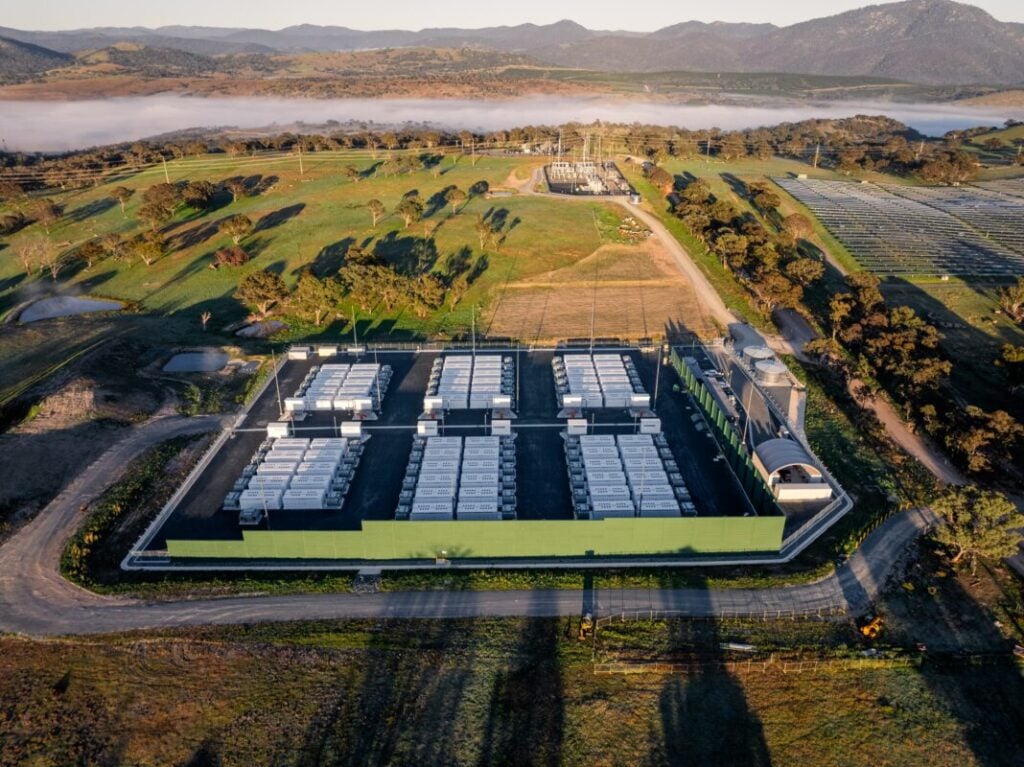
Australia committed a record 2.4GW of renewable energy projects to construction in the third quarter of 2026, while battery energy storage systems (BESS) committed in the quarter covered 13% of the new storage capacity needed by 2030.
The figures come from the latest Australian Renewable Energy Scorecard, published quarterly by the Institute for Energy Economics and Financial Analysis (IEEFA) and consultancy Green Energy Markets.
The 2.4GW is 20% above the previous record, set in Q1 2022, and follows low volumes in the first two quarters of the year.
Wind made up 1.5GW of the quarter’s commitments. The scorecard said Queensland now has more than 90% of the wind capacity it needs by 2030, and Western Australia and South Australia more than 60%, largely due to power purchase agreements (PPAs) and direct investment by state-owned utilities.
Try Premium for just $1
- Full premium access for the first month at only $1
- Converts to an annual rate after 30 days unless cancelled
- Cancel anytime during the trial period
Premium Benefits
- Expert industry analysis and interviews
- Digital access to PV Tech Power journal
- Exclusive event discounts
Or get the full Premium subscription right away
Or continue reading this article for free
For utility-scale BESS, the report said that “at this rate the remaining capacity gap to 2030 could be in construction in less than one and a half years.”
BESS under construction now equals 28% of the new capacity needed to meet the federal government’s 82% renewables target, ahead of wind at 21% and solar PV at 16%.
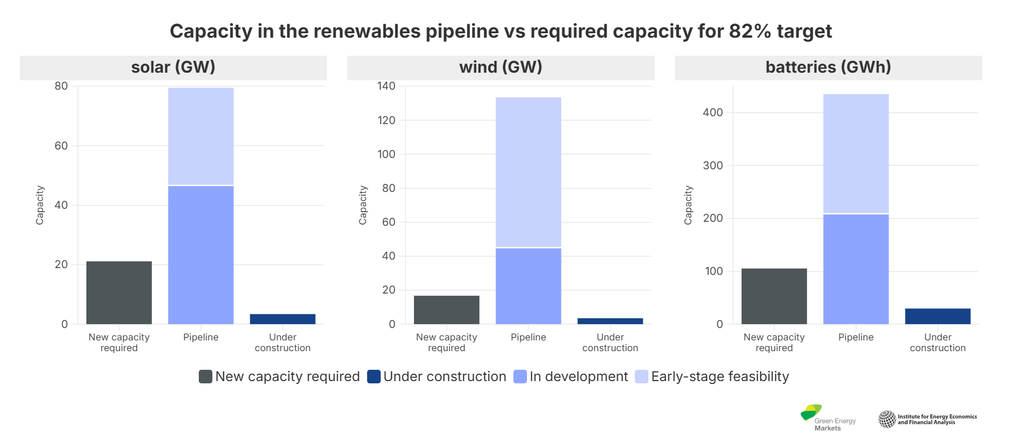
The scorecard measures storage in GWh. Its charts put the new BESS capacity required by 2030 at roughly 105GWh, against around 30GWh under construction and more than 200GWh of projects in development, excluding early-stage proposals.
Every state with a storage requirement has between 18% and 39% of it under construction. Tasmania needs no new BESS because of its hydro capacity. All states except New South Wales (NSW) have more battery storage capacity approved than they need, and NSW shows only a slight gap.
NSW has the largest requirement, at around 45GWh on the scorecard charts. Paul Peters, CEO of the NSW Energy Security Corporation, has said that “75% of what we need in 2030 is not there today”, in coverage that found grid-forming inverters feature in 74% of the National Electricity Market’s (NEM) 33.2GW BESS pipeline.
That points to grid-forming power conversion systems (PCS) taking a large share of the next wave of procurement.
Federal tenders are adding to the pipeline: the government selected 15 standalone BESS projects totalling 4.2GW/16.1GWh under Capacity Investment Scheme (CIS) Tender 8, all due to operate by 31 December 2029.
Contracts remain the main bottleneck for solar PV and wind. Only 6% of fully approved projects have also been contracted, the scorecard said, and just 4.6GW (18%) of the 25.5GW of wind and solar PV awarded federal or NSW underwriting has reached construction or operation.
Government officials disclosed in October that 27 of the 109 projects awarded CIS agreements will not proceed with them. IEEFA said it has not yet adjusted its charts, as the government has not identified the projects.
Projects now in construction represent around AU$8.4 billion (US$5.6 billion) of direct domestic investment, led by Queensland at AU$2.5 billion. If the remaining fully approved pipeline proceeded, investment would reach around AU$51 billion, according to the report.
Fleet growth and pressure on revenues
The commitments add to a fast-growing operating fleet. The Australian Energy Market Operator (AEMO) said 9.1GW of generation and storage reached full output in FY26, including 12.9GWh of storage across 34 projects, with battery storage making up 52% of its 75.4GW connections pipeline.
Energy held in NEM BESS hit a record 20.17GWh on 6 November, up 203% in a year. The Australian Energy Regulator (AER) has reported that BESS set the wholesale price 16.3% of the time in 2025, up from about 1% in 2021.
Revenues are coming under pressure as the fleet grows. In Q3 2026, 59 grid-scale BESS earned a combined AU$88.91 million, with five days delivering 15% of revenue, according to analytics platform NEMPulse.
Lenders have noted price spreads falling from the AU$180-200/MWh once expected to nearer AU$100/MWh.
“We have learned more in the past six months than we have in the past six years,” François-Régis Pialoux, director of energy at ING Australia, said in coverage of how Australian lenders are navigating merchant risk.
Suraj Narayan, managing director Australia at Valo, the Wärtsilä joint venture, put it more bluntly. “The market’s getting tough,” he said in an interview with ESN Premium on why Australia values BESS bankability above all.
Behind the meter, the scorecard recorded a 44% drop in home battery storage installations in Q3 after a record Q2, with average system size down 20% from a record 32kWh. It linked the fall to the scaling back of the Cheaper Home Batteries Program rebate in May 2026.
That follows a record first half, when households installed 276,011 home battery storage systems and 13 grid-scale storage projects totalling 1.6GW/6.5GWh reached financial close, according to Clean Energy Council figures reported by PV Tech.
Beyond 2030, AEMO’s 2026 Integrated System Plan calls for 35GW of short and medium-duration storage plus 5GW of long-duration storage by 2050. AEMO CEO Daniel Westerman warned that “slower progress will erode benefits to consumers and present risks to reliability.”
Never miss an Australian energy storage story. Sign up for our Australia newsletter and get the latest project announcements, policy updates and market analysis delivered directly to you.