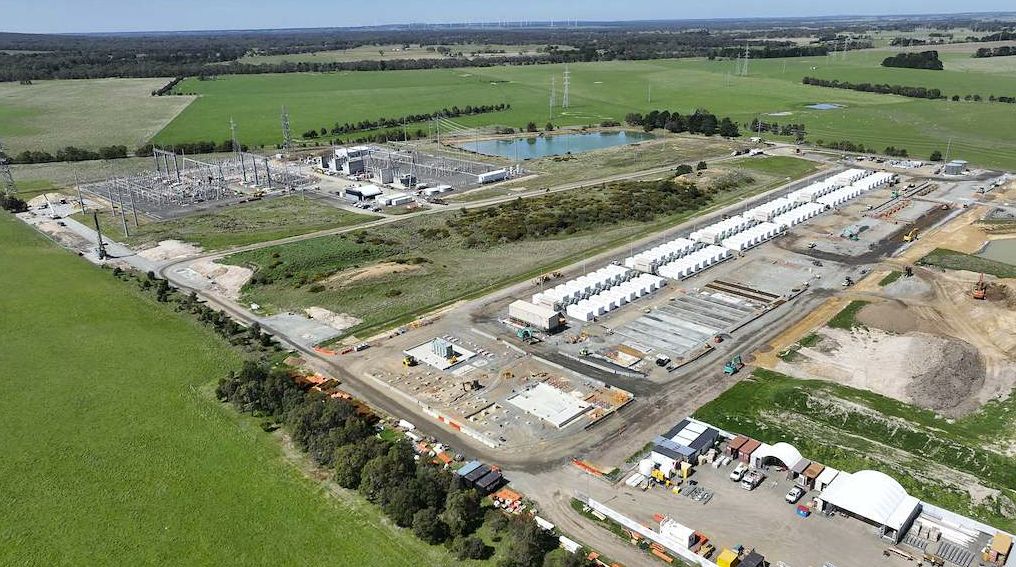
Battery energy storage systems (BESS) account for 5.3GW of the 8.4GW of new projects added to Australia’s National Electricity Market (NEM) since December 2025, according to the Australian Energy Market Operator (AEMO).
AEMO, the operator of the NEM and Western Australia’s Wholesale Electricity Market (WEM), published its 2026-27 Summer Outlook on Friday (20 November).
It said electricity and gas supplies are expected to remain sufficient under forecast conditions from November to March, “but we know conditions can change quickly, particularly during periods of extreme heat,” said Michael Gatt, AEMO executive general manager of operations.
The 8.4GW is spread across more than 30 projects. Besides battery storage, it comprises 1.1GW of solar PV, 0.7GW of wind, 0.7GW of gas-fired generation and 0.5GW of hybrid solar PV and battery storage, AEMO said.
Try Premium for just $1
- Full premium access for the first month at only $1
- Converts to an annual rate after 30 days unless cancelled
- Cancel anytime during the trial period
Premium Benefits
- Expert industry analysis and interviews
- Digital access to PV Tech Power journal
- Exclusive event discounts
Or get the full Premium subscription right away
Or continue reading this article for free
The figure compares with the 2024-25 summer, when AEMO said 750MW of new storage had been commissioned to full output on the NEM since September 2023, a 58% rise in available BESS capacity at the time.
AEMO’s outlook said additional BESS capacity is available in every NEM region except Tasmania, where dry conditions may also affect hydro availability. Synchronous generation availability is expected to be similar to an average summer, with planned maintenance reducing it in New South Wales (NSW) and Queensland in November.
“Additional BESS facilities provide greater operational flexibility,” the report said. However, AEMO added that while new BESS reduces the risk of reliability challenges, “this may be offset by the extreme conditions expected.”
El Niño conditions are forecast to persist into autumn 2027, with warmer and drier weather across most of Australia. AEMO said heatwaves could drive record maximum demand in both the NEM and WEM, while bushfire risk is elevated along corridors including the Heywood Interconnector and Queensland-NSW Interconnector (QNI).
Its Loss of Load Probability (LOLP) assessment, which models the chance of demand exceeding supply in the riskiest half-hour of each day, found only a few high-risk days, in Victoria and South Australia in January 2027, at 20% to 40%. LOLP was low in all other NEM regions.
AEMO said the risk is greatest when extreme heat coincides with low wind and solar PV output, outages and “storage is depleted”.
The LOLP figures exclude emergency reserve contracts, which AEMO can call on through the Reliability and Emergency Reserve Trader (RERT).
The growing fleet is already visible in NEM data. Energy held in NEM BESS assets reached a record 20.17GWh on 6 November, up 203% in a year, according to analysis by energy transition adviser Geoff Eldridge.
AEMO also linked the fleet to lower gas use. Average gas-fired generation demand this summer is forecast to be similar to last summer and lower than earlier years, “reflecting the growing contribution of large-scale battery storage,” the outlook said.
Interconnection is also changing. Stage 2 of Project EnergyConnect, the NSW to South Australia link, was energised in early November, raising transfer capability from 150MW to 350MW, subject to testing. Heywood capability between Victoria and South Australia is expected to rise from 600MW to 650MW.
Storage and the low-demand challenge
Summer peaks are only part of the picture. Gatt said AEMO is preparing for increasingly varied demand as storage and renewables grow, and that “increasing rooftop solar can push daytime operational demand to very low levels”, particularly on weekends and public holidays.
Minimum system load conditions remain possible in the NEM this summer under certain outage conditions, AEMO said. The Australian Energy Market Commission (AEMC) is consulting on minimum system load market rules, including a proposed paid service that BESS could bid into, with a draft determination due by 3 December.
In the WEM, AEMO said more than 1GW of transmission-connected storage provides greater operational flexibility and reduces the risk of minimum demand threshold events. Three BESS totalling 600MW have reached full output in the WEM since December 2025.
Those include Synergy’s 500MW/2,400MWh Collie BESS, completed in February with CATL technology. Earlier this year, utility-scale BESS supplied a record 37.2% of peak demand on Western Australia’s main grid.
WEM margins are tightest in January and February, while concurrent outages at the Bluewaters, Wagerup and Pinjarra power stations reduce reserves in March. AEMO excluded Merredin ESR 1, a BESS expected to commission over summer, from its reserve calculation.
Hot weather is also where NEM BESS owners look for revenue. Average NEM battery price spreads fell 85% in a year to AU$51/MWh (US$34/MWh) in Q2 2026, as grid-scale capacity passed 9,000MW.
In Q3, 59 grid-scale BESS earned AU$88.91 million, with five days delivering 15% of revenue, according to analytics platform NEMPulse. Suraj Narayan, managing director Australia at Valo, said “the market’s getting tough” in an interview with ESN Premium on why Australia values BESS bankability above all.
More capacity is under construction. The latest Institute for Energy Economics and Financial Analysis (IEEFA) scorecard found that Australia’s remaining BESS gap to 2030 could be in construction within 18 months, with projects under construction covering 28% of the new storage needed.
Never miss an Australian energy storage story. Sign up for our Australia newsletter and get the latest project announcements, policy updates and market analysis delivered directly to you.