The Australian Energy Market Operator (AEMO) has set out a storage requirement of almost 40GW in its latest 2026 Integrated System Plan (ISP), split between 35GW of short and medium-duration energy storage for daily firming and 5GW of long-duration energy storage (LDES) for seasonal reliability.
AEMO published the latest ISP this morning (25 June), setting out its least-cost roadmap for the National Electricity Market (NEM) through to 2050. The plan reaffirms that renewable energy, firmed with energy storage, backed by gas and connected through upgraded networks, remains the lowest-cost pathway for the NEM.
“Extensive stakeholder consultation and modelling of thousands of potential investment combinations has identified the least-cost option,” AEMO CEO Daniel Westerman said.
“Renewable energy, firmed with storage, backed up by gas and connected with upgraded networks remains the least-cost roadmap to meet Australia’s energy needs.”
Try Premium for just $1
- Full premium access for the first month at only $1
- Converts to an annual rate after 30 days unless cancelled
- Cancel anytime during the trial period
Premium Benefits
- Expert industry analysis and interviews
- Digital access to PV Tech Power journal
- Exclusive event discounts
Or get the full Premium subscription right away
Or continue reading this article for free
The ISP divides storage into three distinct categories based on the functions they perform. Short-duration energy storage, categorised as systems with durations below 4 hours, provides rapid frequency response and short-duration peak management.
Meanwhile, medium-duration storage, covering systems from 4-12 hours, handles the daily intraday cycle of absorbing midday solar surplus and dispatching it during the evening peak.
Together, these two categories make up the 35GW target.
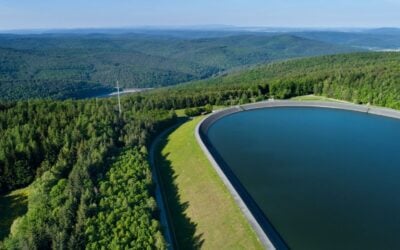
LDES, at 12 hours and above, firms renewables across extended low-wind and low-solar periods and during winter – a role the ISP assigns to pumped hydro and the NEM’s existing hydro fleet.
The ISP’s Optimal Development Path (ODP) calls for almost 120GW of grid-scale wind and solar, nearly 50GW of utility-scale storage and hydro, 17GW of flexible gas and 6,000km of new transmission by 2050. Most of the NEM’s remaining coal fleet would withdraw by 2038, with all to exit by 2049.
The ODP represents the lowest-cost combination of generation, storage and network investments needed to keep the lights on across the NEM as coal-fired power stations retire and electricity demand grows.
The grid-scale energy storage pipeline already exceeds the 2050 target
One of the more striking data points in the ISP is the scale of battery storage already in the NEM’s connections queue.
The ISP confirms that at the start of 2026, approximately 67GW of projects were progressing through the connections process, of which 45GW are grid-scale energy storage, already exceeding the ISP’s entire 35GW short-to-medium energy storage target for 2050.
However, it is important to note that this does not mean 45GW will be built. Historical attrition rates mean a large proportion of queued projects will not reach financial close.
As Energy-Storage.news reported earlier this year, battery energy storage projects accounted for 46% of Australia’s 64GW energy investment pipeline, with standalone BESS representing nearly half of all planned capacity additions.
The Clean Energy Regulator’s pipeline data for May 2026 showed a probable queue of 32GW against a committed queue of just 7.3GW, showcasing the gap between registered interest and committed capital.
What the connections figure confirms is that the market has already priced in the commercial viability of short- and medium-duration storage in the NEM, ahead of any ISP mandate.
The battery fleet’s operational momentum is also accelerating. Indeed, Australia’s battery storage fleet tripled its daily load-shifting contribution as 4.4GW came online in Q1 2026. This was also recorded as the fastest quarterly addition in the NEM’s history.
The pipeline’s technical profile is also evolving in line with the ISP’s requirements for storage assets. Grid-forming inverters feature in 74% of Australia’s NEM battery storage pipeline.
The ISP explicitly acknowledges that battery storage and synchronous condensers can now perform many of the stability services previously delivered by coal plants.
Delivery, not planning, is now the constraint
The ISP is clear that the planning work is done. The focus now is on delivery.
In the same week the ISP was published, the Capacity Investment Scheme Tender 8 awarded contracts to 15 battery storage projects totalling 4.2GW/16.1GWh across the NEM, all of which are required to be operational by 31 December 2029.
The results spanned New South Wales, Queensland, South Australia and Victoria, with Ampyr Energy, Akaysha Energy, Eku Energy, Edify Energy and Potentia Energy among the successful developers.
The ISP also models a constrained delivery scenario in which generation, storage, and transmission projects take longer and cost more than planned.
In that scenario, some 2030 policy targets would be delayed, and consumer benefits would be eroded. AEMO’s analysis confirms that the ODP is robust to those delays in its project selection but underscores the urgency of maintaining the delivery pace.
“While momentum in investment and delivery continues to build, challenges remain in delivering essential infrastructure at the pace required,” Westerman said.
“Slower progress will erode benefits to consumers and present risks to reliability.”
The Step Change scenario, considered most likely by AEMO at 46% probability, requires AU$106 billion (US$73 billion) of investment by 2050 across generation, storage, firming, and network infrastructure.
New transmission in the ODP is projected to deliver AU$28 billion in net market benefits to consumers, comprising AU$26 billion in avoided system costs and AU$2 billion in emissions-reduction value.
Interested in Australia? Read Energy-Storage.news’ Energy Storage Summit Australia coverage and related content.