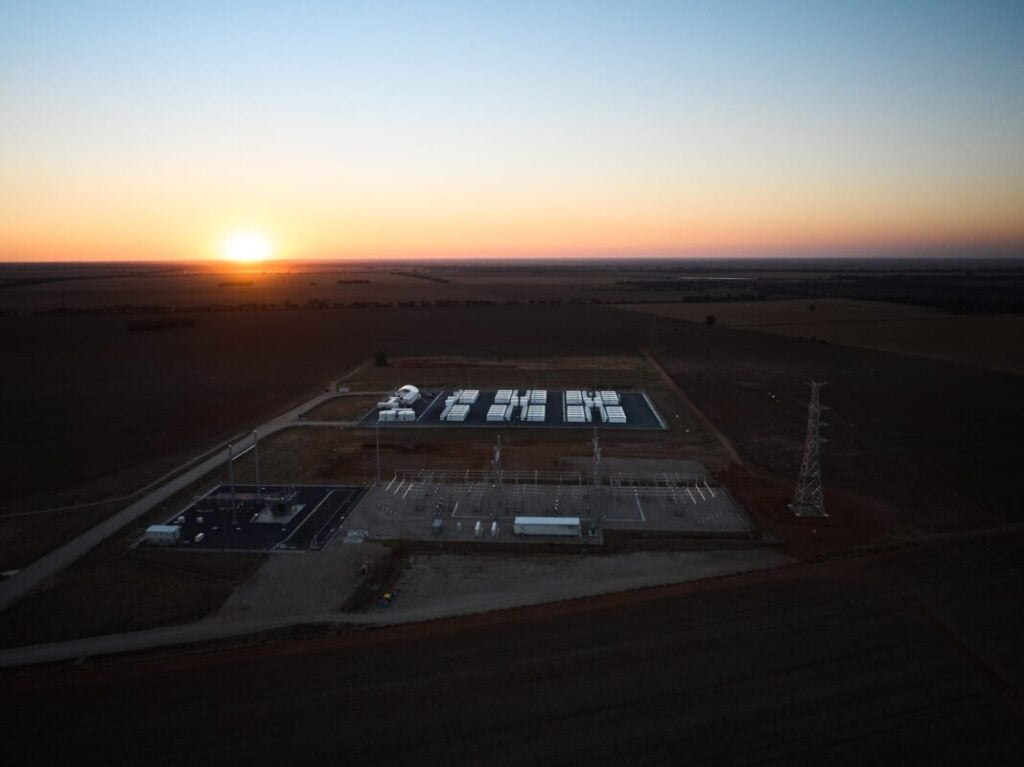
Around 74% of battery storage projects in Australia’s National Electricity Market (NEM) pipeline are confirmed to be equipped with grid-forming inverters, according to the Australian Energy Market Operator (AEMO).
Grid-forming (GFM) equipped battery storage has become central to AEMO’s system strength strategy as the NEM transitions away from coal-fired generation, which historically provided these services as a by-product of operation.
A grid-forming BESS equipped with advanced inverters can independently maintain grid voltage and frequency, providing essential system strength and stability services that were traditionally supplied by coal- and gas-fired power plants with spinning turbines.
The grid-forming technology featured prominently at the Energy Storage Summit Australia 2026 in Sydney last month, where representatives from AGL and Fluence discussed the technical challenges, commissioning innovations and hard-won lessons from the 500MW/1,000MWh Liddell grid-forming BESS.
Try Premium for just $1
- Full premium access for the first month at only $1
- Converts to an annual rate after 30 days unless cancelled
- Cancel anytime during the trial period
Premium Benefits
- Expert industry analysis and interviews
- Digital access to PV Tech Power journal
- Exclusive event discounts
Or get the full Premium subscription right away
Or continue reading this article for free
Battery storage pipeline surges to 33.2GW
Battery energy storage systems (BESS) continue to lead the NEM’s generation and storage development pipeline, with standalone battery storage power output reaching 33.2GW in the first quarter of 2026, according to AEMO’s latest Connections Scorecard.
The 33.2GW battery storage pipeline represents a 62% increase from 20.5GW recorded in the first quarter of 2025, with utility-scale battery storage now comprising 49% of the total 67.3GW of projects progressing through the NEM connection process in Q1 2026.
Additionally, the scorecard shows that the overall pipeline has expanded by 33% to 50.5GW from the end of Q1 2025.
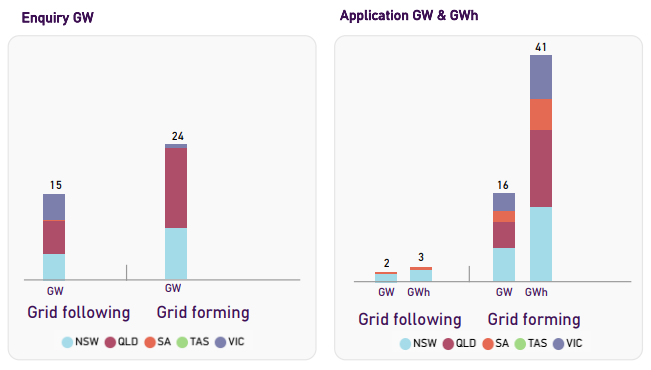
AEMO group manager for onboarding and connections, Margarida Pimentel, said projects in the application stage, where performance of project design is assessed, increased 51% over the past year from 19.7GW to 29.8GW, with 18 projects totalling 5.5GW entering the application stage in the March quarter alone.
“There is positive momentum across the connections pipeline, with strong growth in projects progressing through the early stages of the application process,” Pimentel said.
Grid-scale solar capacity in the pipeline rose from 17.7GW to 20.7GW year-on-year, while wind increased from 8.32GW to 9.75GW. Hydro generation remained stable at 3GW.
Meanwhile, gas capacity decreased 74% from 0.9GW to 0.2GW with the commissioning of the 660MW Hunter Power Station to full output.
Implementation challenges persist
Pimentel noted that projects are taking longer in the proponent implementation phase due to prolonged funding uncertainty, changes in project ownership, supply chain and resource constraints, and design modifications.
“What’s important is that these projects continue through to registration and commissioning to full output, so they can support reliability and the transition of the power system,” she said.
For the March 2026 quarter, eight projects totalling 1.4GW received application approvals, eight projects totalling 1.5GW were registered, and five projects totalling 1.4GW reached full output.
The commissioned projects included the 660MW Hunter Power Station, the 440MW Clarke Creek Wind Farm, the 250MW/500MWh Swanbank BESS, the 50MW/400MWh Limondale BESS, and the 22MW Wangaratta solar PV power plant.
The new capacity will help meet an anticipated 28% rise in electricity demand by 2035 while offsetting the planned retirement of 11GW of predominantly coal-fired power stations over the next decade, including Eraring, Bayswater and Vales Point in New South Wales, Yallourn in Victoria, and Callide B in Queensland.
The pipeline growth comes as Australian states race to deploy battery storage to meet renewable energy targets.
Indeed, New South Wales has been warned that 75% of its 56GWh storage requirement for 2030 has not yet reached financial investment decision, with the state’s storage needs increasing from an earlier estimate of 40GWh due to higher-than-expected solar adoption.
“Two years ago, we needed 40GWh of storage operational by 2030. That has now increased to 56GWh solely due to solar penetration. Of the 56GWh needed, 12.5GWh has hit the financial investment decision. 75% of what we need in 2030 is not there today,” Paul Peters, CEO of New South Wales’ Energy Security Corporation, said at the Energy Storage Summit Australia 2026 last month.
The shift from wind to solar in the generation mix has added 16GWh to the state’s 2030 storage requirement, as solar operates for fewer hours per day than wind. Victoria is targeting 6.3GW by 2035 and has already become the first state to exceed 1GW of simultaneous battery storage charging.
Geopolitical instability positions Australia as safe haven for battery investment
Australia’s battery storage deployment has accelerated amid geopolitical instability in the Middle East, which has disrupted global fuel supplies and highlighted the country’s AU$50 billion (US$35.64 billion) annual dependence on imported oil and diesel.
Tim Buckley, founder and director of think tank Climate Energy Finance, told ESN Premium last month that the conflict has positioned Australia as a safe haven for international renewable energy capital that had been flowing to Middle Eastern battery markets.
“Substantial capital from China, Europe and America has been flowing into Middle East battery markets, which have been challenging Australia as one of the fastest-growing battery storage markets globally,” Buckley noted.
“All of that would have been put on hold, and so global investors would, yet again, have a reminder. Geopolitical risk premiums in Australia are very low for a reason,” Buckley said, adding that Australia offers international investors a combination of low geopolitical risk, abundant capital, extensive land availability, and “brilliant wind and solar onshore” resources.
While Australia’s pipeline continues to grow, Europe deployed 3.4GWh of battery energy storage systems in March 2026 alone, accounting for 19% of the global total and more than what the continent deployed in the entire year of 2023.
Over 1.4GW/3.4GWh of grid-scale BESS came online in Europe during the month, likely its best month ever.
Globally, 6.7GW/18.4GWh of grid-scale battery storage systems entered commercial operations in March, with China accounting for approximately 40% of the total at 2,765MW/8,536MWh.
Interested in Australia? Read Energy-Storage.news’ Energy Storage Summit Australia coverage and related content.