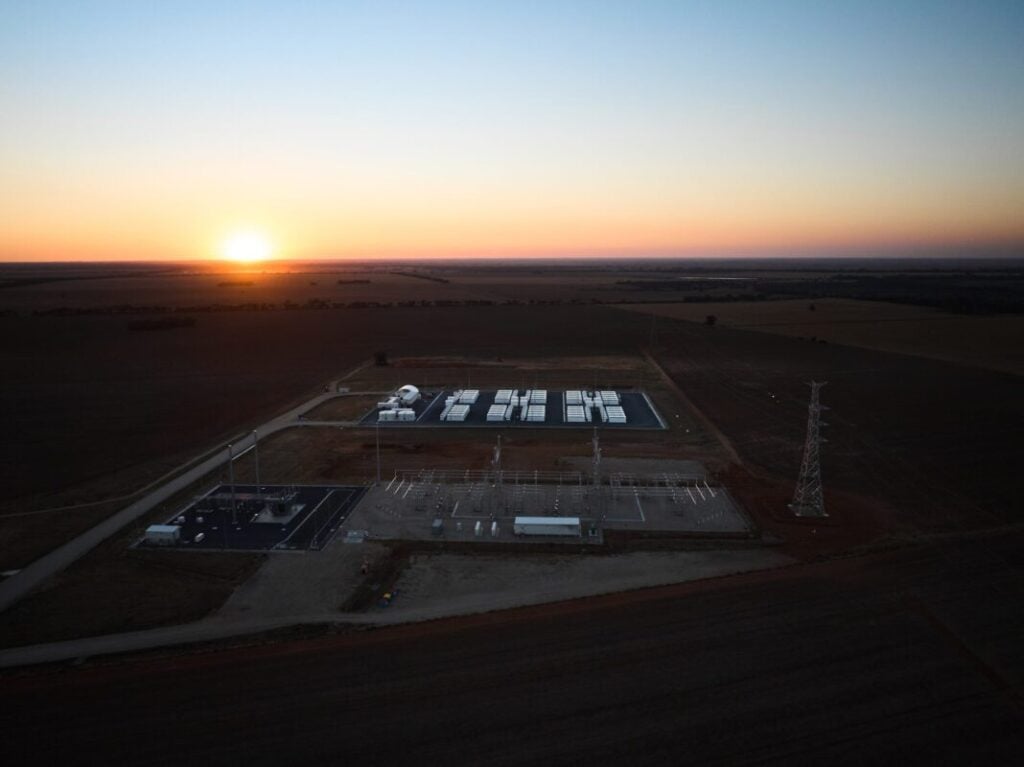
Grid-forming inverter-equipped battery energy storage systems (BESS) have not yet been confirmed to meet the highest tier of system strength requirements in Australia’s National Electricity Market (NEM), according to the Australian Energy Market Operator (AEMO).
However, this has not stopped the organisation from identifying the technology as a potential alternative to synchronous machines as coal-fired generation exits the grid in its final 2026 General Power System Risk Review (GPSRR) report, released last week (31 July).
The GPSRR is an annual requirement under rule 5.20A of the National Electricity Rules and provides a forward-looking view of low-probability but high-impact risks facing the grid.
The 2026 edition assessed four priority risks: increasing large-load connections from data centres, non-credible system-strength risks from synchronous-machine retirements, large non-credible generation and network contingency events and voltage-control risks.
Try Premium for just $1
- Full premium access for the first month at only $1
- Converts to an annual rate after 30 days unless cancelled
- Cancel anytime during the trial period
Premium Benefits
- Expert industry analysis and interviews
- Digital access to PV Tech Power journal
- Exclusive event discounts
Or get the full Premium subscription right away
Or continue reading this article for free
On system strength, the report notes that the timely delivery of synchronous condensers and transmission augmentations remains the primary means of maintaining fault levels as coal retires, but grid-forming BESS is explicitly named as an alternative or supplementary solution under active consideration.
“The consideration of additional synchronous condensers, grid-forming battery energy storage systems or other alternative solutions will continue promptly to support system strength in the NEM,” the report states.
The report distinguishes between two tiers of system-strength provision. Grid-forming BESS has demonstrated the ability to support voltage waveform stability, one component of system strength that has historically required synchronous machines.
What it has not yet been confirmed to deliver at scale is protection-quality fault current, the higher standard required to meet minimum system strength levels under the National Electricity Rules.
AEMO is proposing to address this gap directly, announcing plans to procure Type 2 Transitional Services to trial whether grid-forming inverters can provide protection-quality fault current in real grid conditions.
The trial will assess whether inverter-based technologies can deliver fault current of sufficient magnitude, duration, and composition for the reliable operation of power system protection systems.
That distinction carries immediate commercial weight. As Transgrid’s recent material change in circumstances assessment confirmed, the 38% blowout in synchronous condenser costs, with Phase 1 condensers now carrying a total project cost of AU$1.13 billion (US$920 million) against an original average estimate of AU$163 million per site, has sharpened the commercial incentive to resolve that technical question as quickly as possible.
Transgrid has proposed substituting 900MW of grid-forming BESS for two of the five originally planned Phase 2 synchronous condensers, pending confirmation that the technology can credibly contribute at the minimum system strength level.
The scale of the system strength challenge
The GPSRR’s analysis of the system strength risk is detailed and scenario-specific.
AEMO modelled the consequences of the non-credible loss of two large synchronous units across New South Wales and Victoria, under conditions where up to three other large synchronous units are already on planned or unplanned outage.
The scenarios are stress-tested against the expected retirements of the Eraring power station in New South Wales and the Yallourn power station in Victoria.
The findings for New South Wales are relatively encouraging, provided synchronous condensers and transmission augmentations are delivered on schedule. With those solutions in place, the report concludes that even with three large synchronous units on prior outage, the non-credible loss of two coal units can be managed operationally without further action.
If those solutions are delayed beyond Eraring’s retirement, the picture changes materially. The report finds that without synchronous condensers in place, there may be insufficient units available to resecure the system for some non-credible contingency events under multiple outage conditions.
Victoria presents a more constrained picture. With the Hazelwood synchronous condenser in place before Yallourn’s retirement, resecuring the system after the non-credible loss of two Loy Yang units with three coal units already on prior outage may require up to eight fast-start gas units to be brought online within 30 minutes, a target the report describes as difficult to achieve.
If synchronous condensers are delayed beyond Yallourn’s retirement, that figure rises to 16 fast-start units, a scenario AEMO acknowledges may not be achievable within the desired timeframe.
The report calls for improved coordination of outages to reduce the period where multiple units are offline concurrently, and for operational procedures to be extended to cover specific non-credible contingency events.
Three incidents involving the simultaneous loss of two large synchronous units had already occurred in FY25-26 before the report’s 1 July 2026 data cut-off. This includes the loss of Yallourn Units 3 and 4 on 16 October 2025, the loss of Callide C3 and C4 on 15 January 2026, and the loss of both Vales Point units on 2 February 2026.
The GPSRR frames those incidents as evidence that low-probability events of this type are not hypothetical, thereby directly informing the urgency of system strength delivery timelines.
Battery storage in a rapidly changing grid
The GPSRR’s findings indicate that the battery storage fleet is reshaping NEM operations faster than any other single technology.
Australia’s grid-scale battery fleet passed 9,000MW in Q2 2026, with NEM-wide battery price spreads collapsing 85% year-on-year to an average of AU$51/MWh as the installed fleet scaled rapidly.
Within that pipeline, grid-forming capability has become the dominant architecture. Grid-forming inverters now feature in 74% of Australia’s 33.2GW NEM battery storage pipeline, a proportion that reflects both the commercial incentive of system strength contracts and the growing operational base from which AEMO can accumulate field data on real-grid inverter behaviour.
That field data is what the proposed fault current trial is intended to build on. AEMO has stated that it will obtain and analyse fault-current data from commissioned grid-forming BESS to better understand their responses during faults, with the Engineering Roadmap and Type 2 Transitional Services providing the framework for that work.
Readers of Energy-Storage.news may be aware that AEMO previously designated grid-forming BESS as a priority action for 2026, describing the technology as set to form the “operational heartbeat of the New South Wales power system” as synchronous generation retires.
The GPSRR now adds a formal risk assessment layer to that priority designation, setting out the conditions under which the technology’s role will expand from the efficient level of system strength to the minimum level.
The report also addresses the separate but related risk posed by data centres as inverter-based loads. AEMO’s modelling shows that by 2030, a single fault on the 330kV network near Sydney West could disconnect approximately 1,500MW of data centre load in the absence of voltage ride-through standards.
Data centres are currently forecast to reach 6% of NEM demand by 2029-30 under AEMO’s Step Change scenario, rising to as much as 10% by 2050. The report supports the AEMC’s proposed Package 2 load access standards to address ride-through, active power recovery, and ramp-rate risks.
The GPSRR also draws lessons from the April 2025 Iberian Peninsula blackout, in which insufficient voltage control contributed to a cascading failure across Spain and Portugal.
AEMO recommends extending voltage control risk studies to include non-credible contingency events under minimum system load conditions and during periods of low fault levels.
Power system oscillation risks are flagged for inclusion in a future GPSRR or the Transition Plan for System Security. Forced oscillations from AI training loads, which can vary data centre demand by up to 60% of facility rating within seconds, are identified as a risk for sub-synchronous interactions with turbine shafts and inter-area power flows.
Never miss an Australian energy storage story. Sign up for our Australia newsletter and get the latest project announcements, policy updates and market analysis delivered directly to you.
Solar Media (part of Informa Group) will host the Battery Asset Management Summit Australia 2026 on 25-26 August at the Amora Hotel Jamison in Sydney, bringing together asset owners, operators, trading teams and optimisers to address revenue strategy, lifecycle management and operational performance across Australia’s fast-growing battery storage fleet.
Readers of Energy-Storage.news can get 20% off their tickets using the code ESN20 at checkout. Find out more about the Summit on the official website.