In this US news roundup, Eos has received an advance on its DOE loan, FlexGen and Lighshift have partnered on 16 BESS projects, and Georgia Power has energised a 128MW BESS.
Eos Energy draws US$87 million from DOE loan facility
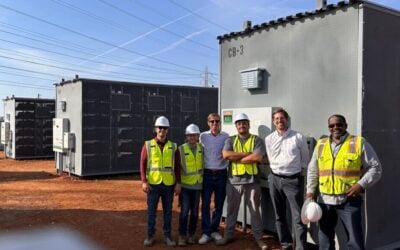
Zinc hybrid cathode battery maker Eos Energy Enterprises has received a US$87 million advance under the second tranche of its loan agreement with the US Department of Energy (DOE).
Announced 14 September, the advance, through the DOE’s Office of Energy Dominance Financing (EDF) reimburses 80% of eligible costs associated with the company’s Thorn Hill manufacturing facility in Warrendale, Pennsylvania. Eos has now drawn a total of approximately US$178 million from its DOE facility since 2024.
The company’s Line 2 at the Pennsylvania battery energy storage system (BESS) manufacturing facility entered commercial production in June 2026 and is being ramped towards its designed annual manufacturing capacity of approximately 2GWh.
Try Premium for just $1
- Full premium access for the first month at only $1
- Converts to an annual rate after 30 days unless cancelled
- Cancel anytime during the trial period
Premium Benefits
- Expert industry analysis and interviews
- Digital access to PV Tech Power journal
- Exclusive event discounts
Or get the full Premium subscription right away
Or continue reading this article for free
Upon completion of the planned relocation of Line 1 to Thorn Hill, subject to lender approvals, Eos expects the facility to support approximately 4GWh of annual manufacturing capacity across two lines.
The company expects to create jobs across four shifts to staff Line 2 at the Western Pennsylvania facility. Eos stated that the line continues to ramp towards full production as additional shifts come online, consistent with the company’s phased manufacturing scale-up strategy.
Earlier this month, developer-operator MN8 Energy and tech giant Google announced the Mammoth Solar project in Kanawha County, West Virginia, which combines 86MW of solar, 10MW/100MWh of Eos’ Z3 zinc-based long-duration energy storage (LDES) solution, and a 70MW/280MWh lithium-ion (Li-ion) BESS.
In July, Eos received a Golden Dome for America contract from the US Department of Defense (DoD) to integrate mission-ready LDES in support of national defence requirements.
The company will deploy its Z3 solution for the Golden Dome defence initiative announced by President Trump, though the project’s completion within the proposed timeline and its overall delivery remain highly uncertain.
FlexGen and Lightshift expand partnership across 16 BESS projects in Massachusetts, Virginia and Vermont
Software-focused energy storage system integrator FlexGen Power Systems and US storage and solar developer-operator Lightshift Energy are expanding their partnership.
Announced 16 September, the companies are partnering on 16 BESS projects in Massachusetts, Virginia and Vermont, with six projects already operational and ten under construction.
The completed projects deliver more than 25MW/85MWh of storage capacity to the PJM and ISO-NE markets, whilst the projects under construction will add over 55MW/200MWh of capacity.
Lightshift develops, owns and operates the projects, whilst FlexGen provides energy storage software and services, including its FlexGen HybridOS energy management system (EMS).
The partnership began in 2024 with the deployment of FlexGen’s HybridOS EMS at Lightshift’s battery storage project in Groton, Massachusetts. Located adjacent to a local substation, the site provides grid support through peak shaving during high-demand periods.
Since then, Lightshift has selected FlexGen’s HybridOS for additional projects spanning diverse use cases, battery manufacturers and utility customers across New England and the PJM region.
The companies have recently expanded their collaboration by completing a comprehensive integration of FlexGen’s EMS at Lightshift’s BESS facility in Danville, Virginia.
The site provides flexible capacity to Danville Utilities to support peak shaving and demand response programmes during periods of high demand.
The two companies claimed that through a complex upgrade of the battery management system (BMS) and EMS, along with additional battery augmentation, FlexGen and Lightshift enhanced the site’s capacity by 14%, delivering additional grid stability and extending the energy storage asset’s lifespan.
FlexGen and Lightshift plan to continue expanding their portfolio through additional projects, including Danville II, a second 11MW project with Danville Utilities that will function as a peak shaving asset.
HybridOS will serve as the EMS for the ten projects under construction. The software is compatible with more than 80 configurations of batteries and power conversion systems (PCS).
Earlier this month FlexGen and developer SMT Energy announced start of operations of the 160MW/320MWh Houston IV BESS in Houston, Texas.
ESN Premium spoke with Rob Greskowiak, chief commercial officer at Lightshift, about the company’s distributed storage approach to meeting rising electricity demand in PJM, including the massive impact of data centre developments, in April.
The company announced on 16 April a five-project, distribution-scale battery storage portfolio across Virginia.
Greskowiak noted in that interview, “The thesis has always been ‘bigger is better.’ If I’m going to go build a project and mobilise a construction crew and get an interconnect position, I’d much rather build 500MW than 50MW for economies of scale purposes. While I think that’s true for a lot of generating resources, I think battery storage specifically as an asset class has bucked that trend.”
Georgia Power brings 128MW Robins battery facility into commercial operation
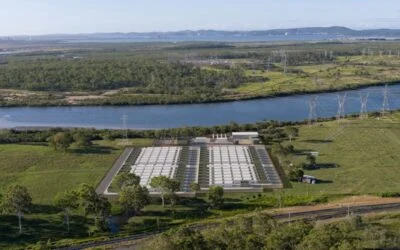
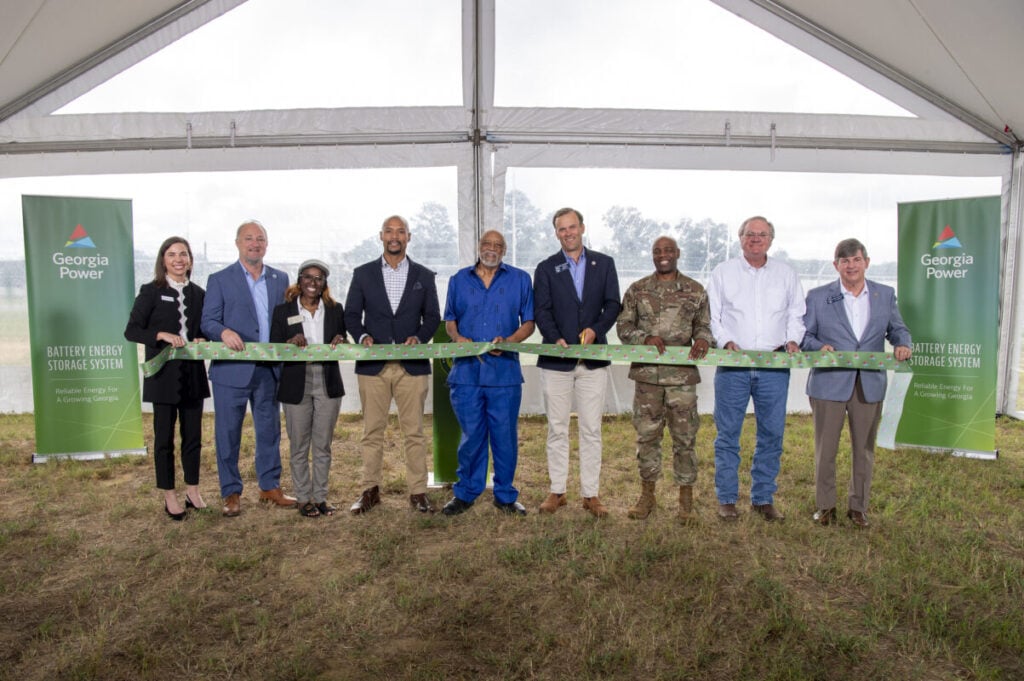
Utility Georgia Power has brought its 128MW Robins Battery Facility into commercial operation near Warner Robins, Georgia.
Announced 15 September, the facility can deliver stored energy to the grid for up to four hours (512MWh) and is paired with the nearby Robins Solar Facility.
State and local officials, alongside leaders from Robins Air Force Base, attended a ceremony to mark the commercial operation of the project. Attendees included Robins Air Force Base Col. Johari Hemphill, Senator Larry Walker, Senator David Lucas, Senator Steven McNeel, Representative Anissa Jones, Central Georgia Joint Development Authority Chairman James Vaughn, and Macon-Bibb County Mayor Lester Miller.
Burns & McDonnell served as the engineering, procurement and construction (EPC) contractor for the Robins Battery Facility and delivered the project on schedule.
The Robins BESS is one of four BESS projects approved in the 2023 Integrated Resource Plan (IRP) update by the Georgia Public Service Commission (PSC). Georgia Power has completed battery storage facilities in Cherokee and Lowndes counties totalling 579.5MW and is nearing completion of a 57.5MW facility in Floyd County.
The PSC has also approved nine additional BESS facilities across eight sites statewide, adding more than 3,000MW of energy storage capacity. Sites were selected based on their ability to efficiently support grid operations, including proximity to existing infrastructure, substations and company-owned properties.
Planned facilities include locations at Plants Bowen, Hammond, McIntosh, Wansley and Yates, as well as stand-alone sites in Hall and McDuffie counties.
Georgia Power has also received approval for two solar facilities paired with battery storage, providing a combined 350MW of generating capacity. The new solar-plus-storage facilities will be located in Laurens and Mitchell counties.
The project is part of Georgia Power’s broader strategy to add cost-effective energy resources through the PSC’s IRP process.
In July, Georgia Power completed construction of the 49.5MW/198MWh Moody Battery Facility, outside of Valdosta, adjacent to the Moody Air Force Base.