Energy-Storage.news talks data centres, domestic content and US market strategy with LG Energy Solution Vertech chief product officer Tristan Doherty, at RE+ 2026.
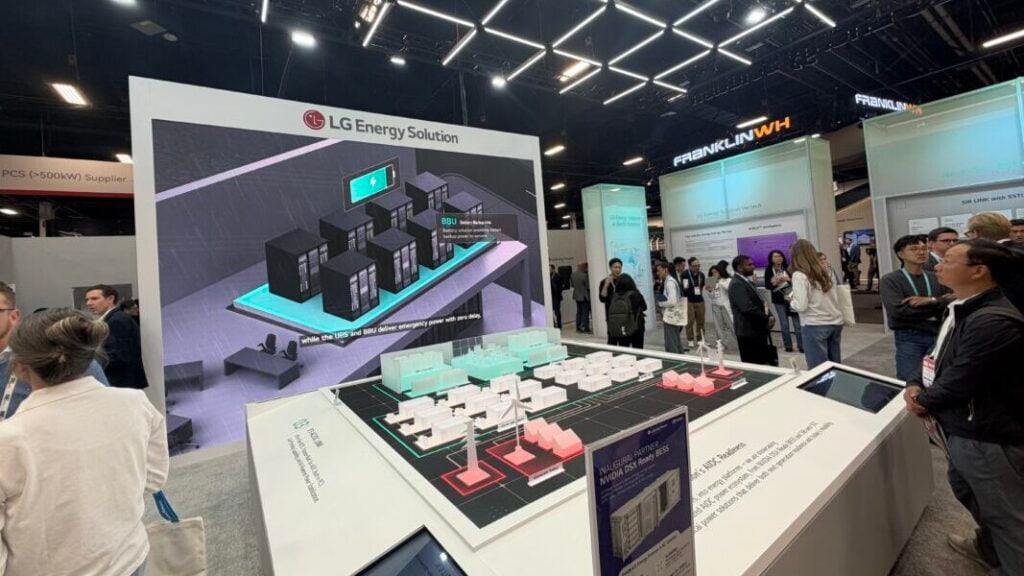
South Korean battery giant LG Energy Solution (LG ES) is showcasing its integrated power infrastructure for AI data centres at RE+ 2026 in Las Vegas, Nevada, US.
The AI data centre (AIDC) solutions are being shown alongside its battery energy storage systems (BESS) and other technologies, including a zone for its US-based system integrator, LG ES Vertech.
Data centres have been a popular topic at RE+, with experts examining their role to date and how public sentiment has shifted following the US Midterm elections, leaving it unclear how state and federal policy could affect data centre development and, in turn, BESS and renewables projects.
Try Premium for just $1
- Full premium access for the first month at only $1
- Converts to an annual rate after 30 days unless cancelled
- Cancel anytime during the trial period
Premium Benefits
- Expert industry analysis and interviews
- Digital access to PV Tech Power journal
- Exclusive event discounts
Or get the full Premium subscription right away
Or continue reading this article for free
Doherty said: “We did an internal analysis, sorting through the election results to identify the new trend. Maybe it’s too much reading into the tea leaves, but I feel as though the resistance is not everywhere. In many places, resistance to data centres stems from communities not knowing what the projects will look like, and we just want to make sure it works for everyone.”
From EV capacity to ESS
Much of LG ES Vertech’s growth has come from battery production capacity freed up on the EV side of LG ES’ business. “We’re beneficiaries of how the EV side of the house has evolved and how it’s freed up a lot of capacity that’s then been available for energy storage,” Doherty said.
He noted that plans expanded from an initial 1GWh to a 4GWh line in Arizona, then 16GWh in Michigan, and now target 70GWh across North America by the end of next year.
He attributed the growth to domestic-content policy and supply-chain uncertainty: “It started off by driving a lot of the larger, more risk-conscious developers and utilities to our product, and now we’re just seeing everyone is sort of coming in the door.”
Certainty versus policy detail
Doherty said the broader domestic-supply trend gives developers confidence to make long-term investment decisions, calling it “a bipartisan macro trend” unaffected by changes in government.
However, he noted that shifting policy details remain a challenge, particularly as project sizes have grown from tens of millions to billions of dollars, requiring greater financing certainty.
FEOC rules and data centres
On foreign entity of concern (FEOC) restrictions, Doherty was positive: “It’s a willful signal to the market that as a country, we want to build a domestic supply chain. We’re doing what the current government and current policy is asking us to do.”
He pointed to US battery manufacturing growing from near zero to over 100GWh in roughly two years as evidence of the policy’s impact, while acknowledging that developers want consistent, predictable rules.
Doherty described grid capacity as largely underused outside peak demand: “The entire grid is designed essentially for four peak hours, plus 20% extra. On average, we’re using less than 50% of the full capacity.”
He said data centres could help absorb that unused capacity, improving overall affordability, and cited utility DTE Energy’s two-year customer rate freeze, achieved through smart grid planning for data centre load growth, as a model. He also stressed that broader industrial and electrification demand continues “with or without data centres.”
Software layer
Doherty also highlighted LG ES’ Aeros Intelligence software platform as part of its shift from cell supplier to full power-plant and intelligence provider, aimed at maximising the value extracted from increasingly costly battery assets: “We want to make sure we use every ounce of value out of those assets.”