
Energy-Storage.news Premium speaks with Rob Greskowiak, chief commercial officer at Lightshift Energy, about the company’s distributed storage approach to the demand of PJM.
US storage developer-operator Lightshift Energy announced on 16 April, a five-project, distribution-scale battery storage portfolio across Virginia, US.
The company says the battery energy storage system (BESS) portfolio represents a fundamental shift in how energy storage can address PJM’s mounting transmission cost crisis without waiting years for interconnection approvals.
The projects, developed with nonprofit Blue Ridge Power Agency (BRPA), will serve three rural utilities, Central Virginia Electric Cooperative, Craig-Botetourt Cooperative, and the City of Salem, that are grappling with year-over-year increases in transmission and distribution costs within utilities Dominion Energy and American Electric Power zones.
Try Premium for just $1
- Full premium access for the first month at only $1
- Converts to an annual rate after 30 days unless cancelled
- Cancel anytime during the trial period
Premium Benefits
- Expert industry analysis and interviews
- Digital access to PV Tech Power journal
- Exclusive event discounts
Or get the full Premium subscription right away
Or continue reading this article for free
Lightshift’s announcement comes as PJM faces approximately “US$11 billion in potential transmission projects entering the rate base over the next several years”, costs that ultimately flow down to utilities and their customers. For rural, lower-income communities already struggling with affordability, those escalating charges have created an urgent demand for alternatives.
The average Virginia resident could pay an additional US$5,200 in electricity costs over the next ten years without new renewable energy deployment, according to a recent American Clean Power Association (ACP) analysis.
The state, located within PJM’s service territory, is experiencing surging energy demand driven largely by data centre growth. Governor Abigail Spanberger has also taken steps to address this issue, earlier this month, signing legislation authorising the state to target 20.78GW of energy storage.
“I’ve been in the energy industry now for about 17, 18 years, and I’ve never seen folks trying to hit a pause on economic development, especially at this scale,” says Greskowiak, referring to growing resistance to data centre development driven by electricity price concerns. “That’s why you’re seeing governors in Pennsylvania and other states saying, ‘We’ve got to figure out how to put a cap on some of these costs, because it’s getting out of control.'”
The distribution-scale advantage
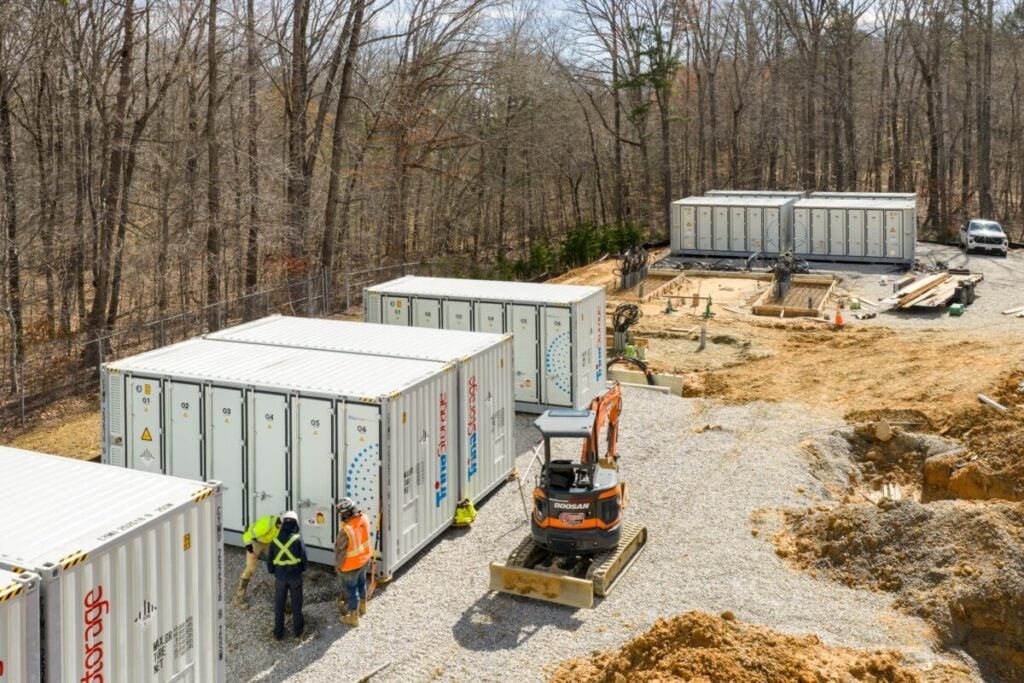
Rather than pursuing 200MW-500MW transmission-scale projects that require years of PJM interconnection studies and tens of millions in upgrade costs, the company is deploying smaller batteries, typically 20MW or less, at existing distribution substations.
“The thesis has always been bigger is better,” Greskowiak explains. “If I’m going to go build a project and mobilise a construction crew and get an interconnect position, I’d much rather build 500MW than 50MW for economies of scale purposes. While I think that’s true for a lot of generating resources, I think battery storage specifically as an asset class has bucked that trend.”
In this case, Greskowiak and LighShift argue that the economics work because of battery storage’s unique characteristics. A 20MW solar farm requires approximately 100-150 acres of land, while a 20MW battery system occupies less than a third of an acre. That difference in footprint can mean lower land costs, faster permitting, and reduced community opposition.
More importantly, by siting projects on the distribution system rather than the transmission grid, Lightshift can avoid the bottleneck that has clogged PJM’s interconnection queue.
“A lot of these local utilities, whether it’s a cooperative, municipality, etc., they’re in charge of their own grid,” Greskowiak says. “If the local municipality can study our projects that are on their system, not on the PJM system, and they can say, ‘Listen, all of the energy that’s going to be used and deployed is going to stay within our little community, and we’re not going to send it up to PJM’s wires,’ as long as they can demonstrate that to PJM, PJM doesn’t need to study it.”
Under this framework, projects should be able to move from concept to commercial operation in 12-24 months, compared to five to ten years for transmission-scale assets navigating PJM’s queue.
Peak shaving
The primary value proposition for Lightshift’s rural utility customers is peak shaving, using batteries to reduce their maximum demand during the hours when transmission charges are calculated.
“When we peak shave for them, what we’re doing is we’re saying, ‘Hey, we will essentially make you disappear off the grid for those hours to mitigate some of those costs that you’re going to have to pay to the larger transmission owner,'” Greskowiak explains. “So, we’re able to increase resilience in local communities and help folks save money on day one.”
By reducing peak demand, utilities can lower their transmission charges while improving local reliability. The batteries are sited at existing substations that are already built but underutilised.
For the BRPA’s members, this addresses an immediate affordability crisis. As rural cooperatives serving lower-income communities, they face the same transmission cost increases as larger utilities but with fewer resources to absorb them.
“We’re focused on the rural areas, and we want to maintain affordability,” Greskowiak highlights. “That’s point number one for us, making sure that this affordability conversation stays intact.”
Beyond cost savings, Lightshift argues that distributed storage offers reliability advantages over centralised deployment.
“If we want to build 200MW of new capacity, we can go build one centrally located battery in the middle of the state.”
Greskowiak continues, “From an accounting perspective, if you’re looking for resource adequacy or capacity, it counts just the same as a bunch of small ones. The problem is, if a line goes out in front of that 200MW project, now it doesn’t get to go anywhere. It’s stuck there.”
By contrast, ten 20MW batteries distributed across different substations spread both the reliability benefits and the risk. If one transmission line fails, 180MW of capacity remains available to the grid.
That distributed approach also helps to mitigate stranded asset risk in a time of uncertain load growth, particularly around data centres.
“If we build this one central thing that is giving unique benefits to one area of the grid at 200MW— if that data centre load goes away, that area is still going to benefit, but it’s going to have an outsized impact on that community,” Greskowiak says. “What I think would be better is if you have distributed assets that are bolstering the grid across the state and not just concentrated in one area.”
The data centre connection
Lightshift’s distributed model aligns with emerging thinking about data centre deployment. Greskowiak explains that instead of concentrating hundreds of MWs of load in hyperscale facilities, companies including EPRI and NVIDIA have begun exploring 5MW-20MW data centres located at distribution substations to reduce latency for applications requiring real-time processing.
“If you’re going to put a 5MW data centre at some Metro Detroit substation, let us go put a battery right next to it to do two things: one, manage peaks, and two, bolster reliability for that local community,” Greskowiak notes. “So I think there’s a really good third rail conversation going on here of not only how do we rethink energy, but also how do we rethink data centres.”
The approach addresses the growing backlash against hyperscale data center development, which has faced “almost unprecedented NIMBYism in recent months as communities realise the facilities bring fewer jobs than expected while driving up electricity costs for existing residents.”
By co-locating smaller data centers with batteries at the distribution level, developers can manage peak demand locally, potentially deferring the need for transmission upgrades that would otherwise be required.
Avoiding the interconnection cost trap
A key advantage of Lightshift’s model is eliminating the interconnection upgrade costs that have made transmission-scale projects increasingly expensive.
“We’re not paying US$5 million – US$20 million interconnection upgrade costs, and we’re not trying to go find these very expensive main power transformers that cost US$3 million – US$6 million apiece,” Greskowiak says. “We’re taking all that money off of the table from what we build, so we can afford to be competitive.”
“Everybody always thought bigger is better, and that’s how you get cheaper projects,” Greskowiak notes. “This is a different moment, and I really do think that the more announcements that we make, like Blue Ridge, like our NWAC portfolio in Massachusetts, the more that message gets out that this is not only cost competitive, but sometimes even cheaper than transmission, I think people are going to really lean into this concept.”
A replicable model?
Lightshift’s approach raises questions about whether distributed storage can scale to address PJM’s broader challenges. The company has already deployed similar projects in Massachusetts and is pursuing additional opportunities across the region.
The model appears particularly well-suited to rural cooperatives and municipal utilities that control their own distribution systems and face acute affordability pressures. Whether larger investor-owned utilities will embrace the same approach remains to be seen, though the economic logic appears compelling given current transmission costs and queue timelines.
For now, Lightshift is focused on demonstrating that distribution-scale storage can deliver measurable benefits quickly, a stark contrast to the years-long wait for transmission-scale projects to clear PJM’s interconnection process.
“While people are waiting for those large assets to get built and to get studied, we can go in and leverage the existing infrastructure that’s already out there and build things in 12 to 24 months,” Greskowiak says. “I think there’s a whole host of reasons why the distribution system is kind of getting its moment right now.”
