
As data centre demand surges, utilities and developers are turning to distributed energy resources (DERs) to ease grid strain, but home energy system design will determine how quickly and reliably they can be mobilised.
Speaking with Energy-Storage.news, Daniel Fletcher, chief business officer of dcbel, outlined why the method used to connect electric vehicles (EVs) to the grid, and the speed at which flexible capacity can be brought online, are becoming central questions for virtual power plant (VPP) development.
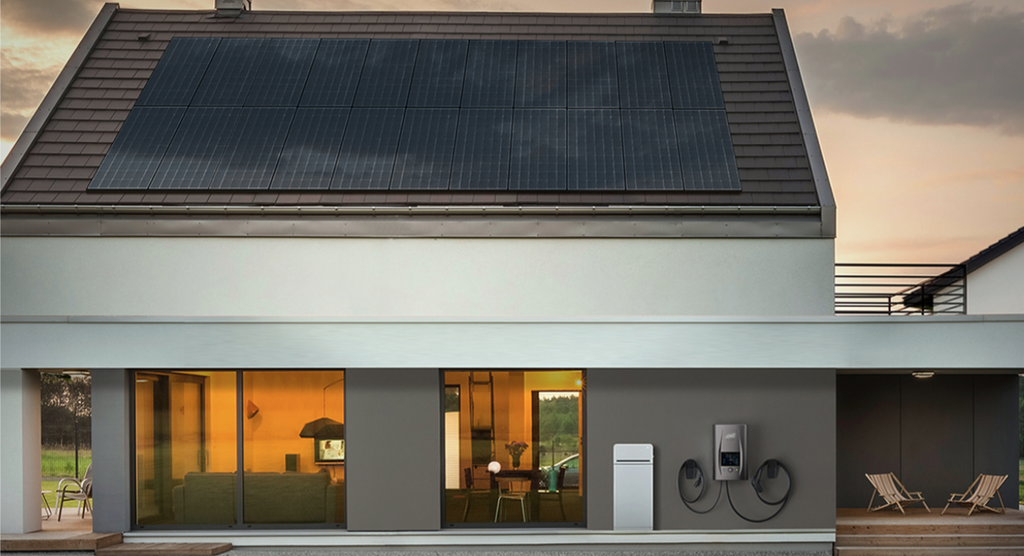
Dcbel created the Ara Home Energy Station, a hardware-and-software solution that can integrate solar PV, home battery energy storage systems (BESS), and EV charging into an automated system.
In 2023, Swedish automaker Volvo Cars made an undisclosed investment in the company to accelerate dcbel’s R&D and commercialisation activities, with a focus on the dcbel r16 Home Energy Station.
Try Premium for just $1
- Full premium access for the first month at only $1
- Converts to an annual rate after 30 days unless cancelled
- Cancel anytime during the trial period
Premium Benefits
- Expert industry analysis and interviews
- Digital access to PV Tech Power journal
- Exclusive event discounts
Or get the full Premium subscription right away
Or continue reading this article for free
DC vs AC bidirectional charging
One of the more technical but consequential issues Fletcher raised was the choice between DC and AC bidirectional EV charging. Most home charging today uses AC, so EVs need an onboard converter to transform AC power into the DC their batteries use. This process causes energy losses during both charging and discharging.
“If you’re charging the car straight in DC from home, then the battery is DC, and so you have the much lower losses,” Fletcher said. “So much more of the energy that you send to the car will get to the battery, which over time means you’re getting more value for money on your home charge by sending it DC.”
Fletcher noted that an established regulatory pathway for bidirectional DC charging already exists under UL 1741 Supplement B.
However, UL 1741 SC, the equivalent standard for bidirectional AC charging, does not yet offer a comparable certification route, aside from a few case-by-case exceptions that companies are testing.
“For the time being, there isn’t a pathway for AC feed-to-grid that is available that you can use from UL,” he said.
He added that the industry has not reached a consensus on which approach will prevail. “What you gain in ease of installation by being able to install into an AC world where people are familiar with that panel and electricians are able to work with it, you can maybe lose over time in operational efficiency, wear and tear. The jury’s still out,” Fletcher said.
Time-to-energy and data centres
Fletcher tied the growing urgency around VPPs and DERs directly to the pace of data centre development.
“Because the data centres have such large loads and they want to move quickly, the time that it takes to get new energy onto the network is a really important metric for where they’re going to put the resources,” he said.
He argued that this is driving interest in smarter, grid-edge demand management that goes beyond traditional demand response.
Fletcher said that because grid infrastructure is typically built to withstand extreme peak demand, average grid utilisation is “under 50% overall for the grid.” He added that coordinating intelligent load shifting to lower peak demand could reduce the investment required to build out peak capacity.
Building on Fletcher’s point, consultancy firm The Brattle Group recently published a report for the NGO Pew Charitable Trusts. It estimates that removing barriers to DERs could save the US power system US$614 billion through 2050. The report also examines how DERs located near electricity users can help meet rising demand from residential, commercial, and industrial customers.
A marketplace model for VPP enrolment
Fletcher identified predictability of participation as a long-standing weakness of DER and VPP programmes. “One of the questions is always, when the event happens, will the resources be there? What rate of participation will there be?” he said.
He argued that permanently connected home energy systems, which can autonomously negotiate and execute trades and generate verifiable energy-flow data, can substantially improve predictability. Flexibility still remains part of the model, since customers can always opt out of discharging their vehicles.
To navigate the fragmented US utility landscape—with nearly 3,300 individual utilities—Fletcher said dcbel designed its system like an app store, letting households enrol in different third-party aggregator or utility programmes based on where they live.
“We decided we had to build in a private app store, like the app store you have on your iPhone, where you can download and use different programmes from different providers of your choice,” Fletcher said.
Once a household enrols in a programme, he explained, “there’s a method for the dcbel to hand over the controls of the device for the things that pertain to that programme, with the user consent and a kind of dual-authenticated process.”
Notably, Fletcher explained how the commercial landscape for DERs is shifting. He cited large-scale capacity deals between aggregators and hyperscale technology companies, “referring to Google and Voltus there with their announcements,” as evidence that distributed, residential-scale resources are increasingly viewed as a readily available solution to large-scale demand problems.
“Our bet is still that the lion’s share of the upside from these things should go to the people who own the assets. So, it’s your house, your car, your battery, your solar,” Fletcher said.
“But we’ll see all kinds of different offers for how those things are paid for and brought quickly into the home, and ours will be among them, offered with different partners.”
