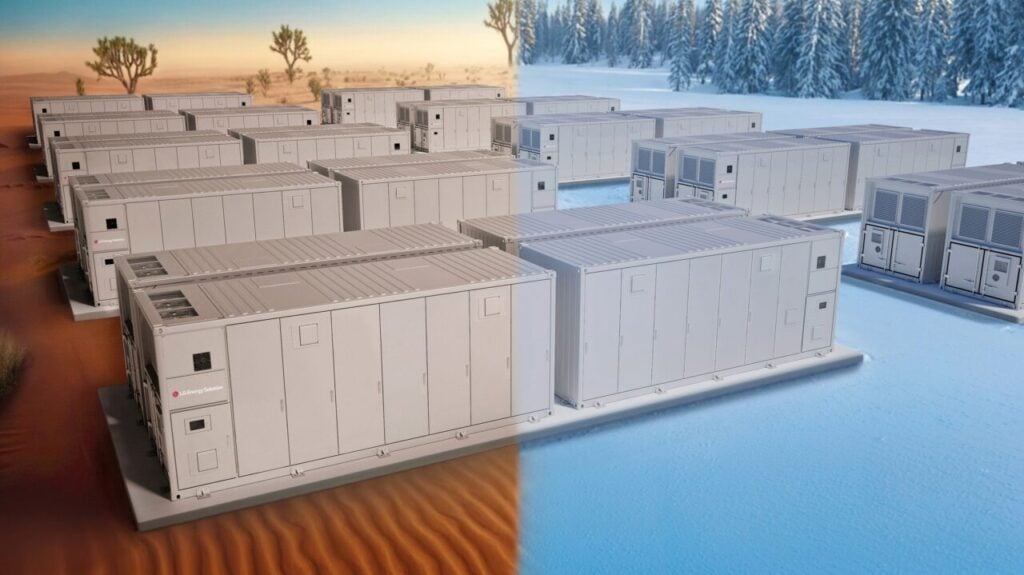
LG Energy Solution (LG ES) saw 28% quarter-on-quarter growth in revenue in Q3 2026, with “significant energy storage system (ESS) shipment growth” among the main drivers.
The South Korea-headquartered battery manufacturer reported its third-quarter results and held an earnings call with analysts yesterday. Revenue for the three months was KRW9.6 trillion (US$7.2 billion), versus KRW7.6 trillion in Q2 2026. Operating profit was KRW756 billion, with an operating profit margin of 7.8%, which was a major jump from the 1.5% operating profit margin reported in the previous quarter.
Energy storage system (ESS) shipments increased by more than 60% from the previous quarter, while automotive revenue growth was in the double-digit percentage range.
Korea Exchange-listed (KXE) LG ES does not currently break out figures for its business segments including the split between components such as cells and complete systems in the ESS business. The announcement did note that the quarter’s “strong” performance was driven largely by new orders in the ESS segment and by extensions and expansions of orders from existing customers in the electric vehicle (EV) segment.
Try Premium for just $1
- Full premium access for the first month at only $1
- Converts to an annual rate after 30 days unless cancelled
- Cancel anytime during the trial period
Premium Benefits
- Expert industry analysis and interviews
- Digital access to PV Tech Power journal
- Exclusive event discounts
Or get the full Premium subscription right away
Or continue reading this article for free
The company expects to see further growth of about 40% in ESS shipments in Q4 2026 while its ESS order backlog stood at 160GWh at the end of the reported period. The company will expand its ESS production capacity in North America to more than 70GWh by the end of 2027, it said.
Operational results included the first orders booked from customers developing AI data centres (AIDCs), while LG ES’s battery energy storage system (BESS) solutions are among the first three to qualify under an Nvidia quality assurance programme for ‘AI Factories’ (i.e., AIDCs). The latter, executives said, was based on “our capabilities for high-capacity lithium iron phosphate (LFP) cells and advanced power conversion systems (PCS).”
Since the Q3 results included some one-off, nonrecurring revenue, LG ES expects a “slight decline” in profitability in Q4. Company management did not offer a 2027 outlook on an earnings call to explain results, although executives said growth is expected across ESS, selected automotive, and cylindrical battery product sales.
LG ES is making “continuous ramp-ups” in production at various sites globally, which executives said is “very important”, and efforts will continue.
However, a KRW987.2 billion non-operating loss was reported for the July-September period, due to valuation losses on derivatives related to foreign currency bonds, interest expenses, and asset impairment on small IT pouch batteries, resulting in a net loss of KRW296.9 billion for the quarter.
ESS in US, EV in Europe and ‘continuous global ramp-ups’
As with fellow Korean battery makers Samsung SDI, which just reported its Q3 financials a few days ago, and SK On, LG ES targets the US BESS market through repurposing EV battery cell production lines to meet demand for stationary energy storage.
Of the three, and of other companies pursuing similar strategies such as Ford, LG ES is thought to have the biggest early-mover advantage, retooling existing lines at its Holland, Michigan, plant to add 17GWh of lithium iron phosphate (LFP) cell production for BESS customers by the end of last year.
It is also adding fresh ESS cell production capacity at new US and Canadian factories that were originally earmarked to make EV cells. The company’s joint venture with General Motors (GM) began mass production of LFP cells in July, and another automaker JV, with Honda, which opened its factory in Ohio this summer, is expected to start full operations in Q4 2026.
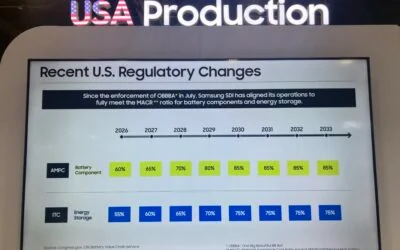
Manufacturing in the US means both production sites and customer projects remain eligible for the country’s production tax credit (PTC) and investment tax credit (ITC) incentives by decoupling the supply chain from prohibited foreign entity (PFE) companies under the One, Big, Beautiful Bill Act’s (OBBA’s) foreign entity of concern (FEOC) rules applicable to Chinese battery imports.
It also mitigates US import tariffs and the recent executive orders banning foreign-produced inverters and bulk power equipment, although given today’s US midterm election results, the policy space could be about to change.
In the company’s EV business, LG ES secured a “stable revenue base for mid- to low-price solutions” in Europe’s EV market with orders for next-generation high-voltage mid-nickel products. LG ES sees European trade and industrial policy also moving towards more strongly favouring domestic content, and company auto executive on the call said, “for key materials, which would include batteries, we do think that the local production capabilities will become more important in the future from the European OEMs,” meaning non-Chinese suppliers such as LG ES.
Upstream, LG ES strengthened partnerships with existing LFP cathode suppliers while signing purchase orders with new, non-PFE suppliers. Raw material deals were also signed with North American suppliers in the US and Canada.