
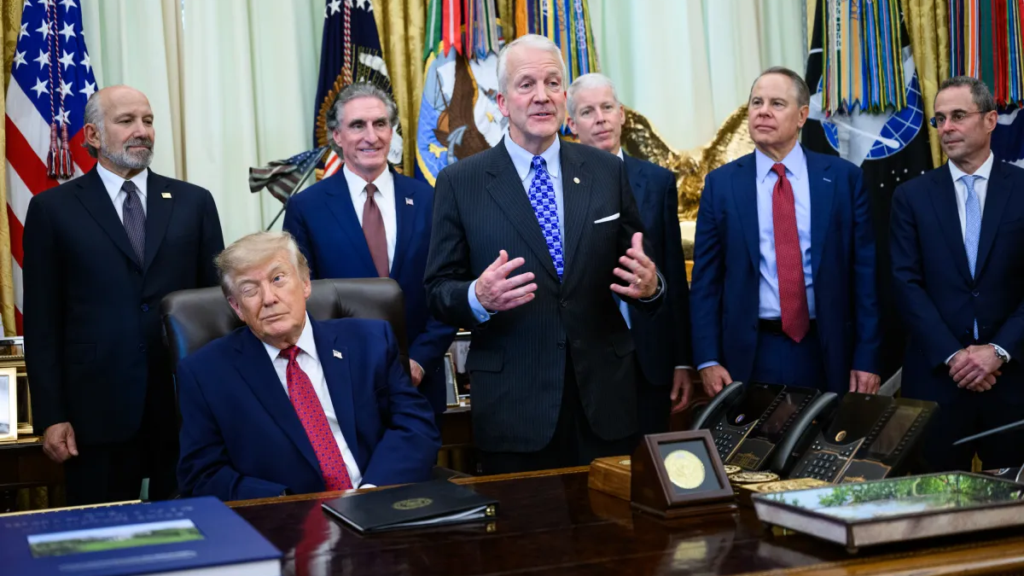
US President Donald Trump’s 26 August emergency executive order banning imports of certain foreign-made power equipment has prompted widespread public comment and private concern across the energy storage industry.
Sources speaking with Energy-Storage.news Premium, on condition of anonymity, described significant operational uncertainty and a united industry position: regulation should be based on technical risk, not country of origin.
What the executive order does
Trump signed the emergency measure on 26 August, declaring a “national emergency” over what he described as foreign actors “increasingly creating and exploiting vulnerabilities in the United States bulk-power system.”
The order targets grid-connected inverters, transformers, and battery energy storage systems (BESS) that interface with transmission lines rated at 69kV or higher, excluding distributed energy resources (DERs) and local distribution infrastructure.
Try Premium for just $1
- Full premium access for the first month at only $1
- Converts to an annual rate after 30 days unless cancelled
- Cancel anytime during the trial period
Premium Benefits
- Expert industry analysis and interviews
- Digital access to PV Tech Power journal
- Exclusive event discounts
Or get the full Premium subscription right away
Or continue reading this article for free
The restriction applies to equipment originating from, or supplied by entities owned, controlled, or directed by, any of 24 countries currently subject to US arms embargoes and sanctions — most significantly China — under a framework similar to existing Foreign Entity of Concern (FEOC) rules.
The order is not yet in effect; it will apply to transactions “initiated” after 26 August, and the Department of Energy (DOE) has 120 days to publish implementing rules.
Transactions will not actually be barred until the DOE determines specific equipment “poses an unacceptable risk” on cybersecurity, sabotage, or remote-access grounds.
Law firm Norton Rose Fulbright has suggested that the DOE could pursue a range of implementation approaches, from a whitelist of pre-qualified vendors and equipment to a licensing regime, or more aggressive steps, such as ordering that existing in-service equipment be isolated, monitored, or removed.
The order follows a narrower FCC ruling in late July that restricts foreign-made connected power inverters, a move that has already created confusion across the BESS and solar sectors.
How this lands with industry sources
An industry source directly involved in the public comment process said the order’s single biggest challenge has been its lack of specificity.
“It is quite far-reaching and broad. It doesn’t really provide a lot of exact details,” the source said, noting that companies are struggling to determine how far back into existing projects the order’s requirements might reach, and how wide a range of equipment — beyond inverters, into transformers and other electrical components — could ultimately be covered.
A related concern, the source said, is whether DOE’s forthcoming rules will introduce entirely new technical standards rather than build on the existing framework.
“We’re all really comfortable with the standards that are used now. A lot of [the public comments] were advocating for a continuation of the North American Electric Reliability Corporation (NERC) Critical Infrastructure Protection (CIP) standards,” the source said, warning that new, conflicting standards could force a fresh round of project re-evaluation and cause significant delays.
“We welcome a strong cybersecurity regime, but we also don’t want to essentially reinvent the wheel.”
A Washington-based government affairs consultant working on the issue said the order prompted an immediate question about its underlying intent.
“The first question you ask is: Is this really about standards, or is this about something else? Are we just trying to impede imports of products from certain countries, or are we really trying to make the grid secure here?”
If the goal is genuine cybersecurity, the consultant said, “we’re fully aligned with the White House, and I think a lot of other organisations that have submitted comments are aligned as well.”
The consultant cited polling from the Rainey Centre, a conservative-leaning think tank, showing that 69% of voters across party lines believe equipment testing and security performance matter more than where hardware is manufactured — a data point the consultant suggested should inform the DOE’s approach to implementation.
Pushing back on country-of-origin logic
Both sources rejected the idea that recent cybersecurity disclosures involving foreign-made monitoring equipment justify blanket geographic restrictions.
The government affairs consultant argued more broadly against using isolated incidents to justify origin-based bans. “Show me a company that hasn’t had a cyber breach in the last two years,” the consultant said.
“There is no system in the world that has zero vulnerabilities. The issue is what do you do when one is found?”
The consultant pointed to domestic manufacturing capacity constraints — echoing concerns raised by supply companies about components such as high-voltage bushings — as a reason why blanket restrictions could do more harm than good.
“It’s the wrong policy to start banning companies or equipment based on geography. We really do undermine everything else we’re trying to achieve here: affordability, AI deployment, manufacturing.”
Organic consensus
Both sources described the roughly 80-plus public comments submitted on the order as showing a striking, largely unprompted alignment across utilities, manufacturers, trade associations, and independent experts, favouring standards- and risk-based evaluation over country-of-origin restrictions.
“These companies all came together organically, because that’s what they believe,” the consultant said, adding that trade associations appear to be reflecting member consensus rather than directing it.
One source said companies facing near-term construction or shipment deadlines are largely managing the uncertainty by seeking extensions rather than making long-term decisions, pending the DOE’s guidance.
