The US energy storage industry broke deployment records in Q2 2026 in gigawatt-hour (GWh) terms, underpinned by growth in the utility-scale segment.
That’s according to the Q3 2026 edition of the US Energy Storage Market Outlook (ESMO) report, published today by the Solar Energy Industries Association (SEIA) and Benchmark Mineral Intelligence.
The quarterly report finds that 6.7GW/20.2GWh of new battery energy storage systems (BESS) came online between March and the end of June, including utility-scale front-of-the-meter (FTM) and distributed behind-the-meter (BTM) systems.
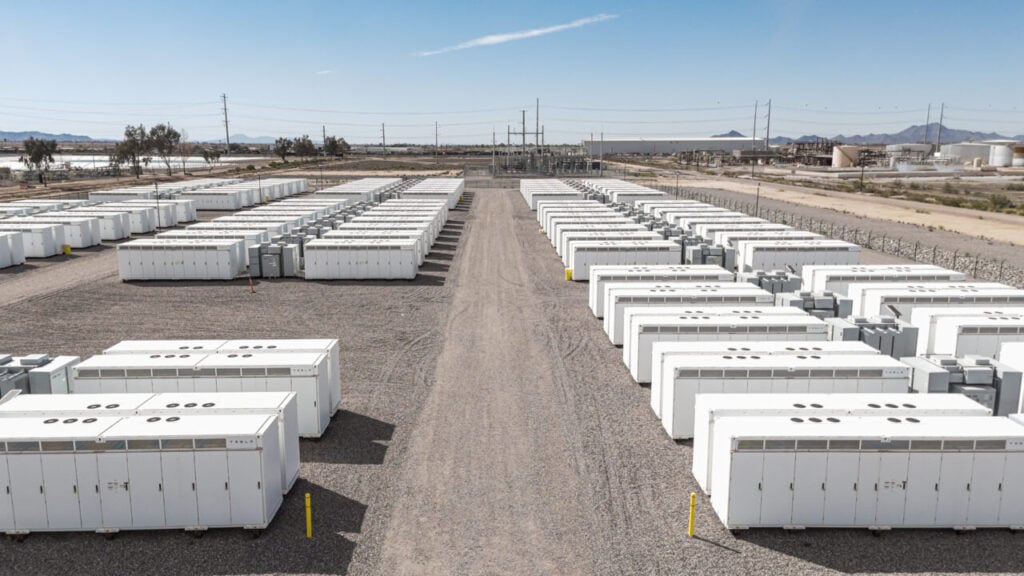
Of this figure, 17.9GWh comprised utility-scale projects, including seven individual projects in Arizona, California and Utah, each with a capacity of 1,000MWh or more. More than half (56%) of new utility-scale BESS capacity was standalone, the remaining 44% paired with solar PV.
Try Premium for just $1
- Full premium access for the first month at only $1
- Converts to an annual rate after 30 days unless cancelled
- Cancel anytime during the trial period
Premium Benefits
- Expert industry analysis and interviews
- Digital access to PV Tech Power journal
- Exclusive event discounts
Or get the full Premium subscription right away
Or continue reading this article for free
Total deployments marked a 104% jump from the previous quarter, when the Q2 2026 report tallied 9.7GWh of new capacity added, including 7.8GWh of utility-scale BESS. At the distributed end, there was 657MWh of new residential capacity added and 1.8GWh of commercial and industrial (C&I) projects brought online in the quarter.
Adding up the first half of the year’s numbers, nearly 10.3GW/31GWh entered operation at all scales, up 23% in GWh from H1 2025 and again, utility-scale comprised the bulk, with 8.1GW/26GWh of deployments.
Residential energy storage has fundamental underlying drivers for its adoption as homeowners seek to control rising electricity costs, offset the falling value of net metering and protect themselves from blackouts. There may also be market drivers toward increased virtual power plant (VPP) enrolment, according to the report.
Although annual residential installs have roughly doubled since 2023, there has been a sharp year-on-year drop following the Trump administration’s elimination of the 25D residential clean energy credit.
The C&I segment is conversely enjoying growing demand driven by the rapid expansion of data centres and the prominence of battery storage in securing onsite power without increasing grid connection.
Bulk of battery storage deployed in red states during record-breaking Q2
SEIA noted that almost three-quarters of the new storage capacity deployed in Q2 is in US states that Trump won in the 2024 election, with the bulk in Arizona, Texas and Utah.
The trade association said that US energy storage capacity has almost doubled in the first 18 months of the second Trump administration, from 88GWh to 165GWh, an even more striking fact than the Q2 record.
According to ESMO, the US policy landscape for BESS so far in 2026 has been characterised by a “balancing act” of domestic manufacturing ambitions, the immediate needs of the electricity grid and energy security concerns.
At the state level, Illinois passed its first act to introduce a 3GW by 2030 energy storage target, Virginia expanded its target to more than 20GW and included long-duration energy storage (LDES) for the first time and Nebraska advanced a framework for its first BESS developments.
At the federal policy level, the SEIA and Benchmark analysts highlighted Section 301 import tariff increases and the saga over International Emergency Economic Powers Act (IEEPA) tariff imposition and the recent Federal Communications Commission (FCC ban on foreign inverters as policy dynamics to watch.
In federal regulation, the industry should keep a close eye on the show cause orders issued in June by the Federal Energy Regulatory Commission (FERC) to all six regional grid operators under its jurisdiction.
FERC asked the regional transmission operator (RTO) and independent system operator (ISO) companies and transmission infrastructure owners to explain how large loads, including data centres and manufacturing operations, will connect to their grids without impacting ratepayer costs and quality of service.
Forecast broadly in line with Wood Mackenzie’s US Energy Storage Market Monitor
SEIA and Benchmark released the first edition of the ESMO report in February, offering a retrospective view of 2025 market activity. 2025 installations surpassed 28GW/57GWh, a 29% increase over 2024 numbers. Utility-scale also dominated last year, with 50GWh of additions concentrated largely in California, Texas and Arizona.
In that kickoff edition, ESMO’s authors forecast 70GWh of US BESS deployments in 2026, in a market it predicted would surpass 47GW/110GWh in annual installations and close to 500GWh of cumulative capacity by 2030.
The analysts now believe demand for energy storage is outpacing previous expectations and have upped their 2030 energy storage forecast to 683GWh, an increase of 11.5%.
The launch of ESMO brought to the market a rival to the quarterly US Energy Storage Market Monitor produced by Wood Mackenzie Power & Renewables. The Monitor is probably the industry’s longest-running comprehensive overview of the US market, having been part of the GTM Research portfolio before Wood Mackenzie acquired parent company GreenTech Media.
Wood Mackenzie’s 2025 figures, released in March, came in slightly lower than ESMO’s, finding 18.9GWh/51GWh of deployments in all segments. In the Q2 2026 US Energy Storage Market Monitor, published in June, Wood Mackenzie forecasted that the US would reach 200GW/655GWh of cumulative energy storage installations by 2031.
ESN Premium subscribers can read our monthly series of global BESS deployment statistics and highlights, based on data kindly provided by Benchmark Mineral Intelligence, starting with the most recent, which found that 18GWh of new battery storage went online in July, 70% of which was in China.