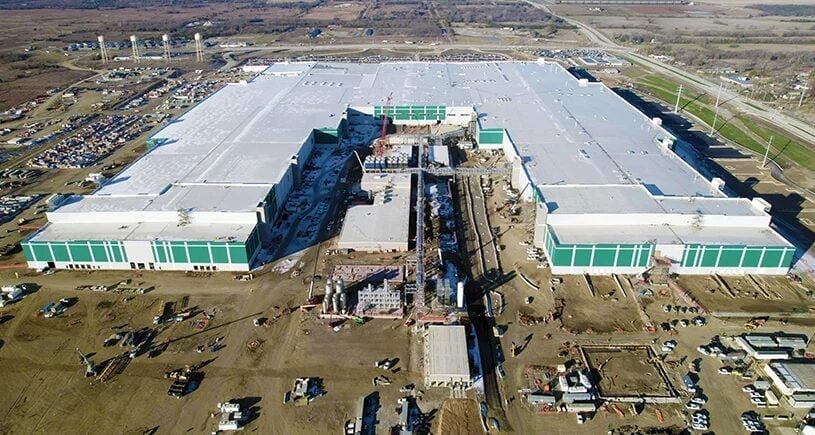
Japanese consumer electronics giant Panasonic intends to convert its electric vehicle (EV) battery cell manufacturing facility in Kansas, US, to produce batteries for data centre applications, beginning Q3 of 2029.
The plan was noted in an 8 June investor presentation from Panasonic Energy, detailing the company’s intentions to repurpose electric vehicle (EV) battery production lines in Japan for data centre applications, ramp up and convert its Kansas factory for data centre applications, and expand module plants in Mexico for data centre battery energy storage system (BESS) applications.
Panasonic also plans to allocate about JP¥350 billion (US$2.18 billion) to its Energy division, which supplies Tesla, as part of a broader US$3.12 billion investment in AI infrastructure spanning fiscal years 2026 through 2028.
The Kansas factory, located in De Soto, was opened on 14 July 2025, with Panasonic noting plans to establish an annual production capacity of approximately 32GWh.
Try Premium for just $1
- Full premium access for the first month at only $1
- Converts to an annual rate after 30 days unless cancelled
- Cancel anytime during the trial period
Premium Benefits
- Expert industry analysis and interviews
- Digital access to PV Tech Power journal
- Exclusive event discounts
Or get the full Premium subscription right away
Or continue reading this article for free
Panasonic has another EV battery production facility in the county, located in Sparks, Nevada. Together, the Nevada and Kansas factories would have produced approximately 73GWh annually.
The repurposing of the Kansas factory highlights a broader trend in the industry, developed from slower than expected EV adoption and the foreign entity of concern (FEOC) restrictions imposed by the ‘One Big Beautiful Bill Act’ (OBBBA).
Ultium Cells, the joint venture (JV) between General Motors and South Korea’s LG Energy Solution, is repurposing its Tennessee EV battery facility in Spring Hill to produce lithium iron phosphate (LFP) cells for ESS.
Samsung SDI and SK On have both expanded US manufacturing and established supply agreements with BESS integrators, while LG ES has converted EV production lines in Michigan into approximately 17GWh of BESS cell manufacturing capacity.
Recently, Ford Motor Company launched Ford Energy, the company’s energy storage-focused subsidiary.
This followed shortly after two major Chinese clean energy companies, Envision Energy and JinkoSolar, sold majority stakes in US manufacturing facilities.
Last year, a consultant, speaking anonymously with Energy-Storage.news, stated, “EV demand is going to decrease because of the removal of the EV consumer tax credit. The battery manufacturing capacity from those is now being repurposed to BESS. It’s not cheap to repurpose, but there’s a lot of sunk cost with a gigafactory, so it’s happening.”
In related news, battery and storage system maker A123 is collaborating with battery management system (BMS) developer Dukosi on a proof-of-concept (PoC) high-capacity BESS targeting North American markets.
The BESS solution combines A123’s 587Ah prismatic form factor LFP cells with Dukosi’s Cell Monitoring System (DKCMS), C-SynQ proprietary communications and a battery management system (BMS) designed by Nuvation Energy.