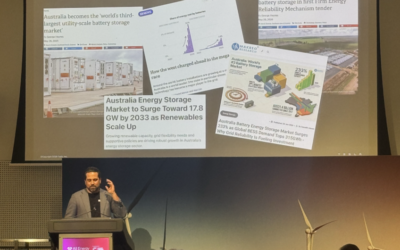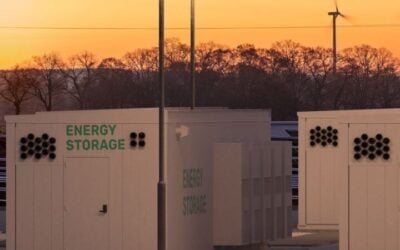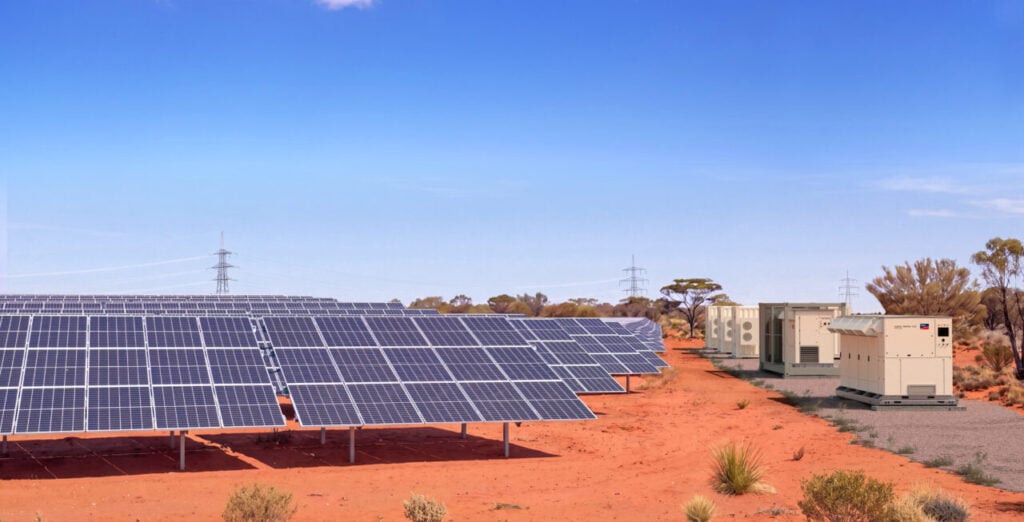
Germany-headquartered inverter manufacturer SMA has launched a grid-forming solar-plus-storage solution in Australia, unveiling it at the All-Energy Australia 2026 event in Melbourne this week.
SMA Australia, the company’s local subsidiary, announced on Tuesday (27 October) that the DC-coupled system extends grid-forming (GFM) capability across an integrated solar PV and BESS plant. Its initial markets for launch are Germany, Australia and the UK.
Most solar PV plants and BESS use grid-following inverters, which track the grid’s voltage and frequency. Grid-forming inverters set their own voltage and frequency references, responding to disturbances in a manner similar to spinning generators in coal and gas plants. That makes grid-forming capabilities key to the smooth operation of an electric system dominated by inverter-based renewable energy resources, such as wind and solar.
In a DC-coupled plant, the solar modules and the BESS share a single inverter connection on the direct-current side. When solar output exceeds the inverter’s capacity, the excess is “clipped” and lost. SMA said its system stores that energy for dispatch when demand or prices are higher.
Try Premium for just $1
- Full premium access for the first month at only $1
- Converts to an annual rate after 30 days unless cancelled
- Cancel anytime during the trial period
Premium Benefits
- Expert industry analysis and interviews
- Digital access to PV Tech Power journal
- Exclusive event discounts
Or get the full Premium subscription right away
Or continue reading this article for free
The solution combines power conversion equipment, plant controls and engineering support, which SMA said reduces the work of coordinating equipment and control systems from multiple suppliers. It uses silicon carbide semiconductors, with DC/DC conversion efficiency of up to 99.5%.
SMA’s Australian engineering team supports system configuration, grid modelling and compliance with local network requirements.
John Alexander, managing director of SMA Australia, said grid connection, project bankability and long-term asset performance were critical to Australia’s energy transition.
“Australia has some of the most demanding grid connection requirements in the world,” Alexander said.
“Developers need more than technology that performs well in isolation. They need integrated solutions designed for Australian conditions, backed by local engineering expertise and long-term support.”
He added that the next phase of the transition “will be measured by how many actually connect to the grid, perform reliably and deliver a return,” and that grid stability “goes directly to investment confidence and long-term project value.”
SMA said more than 10GW of its solar and BESS inverter capacity is connected to the Australian grid. This year, it has received approvals for more than 6GW of grid-forming BESS and hybrid projects in the National Electricity Market (NEM) under clause 5.3.4A of the National Electricity Rules, the process for agreeing a project’s technical performance standards.
Its grid-forming inverters are used at Origin Energy’s 300MW/650MWh Mortlake Battery in Victoria, which has 116 Sunny Central Storage inverters. The AU$400 million (US$260 million) project, with Fluence as main contractor, entered testing and commissioning at Origin’s Mortlake Power Station site in March.
SMA also supplied 38 inverters to FRV Australia’s 100MW/200MWh Terang Battery in south-west Victoria, a 2-hour system that was one of two grid-forming BESS projects awarded state government funding in 2022, receiving AU$7 million from the Victoria Energy Innovation Fund.
The group’s system integrator subsidiary, Altenso, entered the Australian market last year with two 120MW/480MWh BESS projects in New South Wales for developer Avenis Energy. Construction on the Moree and Delinquin projects was expected to start by mid-2026, with commercial operation targeted for 2028.
At All-Energy Australia this week, CATL unveiled the global launch of its 9MWh TENER+ BESS, while Fluence used its session to argue that algorithmic bidding is not the NEM’s ‘boogeyman’.
Grid-forming BESS and system strength in Australia
SMA’s launch comes as Australia looks to grid-forming BESS for system strength, the grid’s ability to withstand disturbances, as coal plants retire. The Australian Energy Market Operator (AEMO) made grid-forming BESS a priority in its engineering roadmap for 2026.
Grid-forming inverters already feature in 74% of the 33.2GW NEM BESS pipeline, according to AEMO data, but the market operator has not yet accepted the technology for the minimum level of system strength the grid needs to operate safely.
Transmission network operator Transgrid has opened a pathway for up to 900MW of grid-forming BESS to count towards New South Wales’ minimum system strength after costs for its first phase of synchronous condensers rose by 38%. If confirmed, the BESS capacity would replace two of five planned second-phase condensers.
AEMO’s latest risk review found that grid-forming BESS has not yet been confirmed to provide protection-quality fault current, and the market operator plans a trial to test it in real grid conditions.
SMA is one of the industry partners in a University of New South Wales project backed by the Australian Renewable Energy Agency (ARENA) that will study how grid-forming BESS interacts with protection systems when providing fault current.
In Europe, SMA’s Sunny Central UP-S platform last month became the first inverter certified to supply inertia to the German grid, giving it access to the country’s new inertia market, where the four transmission system operators began procuring services in January.
Never miss an Australian energy storage story. Sign up for our Australia newsletter and get the latest project announcements, policy updates and market analysis delivered directly to you.