Inverter manufacturer SMA Solar Technology has become the first to be certified as capable of providing inertia to the German grid.
The Germany-headquartered power electronics manufacturer announced yesterday (28 September) that its Sunny Central UP-S battery inverter platform met requirements for grid-forming (GFM) inverters to supply grid-stabilising inertia.
The platform was certified under the VDE FNN guideline Version 2.1. Published in early 2026, the guideline defines the technical and verification requirements for grid-forming units and plants to participate in Germany’s new inertia market.
Alongside the associated certification framework, the VDE FNN guideline establishes a standardised pathway for testing, verifying and certifying GFM technologies.
Try Premium for just $1
- Full premium access for the first month at only $1
- Converts to an annual rate after 30 days unless cancelled
- Cancel anytime during the trial period
Premium Benefits
- Expert industry analysis and interviews
- Digital access to PV Tech Power journal
- Exclusive event discounts
Or get the full Premium subscription right away
Or continue reading this article for free
Players ‘waiting impatiently’ for prequalified grid-forming equipment
With the growth of renewable energy and retreat of thermal generation on the German and European grids, there is a need to replace the role traditionally played by the large rotating mass of thermal generators in maintaining the grid’s operating frequency within a 0.2Hz deviation from 50Hz.
Last year, Germany’s federal network regulator, the Bundesnetzagentur (BNetzA), decided to start a programme whereby transmission system operators (TSOs) would remunerate grid-forming battery energy storage system (BESS) operators for inertia services.
Germany’s four TSOs will enter 2-10-year contracts and make annual payments at fixed prices, with higher payments made for resources with availability over 90%.
The new non-frequency ancillary services market, called Momentanreserve (‘Instantaneous Reserve’) is running from 22 January 2026 to 21 January 2028. The top-tier premium product pays €888.5/MWs (US$105.25MWs) while the Basic contract starts from €76/MWs.
However, ESN Premium recently heard from experts and industry players in the German market that while the introduction of inertia services demonstrates that BESS can contribute essential grid-support functions and could be a bankable long-term revenue stream, there is a lack of prequalified GFM inverters on the market.
Philipp Hesel, senior associate at Aurora Energy Research, said Momentanreserv could boost the IRR for large-scale BESS by 1-2 percentage points (pp). BESS could provide inertia while participating in other revenue streams and lock in long-term contracts, making it “the first bankable long-term revenue stream in Germany without merchant exposure.”
Marie-Sophie Braun, head of markets & regulatory affairs for TotalEnergies-owned developer Kyon said the introduction of inertia services “demonstrates that BESS can contribute essential grid-support functions.”
“All market players are now waiting impatiently for the first prequalified inverters,” Aurora Energy Research’s Philipp Hesel said.
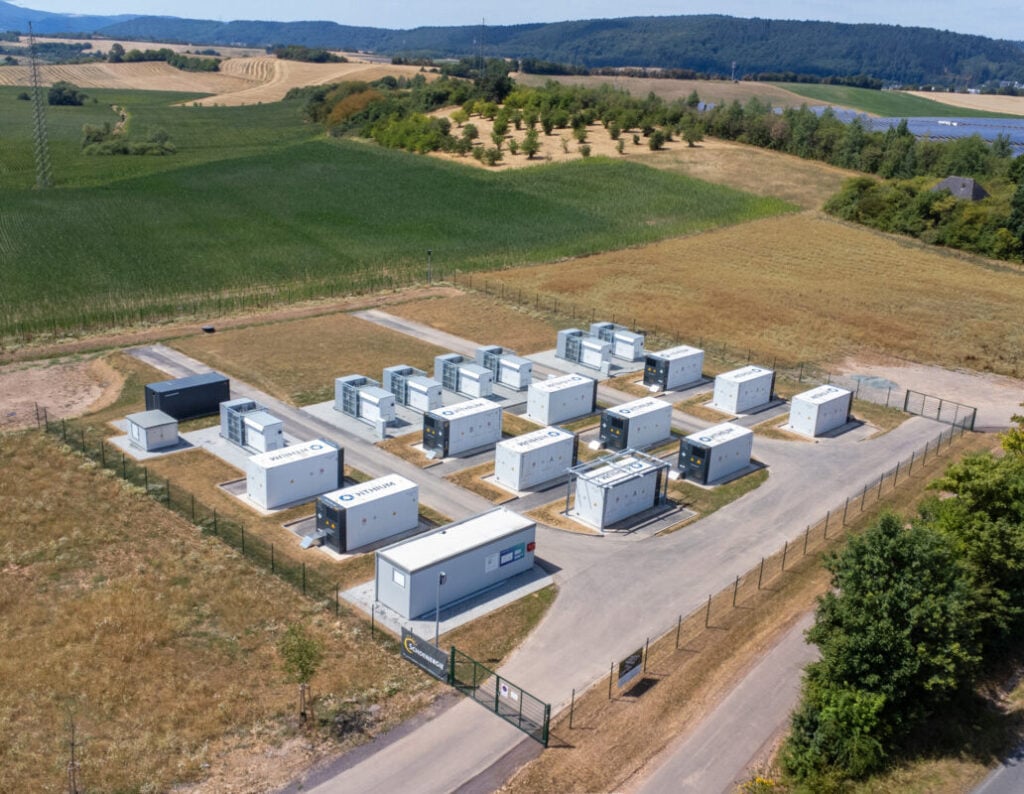
SMA’s grid-forming technologies have already been deployed in real-world projects: Blackhillock and Kilmarnock, a pair of 300MW/600MWh BESS projects in Scotland for developer Zenobe provide inertia to the UK grid under a pilot, as well as Germany’s first large-scale GFM BESS, a 21MW/55MWh project inaugurated last autumn at Trier Region Industrial Park (IRT) in the municipality of Föhren, Rhineland-Palatinate.
The company was also the first to achieve GFM certification under the previous iteration of the VDE FNN guideline. English versions of VDE FNN guidelines can be found here.