
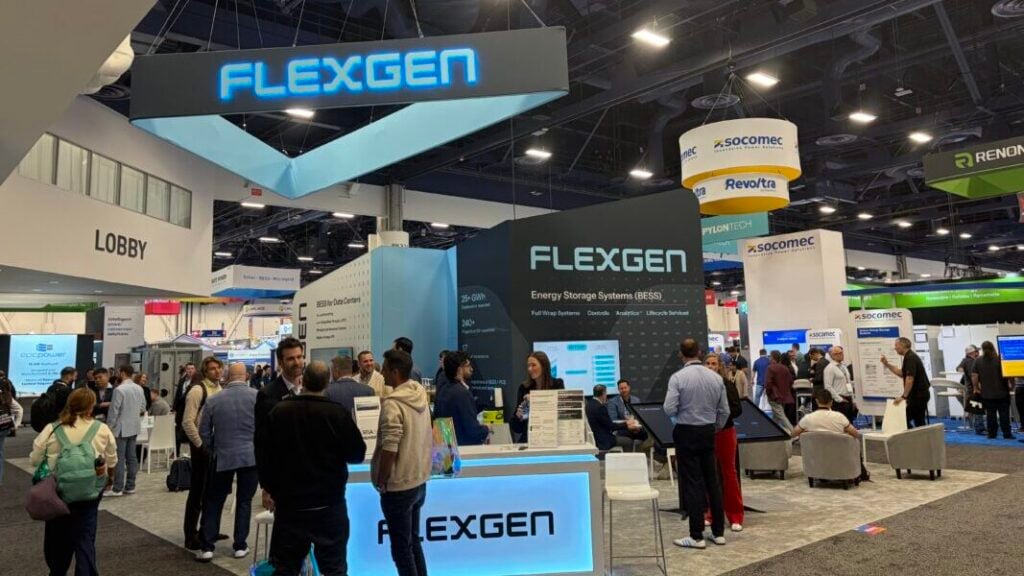
As AI-driven data centre demand reshapes the US power landscape, two battery energy storage system (BESS) technology providers at RE+ this week highlighted an unexpected competitive advantage: experience serving remote, off-grid and island-grid projects.
Speaking separately with Energy-Storage.news, Tony Olivo, senior vice president of software engineering at software-focused energy storage system integrator FlexGen, and Mike Watson, head of product and engineering at Trina Storage, the energy storage arm of solar PV manufacturing giant Trinasolar, described data centre power solutions not as a new frontier but as a return to fundamentals the industry had largely set aside after utility-scale, front-of-the-meter (FTM) projects became economical.
‘Dusting off the old books’
For FlexGen, the connection runs deep in the company’s history. “FlexGen goes back to 2009. I joined in 2012. We were doing all off-grid, microgrid, island grid-forming, diesel generators, gas generators, solar, all together. That was our heritage,” Olivo said.
The company pivoted towards FTM utility projects around 2018, once battery prices fell far enough to make those deals pencil out.
Try Premium for just $1
- Full premium access for the first month at only $1
- Converts to an annual rate after 30 days unless cancelled
- Cancel anytime during the trial period
Premium Benefits
- Expert industry analysis and interviews
- Digital access to PV Tech Power journal
- Exclusive event discounts
Or get the full Premium subscription right away
Or continue reading this article for free
With data centres now demanding standalone, resilient power, Olivo said the work looks familiar. “For data centres, really, it’s about kind of dusting off the old books that we have and kind of bringing it back.”
“All that stuff is still built into HybridOS (FlexGen’s energy management system) about how we manage gas, thermal generation together with batteries to serve a unified load.” The scale, however, is unrecognisable compared to FlexGen’s early projects.
“We used to handle maybe 5MW of gas generators and 1-2MW of storage. Just multiply [that] by a hundred now.”
That scale introduces new complexity that goes beyond the old microgrid framework entirely, Olivo said. Hyperscale data centre campuses are increasingly built as clusters of independently operable “islands,” each able to disconnect from shared generation and storage for redundancy, while technically still drawing from the same pool of resources.
“The more I look into it, the more it’s basically recreating the grid at large,” he said, comparing the dynamic to transmission constraints in West Texas, where abundant wind generation can’t always reach Houston, for example.
“You’re going to have all the generation technically that you need, but maybe not the path to get it from here to there.” He half-jokingly floated a new label for the phenomenon: not quite a microgrid, but a “centre grid,” reflecting how decentralised microgrid concepts are now operating at a scale and density once reserved for the bulk grid.
Olivo also pushed back on the idea that regulatory frameworks such as Texas’s Senate Bill 6 and ERCOT’s Nodal Operating Guide Revision Request (NOGRR) 282, which apply generation-style grid interconnection rules to large loads like data centres, constitute entirely uncharted territory.
“If you were building solar or gas generation or energy storage to just sell energy to the grid, you were already doing this thing,” he said. “I think that’s what’s got people spooked a little bit” — not unfamiliar technical requirements, but the unfamiliar idea that loads, not just generators, must now follow grid interface rules.
A microgrid in a box
Trina Storage reached a similar conclusion from the product side. The company unveiled its newly launched Elementa Hybrid Genset at RE+, pairing BESS with dispatchable gas-fired generation in a fully self-contained system, designed specifically for AI data centres. Watson, however, was quick to frame it in microgrid terms.
“This solution is fully self-contained; it is a microgrid; it’s an island. It creates its own power, and it consumes its own power, so it’s not touching local community power,” Watson said.
The design responds directly to two pressures data centre developers face simultaneously: community concern over new facilities straining shared grid resources, and interconnection queues that can take years to clear.
“Even if you wanted to pull energy from the local community, you would need to connect to the grid,” he said. “The applications and the queues to build that out take years, and these companies can’t wait years. That’s why they’re saying, ‘ Let’s just bring our own generation.’”
When told that FlexGen had drawn the same line back to its remote and off-grid project history, Watson agreed that the comparison closely matched how Trina sees its own genset solution taking shape: essentially, a packaged, standalone microgrid repurposed for a fast-growing, power-hungry customer base that cannot wait for traditional infrastructure to catch up.
Both executives suggested the overlap is no coincidence. In both cases, the core engineering challenge is much the same: delivering reliable power with fast-responding BESS that bridge to or replace other generation, without relying on the surrounding grid.
This is essentially the problem that off-grid, remote, and island-grid projects have always had to solve. In this context, however, AI compute demand has made this longstanding challenge central to the industry’s growth story, on a scale an order of magnitude larger than before.
