Share listing news from three energy storage startups with different areas of specialisation speaks to the ups and downs of going public.
ESS Inc delisted from NYSE mid-pivot
US-headquartered energy storage technology company ESS Tech, Inc (ESS Inc) has been delisted from the New York Stock Exchange (NYSE) after failing to comply with listing requirements.
NYSE delivered the notice on Friday (2 October) that its regulatory arm had initiated proceedings to delist ESS Inc. common stock. It follows a warning issued 24 September that the company was not compliant with stock exchange rules.
This was because the company was unable to maintain its average global market cap above the required US$15 million threshold for a consecutive 30-day period, under Section 802.01B of the NYSE Listed Company Manual.
Try Premium for just $1
- Full premium access for the first month at only $1
- Converts to an annual rate after 30 days unless cancelled
- Cancel anytime during the trial period
Premium Benefits
- Expert industry analysis and interviews
- Digital access to PV Tech Power journal
- Exclusive event discounts
Or get the full Premium subscription right away
Or continue reading this article for free
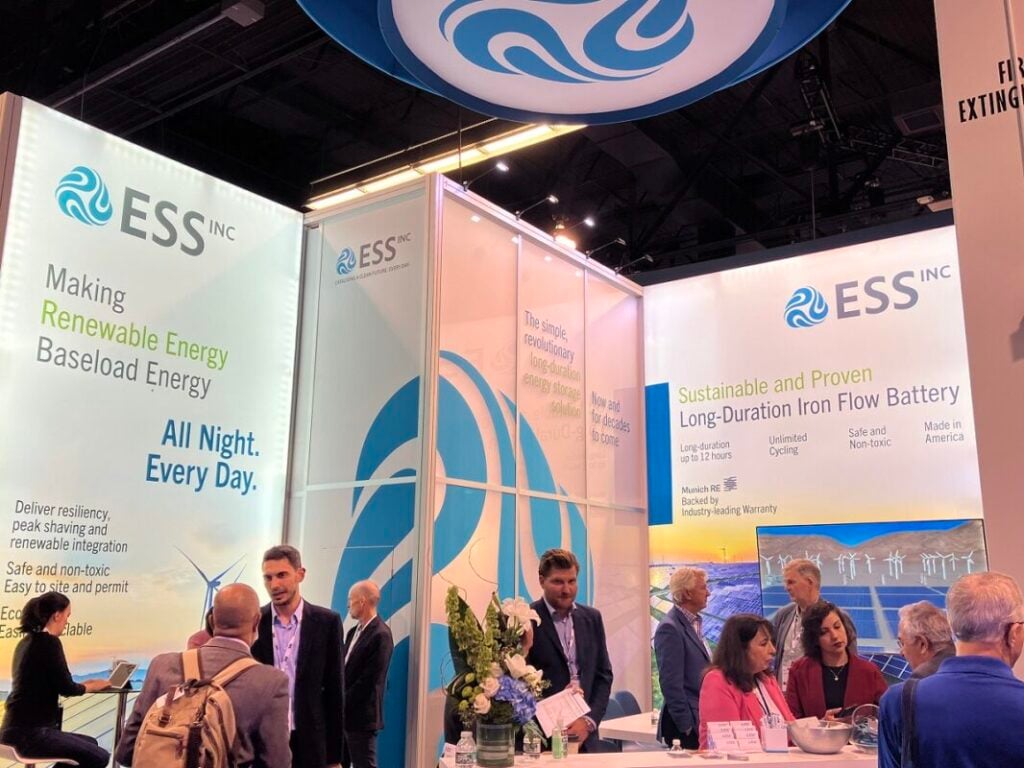
Unsurprisingly, the news comes at a time of both transition and turbulence for ESS Inc. The company is the IP holder for a proprietary iron-and-water electrolyte redox flow battery, which it has been aiming to commercialise since its establishment in Oregon, US, in 2011.
ESS Inc. became one of a wave of energy storage companies to gain a public listing through a special purpose acquisition company (SPAC) merger during the pandemic in 2021. The transaction with a NASDAQ-listed SPAC, ACON S2 Acquisition Corp, valued the combined company at ~US$1.07 billion.
Two other companies that also listed during that SPAC merger wave, Stem and Eos, each received delisting warnings in the second half of 2024.
Fast-forwarding to August 2025, ESS Inc. warned of substantial doubts of its ability to continue operating in its Q2 2025 financial reporting. While quarterly revenue had increased 578% year-on-year, it stood at just US$2.4 million.
Growth in demand for long-duration energy storage (LDES), which the iron flow battery represented, did not materialise as fast as ESS Inc hoped, despite a pivot to a larger unit aimed at utility-scale energy and data centre applications.
Now, the company is in the midst of a more significant pivot: the launch of a sodium-ion (Na-ion) battery storage business. CEO Drew Buckley claimed when reporting Q2 2026 results in August this year that demand for Na-ion “is unlike anything in our company’s history.”
Perhaps ESS Inc’s historical demand is not the most appropriate bellwether for success, but Buckley alluded to “early-stage opportunities approaching US$1 billion across data centres, critical infrastructure, and utility markets,” since the company partnered with US sodium-ion battery startup Alsym Energy in April.
Buckley was appointed CEO in January. In a candid August interview with ESN Premium, he said ESS Inc had struggled to take the flow battery’s impressive performance in the lab to commercial scale, while at the same time “trying to sell as many orders as possible.”
While the iron flow battery is still part of the company’s inventory for commercialisation, it will likely take longer, CEO Buckley said, whereas the Na-ion battery energy storage system (BESS) solution ESS Inc has developed could be “easy to drop in and install at utility-scale.”
“We wanted to replicate the energy density of lithium because we think sodium-ion has a very clear and unique application outside of lithium. A lot of that goes to the temperature range you get from sodium-ion and its ability to handle data centre workloads and AI GPU workloads a lot better than a traditional lithium system because of the temperature range,” Buckley told ESN Premium.
“Our vision is not that sodium-ion displaces lithium. There’s an area of the market that’s going to grow very rapidly, where sodium-ion has a great place, and that’s really around AI data centre workload.”
ESS Inc’s stock can still be traded: from yesterday (5 October), the common stock may be traded and quoted in the market for unlisted, over-the-counter (OTC) securities. That essentially means the stock can be traded directly between two parties via brokers and dealers, rather than through a centralised exchange such as the NYSE.
The flow battery-turned sodium-ion maker will request a review of the NYSE Regulation determination. Meanwhile, ESS Inc. common stock remains outstanding and continues to be held in the same accounts.
ZincFive prepares for ‘different story’ SPAC merger
Nickel-zinc battery storage startup ZincFive and SPAC Spark I Acquisition Corporation have publicly filed a registration statement with the US Securities and Exchange Commission (SEC) for a planned business combination.
The transaction, which the parties expect to close in Q4 this year, subject to shareholder and regulatory approvals, will result in a new company, ZincFive Inc., gaining a NASDAQ listing under the ticker ZFIV.
Announced in June, the deal values ZincFive at ~US$752 million on a pro forma enterprise value basis.
Speaking with ESN Premium around the time of the announcement, ZincFive CEO Todd Higinbotham claimed that the previous wave of energy storage SPAC transactions “was largely coloured by companies going public on the promise of future revenue.”
“We have already achieved commercial scale – nearly 2GW of systems deployed or contracted globally, revenue that more than doubled in 2025 to US$66.9 million, and a US$81 million contracted backlog entering 2026,” Higinbotham told ESN Premium.
The company, also headquartered in Oregon, positions its nickel-zinc chemistry as an alternative to lead-acid or lithium-ion uninterruptible power systems (UPS) and short-duration storage applications, suitable for handling the large load fluctuations of data centres.
Higinbotham wrote a Guest Blog about this premise for the site in March 2025, when he was the company’s chief operating office (COO), explaining how ZincFive believes its technology can help mitigate the major impacts of a data centre-driven surge in electricity demand.
Slovakia’s InoBat nears NASDAQ listing and 20GWh LFP factory opening
Another energy storage SPAC merger looks set to proceed, with InoBat, a battery cell technology developer and BESS manufacturer headquartered in Slovakia, Europe, filing an SEC registration statement for its combination with Cartesian Growth Corporation II.
The pair filed the Form F-4 registration statement with the US SEC last month (24 September). It follows their definitive agreement to enter a business combination in July, at which time InoBat said the deal values the combined company at US$1.265 billion and will raise US$77.5 million in investment from private investment in public equity (PIPE) commitments.
Upon closing of the transaction, the combined company will become InoBat and Cartesian II’s parent company and list on NASDAQ under the ticker INBT.
As of July, InoBat had delivered or was contracted to deliver 875MWh of utility-scale BESS solutions assembled at its facilities in Voderady, Slovakia. Like an increasing number of its rivals, the company is targeting the data centre market and its technology roadmap includes supercapacitors as well as sodium-ion.
InoBat has partnered with Chinese battery manufacturer Gotion High-Tech to develop a 20GWh annual production-capacity lithium iron phosphate (LFP) cell factory located around 40 miles from Surany. The factory’s start of production is targeted for 2027.