
Join us for In Case You Missed It (ICYMI), our weekly recap of thought-provoking and potentially game-changing news from around the world in energy storage.
Every Monday, you can consider it our public service to you, a busy professional doing their best not just to keep up but to stay ahead of the pack.
Click the headline to read more from each story.
If you’re not already signed up to our daily newsletter, the best time to do so is now.
Try Premium for just $1
- Full premium access for the first month at only $1
- Converts to an annual rate after 30 days unless cancelled
- Cancel anytime during the trial period
Premium Benefits
- Expert industry analysis and interviews
- Digital access to PV Tech Power journal
- Exclusive event discounts
Or get the full Premium subscription right away
Or continue reading this article for free
Most read
Spain is making batteries a licensing condition for data centres, and nobody noticed
While ICYMI is usually reserved for news stories, we’ll make an exception for this Guest Blog from Ignacio López Martín, chair of developer Capflex Energia.
A new draft royal decree in Spain “ties grid access for data centres of 1MW and above to hourly renewable matching,” López Martín wrote.
“Not an annual average, not certificates bought in December to square a spreadsheet: 80% of the electricity consumed in each individual hour has to be backed by renewable generation produced in that same hour.”
Urgent need for cybersecurity overhaul as BESS deployment accelerates, Energy Storage Europe says
Trade body Energy Storage Europe has called for significant reforms to the European Union’s (EU’s) cybersecurity framework for BESS.
Energy Storage Europe’s new report, Cybersecurity in Battery Energy Storage Systems: Roles, Responsibilities, and Regulatory Gaps Across the Value Chain, warns that current regulatory gaps and inconsistent implementation across member states are increasing costs and slowing deployment, whilst failing to adequately address grid-level risks.
The trade body has welcomed the European Commission’s focus on cybersecurity in the energy sector and supports the direction of its Cyber Resilience Act (CRA), the Network Code on Cybersecurity (NCCS), and the proposed Cybersecurity Act (CSA) 2.0, but raised concerns about their practical application to battery storage.
SMA battery inverter first to win grid-forming certification for German inertia market
SMA Solar Technology has become the first to be certified as capable of providing inertia to the German grid.
The Germany-headquartered power electronics manufacturer’s Sunny Central UP-S battery inverter platform met requirements for grid-forming (GFM) inverters to supply grid-stabilising inertia under the VDE FNN guideline Version 2.1. Published in early 2026, the guideline defines the technical and verification requirements for grid-forming units and plants to participate in Germany’s new inertia market.
Alongside the associated certification framework, the VDE FNN guideline establishes a standardised pathway for testing, verifying and certifying GFM technologies.
Australia’s most powerful battery storage system officially completed
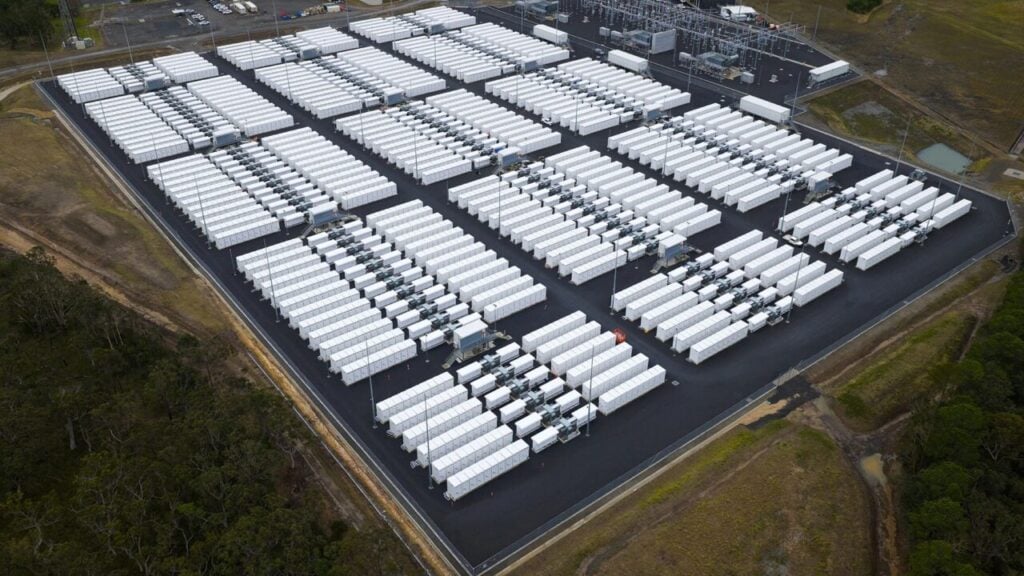
Akaysha Energy has reached final commercial operations at its Waratah Super Battery in New South Wales, Australia, closing out a commissioning process that ran through a transformer failure and months of reduced capacity.
The 850MW/1,680MWh project is built on the site of the former Munmorah coal-fired power station near Budgewoi. It was commissioned by the NSW government and built, owned and operated by Akaysha, a battery storage developer backed by global investment firm BlackRock. Waratah Super Battery is the most powerful operational BESS in Australia.
Waratah is the battery component of the wider Waratah Super Battery site, which also includes a System Integrity Protection Scheme (SIPS) Control System delivered by Transgrid, the operator of NSW’s high-voltage transmission network.
Gotion to supply 6GWh of battery storage for Saudi Arabia’s first utility-scale BESS tender
Chinese battery manufacturer Gotion High-Tech has been confirmed as the battery energy storage system (BESS) technology supplier for three projects totalling 6GWh awarded to an ACWA Power-led consortium under Saudi Arabia’s first utility-scale battery storage tender.
The three sites, Al Muwayah, Haden and Al Kahafa, are each configured at 500MW/2GWh, giving Gotion roughly 75% of the tender’s total 2GW/8GWh capacity, which Gotion values at approximately US$1.16 billion.
The award marks the first international large-scale deployment of Gotion Grid, the company’s utility-scale storage system.
Contracts were awarded by the Saudi Power Procurement Company (SPPC), the Principal Buyer. SPPC signed build-own-operate agreements for four 500MW/2GWh projects in August 2026, the kingdom’s first such contracts for battery storage.
Other news picks
India approves US$19.3 billion Green Energy Corridor Phase III with 50GWh BESS
It’s been a busy few weeks for national and state-level policymakers and regulators in India’s energy sector, including Central Electricity Regulatory Authority (CERC) proposals of new requirements for the grid operation of energy storage.
The biggest announcement in some time came late last week, as the Union Cabinet approved INR 1.86 trillion (US$ 19.3 billion) for the third phase of the Green Energy Corridor, including INR 500 billion for 50GWh of battery storage to support renewable energy integration through FY2032-33.
Volkswagen’s new LFP battery JVs with Gotion will adjust EV and BESS cell production split based on demand
Gotion and Volkswagen AG will establish three joint ventures to manufacture lithium iron phosphate (LFP) batteries and battery materials in Spain, Slovakia and Morocco.
Announced as a partnership between Chinese battery manufacturer Gotion High-Tech and its subsidiaries with Volkswagen and its battery subsidiary PowerCo, the total project investment is estimated at approximately €3.222 billion (US$3.66 billion).
A spokesperson for PowerCo told Energy-Storage.news that the factory in Valencia will focus on producing cells for automotive applications while the Surany factory in Slovakia will produce cells for both EV and BESS markets.
According to the spokesperson, the product split, which has not been disclosed, will be dependent on demand, with automotive prioritised.
Wärtsilä’s energy storage division rebrands through RCT Solutions joint venture
Wärtsilä’s energy storage business will now operate under the new brand name Valo, following the close of the company’s joint venture (JV) with RCT Solutions.
Finnish marine and engine power solutions company Wärtsilä’s JV transaction with German solar PV manufacturer RCT Solutions has closed, with Valo officially launching 1 October 2026.
The pair’s JV agreement was announced in June. Valo will be run as a 50:50 JV. Financial terms were not disclosed, but Wärtsilä reiterated a previous claim that the transaction represents less than 5% of its total assets.
Major US partnerships may signal battery storage’s infrastructure era
EPC firm Linxon, Japanese tech company Hitachi’s Hitachi Energy, and US-based tracker manufacturer FTC Solar have signed a memorandum of understanding (MOU) for North American solar and energy storage projects.
The companies positioned the deal as “scaling the infrastructure” needed for the growth of renewables, grid resilience, and reliable power.
Under the agreement, Linxon will serve as the primary EPC integrator and market-facing contractor, providing full EPC, commissioning, and project execution services.
Hitachi Energy will contribute utility-scale solar inverters, power conversion systems (PCS) for BESS, and the automation and control systems to operate the plants. FTC Solar will provide solar trackers, racking systems, and related balance of system (BOS) solutions.
Canada’s Northland Power closes financing on 1.2GWh of CM-contracted BESS projects in Poland
Independent power producer (IPP) Northland Power has closed financing on two large-scale battery energy storage system (BESS) projects in Poland.
Northland Power, headquartered in Toronto, Canada, announced the close of ~PLN500 million (~US$128.66 million) in financing for the projects on 30 September.
The funding, from undisclosed Canadian and Polish financial institutions, supports the development of projects totalling 300MW of output and 1,200MWh of energy storage capacity, together with government grants from the Polish National Fund for Environmental Protection and Water Management, which provided around PLN1 billion. The two projects are Mieczysławów, which is 200MW/800MWh and Kamionka, which is 100MW/400MWh. Both are currently under construction, with Mieczysławów expected to enter commercial operation in early 2028. Kamionka is due online by mid-2028.
The projects both have 17-year capacity market contracts in place with the ability to earn additional revenue from arbitrage and ancillary services markets.
Additional reporting by Andy Colthorpe.
