
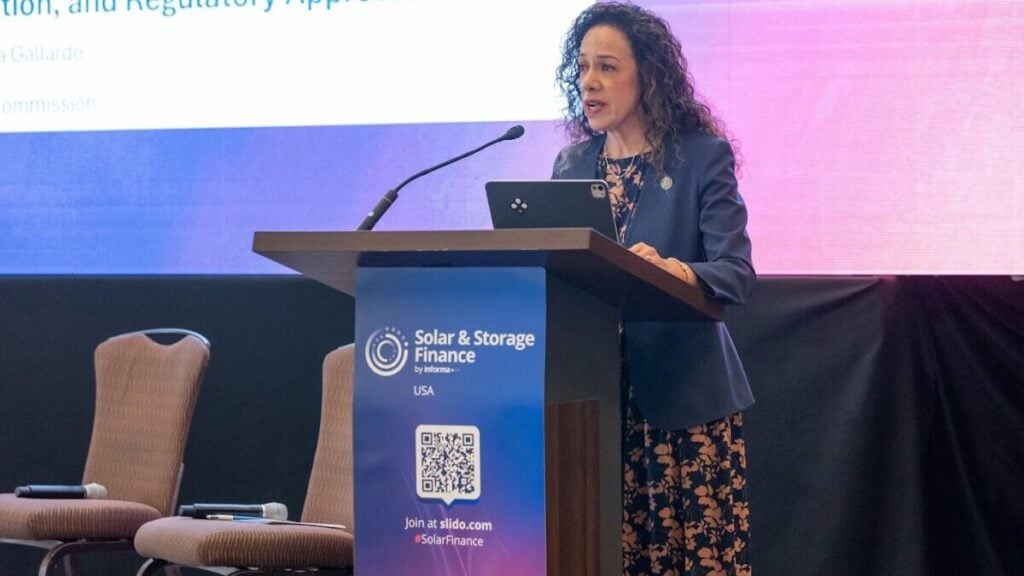
Energy-Storage.news spoke with Noemí Gallardo, Commissioner at the California Energy Commission (CEC), at the US Solar & Storage Finance event in Garden Grove, California, about the growth of BESS within the state.
California has emerged as a national leader in energy storage deployment, achieving a 3,000% increase in battery capacity since 2019, as the Commissioner noted.
Commissioner Gallardo sat down to discuss the state’s ambitious plans for long-duration energy storage (LDES), community-focused deployment strategies, and the challenges of building public support for clean energy infrastructure.
Accelerating LDES
California’s energy storage landscape has transformed dramatically in recent years. “We have gotten over 21GW of battery energy storage on our grid since 2019,” Gallardo explained. “This is like a 3,000% increase, and we’re really excited about that.”
Try Premium for just $1
- Full premium access for the first month at only $1
- Converts to an annual rate after 30 days unless cancelled
- Cancel anytime during the trial period
Premium Benefits
- Expert industry analysis and interviews
- Digital access to PV Tech Power journal
- Exclusive event discounts
Or get the full Premium subscription right away
Or continue reading this article for free
While most of this capacity consists of 4-hour lithium-ion (Li-ion) battery energy storage systems (BESS), the state is now focused on diversifying its portfolio to address multi-day reliability events and seasonal renewable variability.
“We want to diversify our portfolio so that we can do even more, especially as we know that more renewables are coming online, and there’s more demand on the grid,” Gallardo noted. “That’s where we would like to bring in LDES. The more hours that they can deliver, the better it goes for us.”
Streamlining interconnection and permitting
Managing the surge of renewables and BESS projects seeking grid connection has required close coordination among multiple agencies.
The CEC works closely with the California Public Utilities Commission (CPUC) and the California Independent System Operator (CAISO) to navigate the increasingly complex interconnection queue.
“We try to figure it out together, and it can get very complex, especially with the surge of renewables and also energy storage that are trying to get into the queue for interconnection,” Gallardo said. The commission’s research and development funding for demonstration projects generates valuable data that informs CAISO and CPUC decision-making.
CAISO has responded by exploring innovative approaches, including a zonal strategy that prioritises projects based on infrastructure availability and grid needs. “They’re trying to figure out a zonal approach to see where it makes most sense to put these technologies, and give them that spot in the queue based on what’s most viable,” Gallardo explained.
In 2024, the Federal Energy Regulatory Commission (FERC) approved modifications to the CAISO interconnection process. The approval came with significant opposition from numerous renewable energy industry organisations, with some groups calling on FERC to reject the changes outright.
Some of CAISO’s controversial interconnection reforms included a scoring system for projects based on commercial interest, creating new zonal clusters and additional study criteria.
At another discussion taking place at the US Solar & Storage Finance event between Kevin Imboden, global director of market research & intelligence at data centre developer EdgeconneX, and Sandeep Arora, senior vice president & head of transmission & markets at LS Power-owned Rev Renewables, the speakers explained that interconnection costs for utility-scale BESS in California are significantly lower than in other major US markets.
The Opt-In Certification Programme
A significant development in California’s permitting landscape is the Opt-In Certification Programme.
A 2022 state law broadened the CEC’s authority to include BESS facilities with capacities greater than 200MWh, allowing developers to pursue direct state approval instead of navigating local permitting procedures.
Although the commission solicits and considers community feedback throughout the project assessment process, final approval decisions lie with state officials rather than local authorities.
This shift in jurisdiction has sparked resistance from advocates of local control, who believe municipalities should retain primary authority over land use determinations within their boundaries.
“We’ve been able to approve three projects already, and all had energy storage systems. That’s really exciting, it’s about two gigawatts,” Gallardo said. The Commissioner explained that the programme requires developers to provide benefits to local communities and pay prevailing wages for local jobs, creating a balance between grid reliability needs and community value.
“It’s exciting to see this programme working as it’s somewhat new, but it seems like developers are excited about it and it’s working as it was intended,” she added.
This summer, developer New Leaf Energy withdrew its application for a BESS in Santa Cruz County, choosing to seek approval through the Opt-In programme.
BESS community impacts
The CEC’s LDES funding programmes are enabling deployment in disadvantaged communities and tribal lands, with particularly promising results among California Native American tribes.
“(California Native American tribes) view these clean energy projects, especially LDES systems, as a way for them to get tribal energy sovereignty, where they can be more independent and be able to serve their tribal members and even the surrounding communities,” Gallardo explained.
One project Gallardo mentioned involves the Viejas Band of Kumeyaay Indians, which is testing both zinc batteries from Eos Energy Enterprises and vanadium redox flow batteries from Invinity Energy Systems to determine optimal performance.
The microgrid will power the tribe’s casino resort and provide resilience for tribal members and surrounding communities during power outages.
In Madera County, the commission is funding a 10-hour duration system from microgrid integrator Faraday Microgrids and zinc bromide flow battery technology from Australia-based company Redflow for a children’s hospital that provides paediatric care in an underserved area.
“If there is an outage, they can continue providing care to their patients, and you know what a relief for those families to know that their kids are going to be taken care of, even if there is a power outage,” Gallardo said.
Community concerns
Despite California’s progress, energy storage projects still face community opposition, particularly in residential areas. Gallardo acknowledged that concerns about safety, often stemming from past incidents, are valid but emphasised the need for better public education.
“I think what we would like to see more of is openness to educating the public about what these systems are doing for the grid, what these systems are doing to provide value for the local community, and also the changes that have occurred,” she said.
“All of the standards have changed, technologies have changed, the way the systems are set up have changed. The chemistries have changed, and I think we need to do a better job of helping educate the public.”
Projects in rural or remote areas typically encounter less opposition, while those closer to residential communities generate more scrutiny. Gallardo stressed the importance of helping communities understand both the grid-wide benefits and local value of BESS regardless of whether it changes individual opinions.
