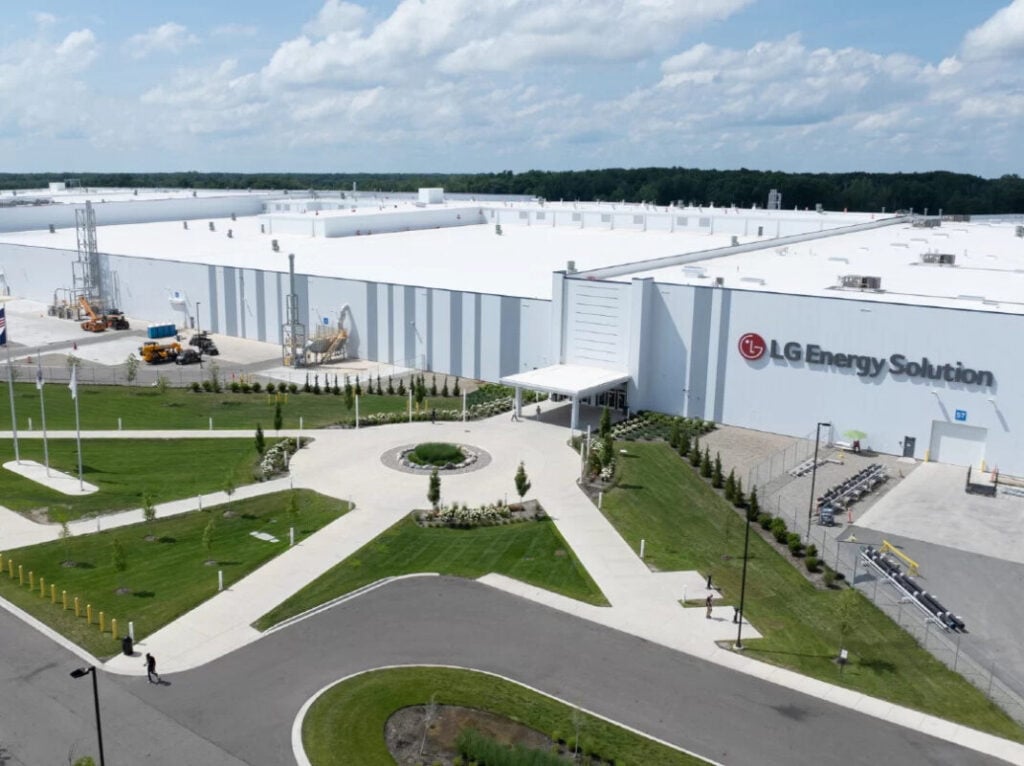
South Korean battery giant LG Energy Solution (LG ES) has begun production at its lithium iron phosphate (LFP) and nickel manganese cobalt (NMC) battery cell factory in Lansing, Michigan, US.
Announced 18 August, LG Energy Solution Michigan-Lansing manufactures large-format LFP batteries for both battery energy storage systems (BESS) and electric vehicles (EVs).
According to LG ES, the plant aims to reach more than 35GWh of annual battery-making capacity at full-scale production. The cells are integrated by LG ES Vertech, the company’s US energy storage division, into systems for utility, grid-scale storage, and commercial and industrial (C&I) applications.
The new factory will also produce NMC cells for Toyota, to be used in vehicles like the 2027 Toyota Highlander EV, which will be assembled at Toyota Motor Manufacturing Kentucky (TMMK) in Georgetown, Kentucky.
Try Premium for just $1
- Full premium access for the first month at only $1
- Converts to an annual rate after 30 days unless cancelled
- Cancel anytime during the trial period
Premium Benefits
- Expert industry analysis and interviews
- Digital access to PV Tech Power journal
- Exclusive event discounts
Or get the full Premium subscription right away
Or continue reading this article for free
The grand opening of the factory was attended by Michigan Governor Gretchen Whitmer, US Secretary of the Interior Doug Burgum, US Representative Tom Barrett and Consul General of the Republic of Korea in Chicago Sangwoo Hong.
In March, the Trump administration announced via the US Department of the Interior (DOI) that LG ES closed a US$4.3 billion supply agreement with Tesla and noted that the LFP cells produced at the factory would be used in Tesla’s Megapack 3 BESS solution.
That announcement was part of a series of large-scale agreements highlighted by the Trump administration during the Indo-Pacific Energy Security Summit. At that time, it was also announced that the US and South Korea were exploring a Critical Minerals Memorandum of Understanding (MoU) through the Department of Energy (DOE) to formalise cooperation on the resilience of the critical minerals supply chain.
The relationship between the two countries has been somewhat shaky during the US president’s second term. Most recently, Donald Trump gave an order to “substantially reduce” joint military exercises between the US and South Korea, according to NPR, citing good relations with North Korea’s Kim Jong Un and South Korea’s own refusal to join the US war on Iran.
Sangwoo Hong noted, “The Korea-US alliance has evolved into a comprehensive strategic alliance including economic cooperation and cutting-edge technology. Today’s opening is a key milestone. The battery industry sits right at the heart of our shared strategic priorities.”
Demand for domestically manufactured components is surging in the US market, driven by multiple policy forces: the Inflation Reduction Act’s (IRA) investment tax credit bonuses for projects using qualifying domestic equipment, the ‘One, Big, Beautiful Bill Act’ (OBBBA) which disqualifies projects with Chinese-made or financed battery cells from ITC eligibility, the recent ban on foreign-produced power inverters, and Section 301 tariffs on Chinese imports.
The new factory joins other LG ES production facilities for LFP cells in the US, including its Holland, Michigan, factory complex, where the company announced an initial US$1.4 billion investment in early 2025 to retool some of the plant’s existing EV cell production capacity to fulfil demand from BESS customers. It brought 17GWh of annual LFP BESS cell production capacity online at the plant towards the beginning of this year.
In June, Japanese consumer electronics giant Panasonic announced plans to convert a Kansas EV cell manufacturing facility to produce batteries for data centre applications and US motor company Ford recently announced a pivot to enter the stationary BESS space through a new subsidiary, Ford Energy.
Meanwhile, Ultium Cells—the General Motors-LG ES joint venture—has pivoted its Spring Hill, Tennessee operations from EV batteries to LFP cells for stationary storage.
In July, L-H Battery Company commenced Li-ion cell production at its Jeffersonville, Ohio plant for automotive and stationary power applications.
LG ES claimed that it has invested over US$2 billion in the Lansing facility, which currently employs about 900 team members. At full capacity, employment is anticipated to grow to 1,700 team members. In April, the company said that heavy Capex investments in manufacturing had put it on track to have more than 50GWh of BESS cell production capacity feeding US markets by the end of this year from five factories, including JVs.
The company also owns Canada’s first battery cell manufacturing plant, at which plans to make BESS cells were announced in late 2025. The factory had its grand opening at the beginning of this year. The plant’s operator, Nextstar Energy, was formed as another automaker JV, with OEM Stellantis, but LG ES took full ownership in February.
Michigan utility DTE Energy will also be among the utilities using batteries built at LG Energy Solution Michigan-Lansing to power future BESS projects.
DeltaX to establish North American headquarters in Georgia
DeltaX, an AI-assisted mobility and ESS-focused tech startup, also headquartered in South Korea, will establish its North American headquarters in Walton County, Georgia.
Announced 14 August, DeltaX claimed the US$141 million investment is expected to create approximately 250 jobs.
The company plans to develop a manufacturing campus on approximately 25 acres at the Piedmont Regional Industrial Park in Monroe, Georgia. The first phase will include a 100,000-square-foot BESS assembly facility, with additional manufacturing facilities for component production to follow. A separate corporate office building is also planned for the site.
Founded in 2020, DeltaX develops BESS, battery management systems (BMS), and AI-powered energy management technologies for utility-scale projects, renewable energy integration, data centres, and commercial and industrial (C&I) applications.
James C. Park, vice president of North America operations for DeltaX, cited Georgia’s business climate, workforce, logistics network, and leadership as factors in the location decision.
The announcement adds to Georgia’s expanding energy storage manufacturing sector. The state has attracted multiple battery and energy storage investments in recent years, supported by factors including workforce training programs, research institutions, and energy infrastructure.
The project received support from the Georgia Department of Economic Development, Walton County Development Authority, utility Georgia Power, Metro Atlanta Chamber, and Georgia Quick Start workforce training programme.
Recently in the state, Georgia Power completed construction on the 49.5MW/198MWh Moody Battery Facility, located outside of Valdosta, adjacent to the Moody Air Force Base.
The Moody BESS was approved with the 128MW/512MWh Robins, 57.5MW/230MWh Hammond, and 530MW/2,120MWh McGrau Phase I & II BESS projects.