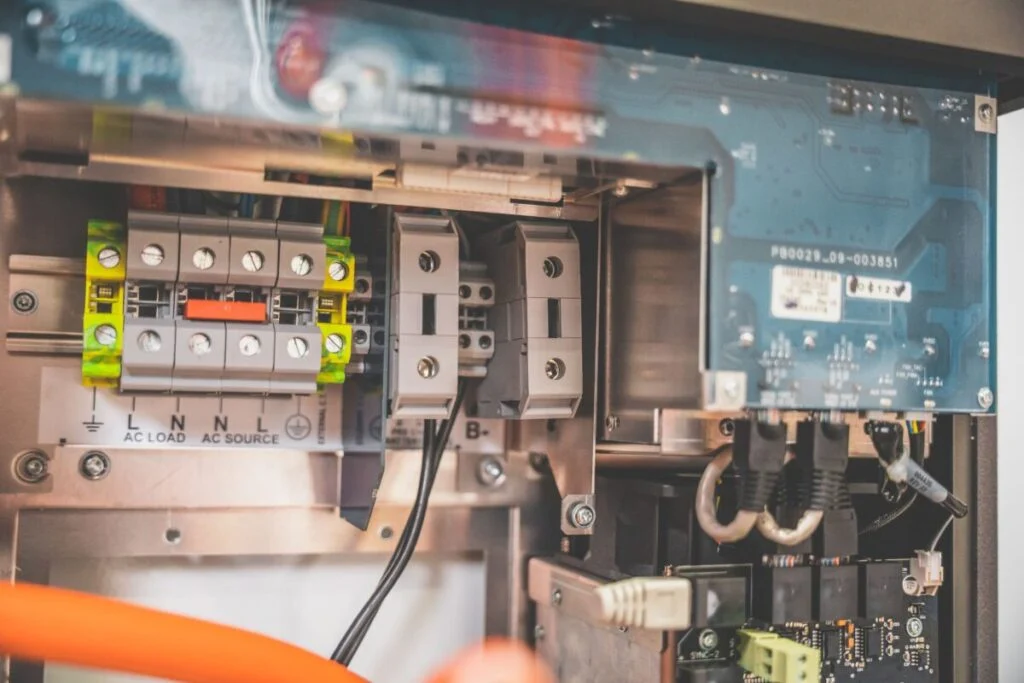
The Public Safety and Homeland Security Bureau (PSHSB) of the US Federal Communications Commission (FCC) has classified foreign-produced power inverters and “advanced robotic devices” as national security threats.
The FCC’s 28 July decision to restrict all new “connected power inverters” produced outside the US has created widespread confusion and potential disruption across the battery energy storage system (BESS) and solar industries.
According to market experts, speaking with ESN on condition of anonymity, the restriction applies to inverters containing “components that enable remote communication, control, sensing, data collection, or monitoring through Wi-Fi, cellular, Bluetooth, or similar connections.”
While the FCC explicitly stated the policy does not apply to inverters already sold or installed in the US, the lack of clarity around enforcement, effective dates, and what qualifies as “previously authorised” has left developers, manufacturers, and EPCs scrambling to understand their exposure.
Try Premium for just $1
- Full premium access for the first month at only $1
- Converts to an annual rate after 30 days unless cancelled
- Cancel anytime during the trial period
Premium Benefits
- Expert industry analysis and interviews
- Digital access to PV Tech Power journal
- Exclusive event discounts
Or get the full Premium subscription right away
Or continue reading this article for free
A ban without clear enforcement
The FCC inverter restriction follows a similar pattern to bans the agency imposed on imported consumer internet routers and drones in late 2025. One of the primary differences being that routers and drones were already explicitly regulated by the FCC, and authorisation was required for their sale long before the bans took effect. Inverters were not.
Industry sources indicate that before this restriction, inverter manufacturers were voluntarily having their radio frequency-emitting components authorised by the FCC, but this was not a requirement for selling inverters in the US market. Inverters themselves were not explicitly regulated by the FCC.
The FCC’s new policy states that previously authorised models can continue to be sold—but a review of FCC authorisation records reveals that what has been authorised are inverter components, not complete inverter products sold to end customers.
This ambiguity creates two possible interpretations: either all inverter imports are now disallowed, or only inverter imports that don’t use previously FCC-authorised communications devices are prohibited. Industry experts emphasise that the distinction between these two interpretations makes an enormous difference for the US market.
If the former interpretation holds, the impact would be immediate and severe. If the latter applies, manufacturers may have a pathway forward—but significant uncertainty remains.
Adding to the complexity, the FCC defines a “foreign produced inverter” as any inverter that does not meet Buy America Act standards—meaning not only must the final product be made in the US, but 65% by value must consist of US components.
That means inverters currently being manufactured in US factories could still be classified as “foreign produced” and therefore prohibited from sale under the new rule.
According to industry forecasts, the US domestic inverter market will likely meet only 40% of combined solar and battery demand for 2027. Any significant disruption to imports could have a chilling effect on both markets.
‘Dumb’ inverters
One potential mitigation strategy involves shipping “headless” or “dumb” inverters—units without embedded wireless connectivity—and equipping them with FCC-authorised communications devices after import.
Sources indicate there is a significant opportunity for inverter makers to ship headless inverters to the US market and have EPCs or installers locally install authorised communications devices after the inverter is sold.
Some manufacturers have already been preparing for this scenario. Our source notes that at least one major inverter manufacturer may have already been shipping inverters without integrated communications equipment, partnering with US-based companies to install those devices domestically in response to previous state-level restrictions on Chinese-owned companies.
From a technical standpoint, inverters do not require external communication to function—they simply convert DC current to AC current (or vice versa) and can operate with basic on/off controls. External communication and monitoring capabilities can be added modularly through industrial modems, programmable logic controllers, or other devices that plug into standard ports.
Sources note that this modularity already exists in the market. Many developers and EPCs already prefer to use their own control systems and routinely replace manufacturer-provided communications equipment with their preferred hardware and software platforms.
Companies making energy management system (EMS) software and power plant controllers (PPC) are already designing systems intended not to run on top of software or hardware embedded in the inverter, but to replace it entirely.
However, this workaround is not without risk. It remains unclear whether inverters shipped with open communication ports, but no embedded wireless capability would be considered compliant, or whether attaching previously authorised communications devices overseas before shipping would trigger the ban.
Conditional approvals
The FCC has established a process for manufacturers to seek conditional approvals from the Department of Homeland Security (DHS) and the Department of Defense (DoD) to sell individual models of foreign-made connected inverters in the United States.
In the case of the router ban, some manufacturers obtained conditional approvals within weeks. However, no Chinese router makers appear on the FCC’s list of approved models, raising questions about the criteria used to grant approvals.
Industry analysts note that the actual criteria by which these approvals are issued will likely be fairly opaque, with significant room for approvals to be granted based on non-transparent reasoning. The lack of objective, measurable criteria and the complete discretion given to issuing agencies has raised concerns about potential favoritism or corruption in the approval process..
One source says, “Going back to the router example, Netgear got a conditional approval fairly quickly. We don’t know why, and that means that there is a lot of room for these approvals to be granted on very suspect reasons, possibly going as far as outright corruption and graft, so someone’s going to get an approval.”
Continuing, “I don’t think the intent is necessarily to completely block the influx of inverters. It is to give the administration more power to pick who gets to import their inverters, which even if it doesn’t completely run the industry to a standstill, is still a fundamental economic fairness problem.”
Some observers have noted that if one were designing a process to obscure improper influence, it would look very similar to the conditional approval framework—with no transparent criteria and entirely discretionary decision-making.
Impact on BESS projects
When developers apply for interconnection, they specify an inverter make and model. If they cannot procure that model due to the restriction, they must withdraw the application and start over with a new inverter specification, potentially adding years to project timelines.
Industry sources warn this has the potential to completely scramble project development for both BESS and solar, as projects in the interconnection queue that cannot secure their specified inverter models will be forced to start over.
The restriction will not affect inverters already installed or those that developers or EPCs have already taken possession of. However, anything under development, currently being built, or awaiting procurement is potentially at risk. There is also uncertainty about how products currently being imported or existing US inventory yet to be sold will be treated.
Compounding compliance burdens
The inverter restriction also arrives as the energy storage industry is still navigating foreign entity of concern (FEOC) requirements under the ‘One Big Beautiful Bill Act,’ (OBBBA) which bars developers from claiming the investment tax credit (ITC) on BESS products with material assistance from manufacturers tied to China, Russia, Iran, or North Korea.
The combination of FEOC restrictions and inverter bans further narrows the pool of viable suppliers, creating compounding compliance burdens for developers trying to secure financing and maintain project timelines.
Tax equity investors and project finance lenders are increasingly requiring documented compliance with both FEOC and FCC requirements before committing capital, adding another layer of due diligence to an already complex procurement process.
The FCC has not specified an effective date for the policy, though assumptions are that it took effect immediately upon the 28 July update to the Covered List.
Industry analysts have reached out to the FCC for clarification but do not expect timely responses.
Sources familiar with the situation emphasise this is an evolving scenario, and understanding of the implications continues to develop. Depending on how regulatory interpretation and enforcement unfold, the impact could range from manageable to catastrophic for the industry.
Forced localisation at higher cost
In the long term, the restriction will likely force some localisation of inverter supply chains and accelerate domestic manufacturing buildout—though sources caution that achieving meaningful scale could take decades without significant capital investment.
As of 2020, US domestic inverter supply could cover roughly 7% of demand, according to a Department of Energy (DOE) report cited in the National Security Determination that preceded the FCC action. Even the buildout since then leaves domestic capacity far short of meeting demand.
Building the capacity to meet US demand would require companies with existing inverter intellectual property—most of which are not American—to invest billions of dollars in new factories or expansions. If the solution is purely domestic capacity expansion, industry experts suggest the timeline could extend to decades.
However, the most likely outcome is that at least some manufacturers will obtain conditional approvals relatively quickly, creating a viable, if uncertain, path forward for portions of the market.
Sources note that forced diversification of inverter supply chains may be the only positive outcome of this policy, though it will inevitably come at higher cost. Beyond that, there is little upside for the market.
Worst-case and best-case scenarios
The worst-case scenario would involve no products receiving conditional approvals and the headless inverter workaround failing to gain regulatory acceptance. Industry experts describe this outcome as potentially catastrophic for the energy storage and solar industries, though they consider it unlikely.
The best-case scenario involves regulatory clarification that inverters using previously authorised communications components are compliant, combined with manufacturers pivoting to headless inverter models that can be equipped with approved communications devices domestically. Under this scenario, the market disruption would be more manageable.
The reality will likely fall somewhere between these extremes, with significant variation depending on manufacturer relationships, regulatory interpretation, and the speed and fairness of the conditional approval process.
Battery Asset Management Summit USA 2026 will be held 15-16 September in Garden Grove, California, hosted by Energy-Storage.news publisher Solar Media (part of the Informa Group). The agenda emphasises addressing the roles of AI, cybersecurity, and second-life applications, broken down into two tracks: Technical Asset Management and Commercial Asset Management. This year, the conference is also co-located with Solar & Storage Finance Summit USA. Visit the official site for more details.