LG Energy Solution (LG ES) posted a quarterly loss in Q1 2026 financial results this morning, partly due to investments in energy storage system (ESS) cell manufacturing.
Despite increased shipments in both its electric vehicle (EV) and ESS batteries, the Korea Exchange-listed (KRX-listed) battery manufacturer saw revenues fall 2.5% year-over-year from KRW6.7 trillion (US$4.5 billion) in Q1 2025 to KRW6.6 trillion in the first quarter of 2026.
That said, an increase in ESS demand alongside “stable” cylindrical EV cell sales drove a 1.2% quarter-on-quarter revenue increase, to KRW6.47 trillion in Q4 2025.
Quarterly operating profit declined 155%, from KRW375 billion to a loss of KRW208 billion year-over-year.
Try Premium for just $1
- Full premium access for the first month at only $1
- Converts to an annual rate after 30 days unless cancelled
- Cancel anytime during the trial period
Premium Benefits
- Expert industry analysis and interviews
- Digital access to PV Tech Power journal
- Exclusive event discounts
Or get the full Premium subscription right away
Or continue reading this article for free
While battery shipments increased amid ongoing cost reduction efforts that have resulted in a 40% overall year-over-year Capex reduction, LG ES said the cost burden of initial ramp-up at its ESS production sites, combined with a decline in EV sales in North America, accounted for the reported loss.
The company has taken an early mover advantage in the US battery energy storage system (BESS) market, being one of the few suppliers at scale that can deliver lithium-ion (Li-ion) cells that meet tax credit thresholds for domestic content and uncoupling from Chinese supply chain imports deemed to originate from a foreign entity of concern (FEOC).
The new rules, introduced through last year’s H.R.1 ‘One Big Beautiful Bill Act’ (‘OBBBA’), require 50% of a project’s ESS components to be sourced locally to gain access to incentives worth up to 40%, including a 30% base credit and 10% domestic content bonus. The 50% threshold rises to 55% in 2027 and continues to rise each year until the incentives are phased out. Projects that begin construction in 2033 will be the last to receive them under the current legislation.
This applies to LG ES’s business indirectly through the investment tax credit (ITC) that developers can receive, while the manufacturer can itself earn production tax credits (PTC). Although the US cut tax credits for EVs, which was a blow to the entire sector and to LG ES as it received KRW458 billion in production incentives in Q1 2025, the company still earned KRW190 billion through the mechanism in Q1 2026.
Five LG ES ESS cell factories to be in operation in North America by end of 2026
LG ES first took the lead in the market by repurposing nickel manganese cobalt (NMC) EV cell production lines for lithium iron phosphate (LFP) ESS cells.
Starting with its factory complex in Holland, Michigan, where it established around 17GWh of annual production capacity by the beginning of this year, the company now has five manufacturing sites in North America.
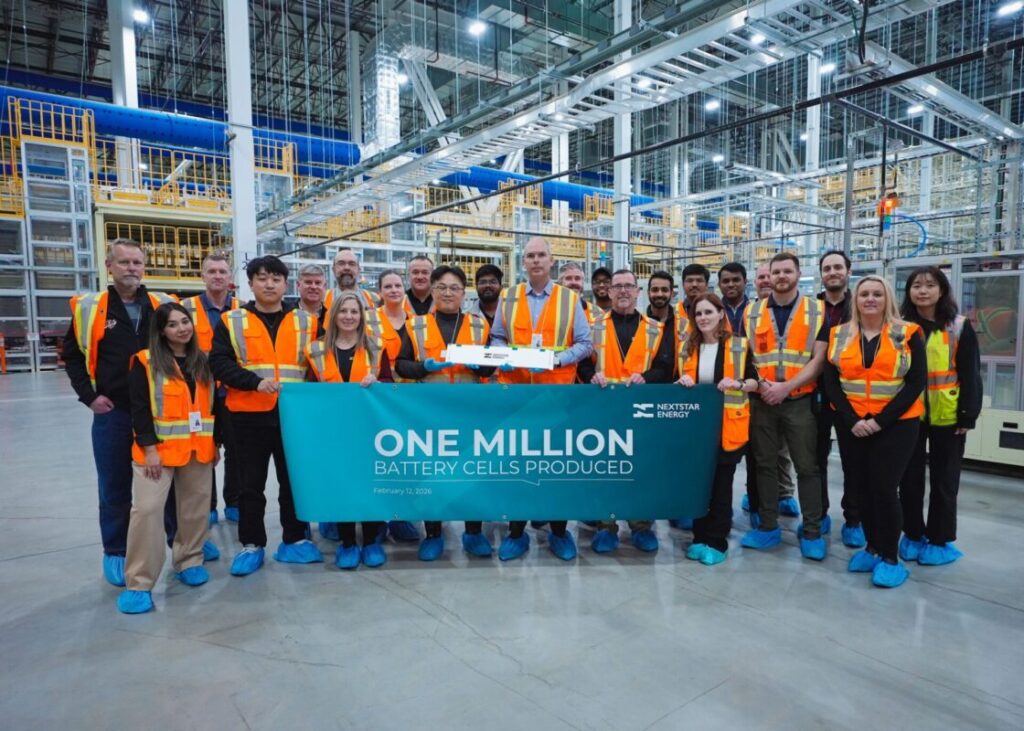
Three are already online, including another plant in Michigan (Lansing) and its Windsor, Ontario, factory in Canada. The Ontario factory was built by LG ES subsidiary NextStar Energy, which was a joint venture (JV) with automotive OEM Stellantis, until the battery maker bought out its partner’s 49% stake in February.
The remaining two factories under construction are also through automotive JVs, the Ultim Cells Plant 2 in Tennessee, which will make both EV and ESS cells, and an LFP pouch cell factory in Ohio with Honda. The company said it is on track to secure “over 50GWh of ESS battery production capacity” in North America by the end of this year.
In its Q3 2025 results last year, LG ES said the revenue impact of slowing EV sales in the US had been partially offset by growth in its ESS business, helping enable a KRW601.3 billion operating profit for the quarter.
Late last year, a battery storage supply chain and market expert told ESN Premium that re-investing the sunk cost of EV battery production gives LG ES and fellow Korean manufacturers Samsung SDI and SK On an opportunity to produce on a scale large enough to potentially meet US demand by the end of 2026.
These manufacturers will be joined by newer market entrants and the ramping up of capacity by existing competitors.
US industry association Energy Storage Coalition, in a March 2026 report, said that US$100 billion of investment commitments in cell manufacturing to date would bring the country to 146GWh of annual production capacity by the end of 2026, far greater than the 60GWh of downstream BESS projects the organisation forecasts will be deployed.
Next-gen BESS cells will be 15% cheaper, LG ES claims
LG ES investor presentation materials also highlighted that, with electricity demand on the rise, particularly given expectations of load growth to feed data centres, solar-plus-storage has significant lead time and levelised cost of energy (LCOE) advantages over gas, coal and nuclear power.
The company also identified the potential market growth opportunity for renewables and EVs created by the recent oil price rises, while also noting an increased preference in European EV and ESS markets for local production.
LG ES said its total order backlog stands at 440GWh, including 100GWh of new orders for its 46-series cylindrical EV batteries. It did not break out ESS backlog numbers in a press release or results presentation.
LG ES did mention last quarter that it received an additional grid-scale BESS project contract in North America, for which it will supply next-generation cells, expected to cost 15% less than its current products, by 2028.
In its previous results release for Q4 2025, published in February, LG ES said it was aiming to secure 90GWh of new ESS orders worldwide on top of turnkey project solutions, with the North American market comprising the bulk of that demand.
Unlike Tesla, which has committed to investing US$25 billion capex during 2025-2026, mostly in factories, AI and robotics, LG ES has apparently already made the bulk of its supply chain investments and aims to streamline capex spending in 2026.
It will, however, work to differentiate its software offerings in battery storage system integration, an area where it is active in through its LG ES Vertech system integrator subsidiary in the US, as well as software for EV product enhancements such as fast charging. An LG ES Vertech spokesperson told ESN Premium in February that the system integrator aims to deliver 50GWh of BESS projects in 2026.
“LG Energy Solution has been betting on the US market for some time now, and we feel very strongly that US manufacturing is the best way forward in the ESS market,” the spokesperson said.
LG ES also seeks to make inroads in future and emerging battery technologies such as dry electrode processing, solid-state and sodium-ion (Na-ion) batteries, it said in its Q1 2026 investor presentation.