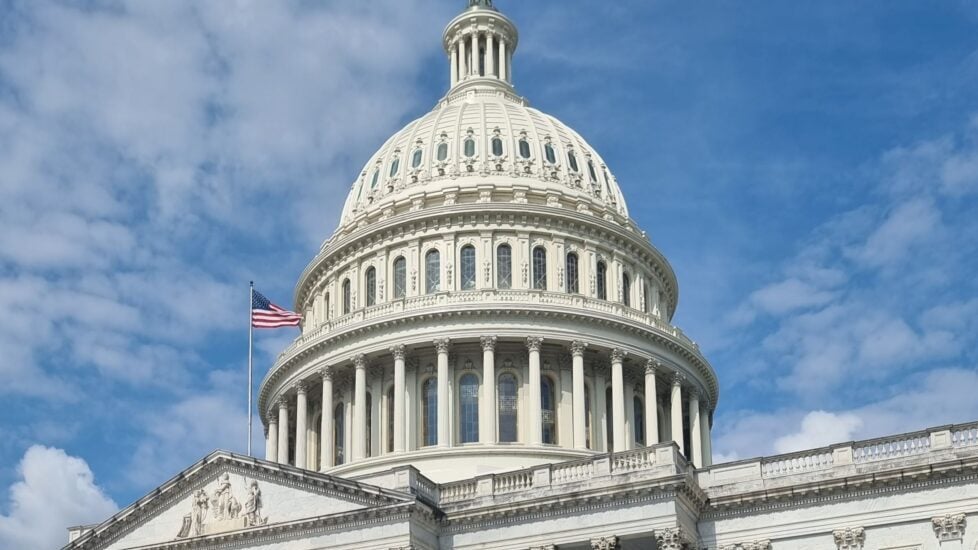
Democrats scored major victories in the US Midterm elections, taking both the House and Senate and flipping several long-held Republican strongholds, with changes likely to occur in the clean energy sector.
The industry immediately began buzzing about what the election results could mean for technologies like battery energy storage systems (BESS), solar PV, and data centres.
The Trump-led Republicans may have to answer for the rapid deregulation that has taken place since the President began his second non-consecutive term.
Approximately US$177 billion in federal grants has been cut or frozen across the US since Trump took office. Additionally, among other moves, the Environmental Protection Agency (EPA) repealed its Greenhouse Gas Endangerment Finding and stopped assigning monetary values to health benefits like avoided early deaths, asthma, and heart disease in its regulatory policy.
Try Premium for just $1
- Full premium access for the first month at only $1
- Converts to an annual rate after 30 days unless cancelled
- Cancel anytime during the trial period
Premium Benefits
- Expert industry analysis and interviews
- Digital access to PV Tech Power journal
- Exclusive event discounts
Or get the full Premium subscription right away
Or continue reading this article for free
News outlet Bloomberg speculated that, given Democrats’ ability to set hearing agendas and use investigative powers to issue subpoenas, “Appropriations could be a focus, given that the Trump White House has repeatedly frozen and withheld funds appropriated by Congress, such as for National Science Foundation and EPA grants.”
Digital news company Politico reports that Democrats are preparing to scrutinise Interior Secretary Doug Burgum and his team, focusing on the troubled Lincoln Memorial Reflecting Pool renovation and officials’ interactions with oil and gas firms.
Bloomberg further reported that EPA chief Lee Zeldin may also come under scrutiny, particularly after Representative Zoe Lofgren, a California Democrat and ranking member of the House Committee on Science, Space, and Technology, recently accused him of failing “to produce a single responsive document, communication, or record” despite numerous requests. Businesses that struck deals with the administration or received regulatory reprieves may also be targets of investigators.
This is also in line with comments shared on LinkedIn by Mona Dajani of law firm Cooley, who stated her belief that “A Democratic Congress will likely investigate offshore wind cancellation agreements, clean energy funding decisions and regulatory rollbacks. Restoring tax credits through legislation still requires presidential agreement or a veto override. Developers cannot underwrite a project on the expectation that incentives will return.”
Data centre rollout could be affected
Michael Thomas, CEO and founder of project monitor Cleanview, shared that it found newly elected governors could pause 41% of planned data centre projects.
Voters elected governors and approved local measures that may alter AI infrastructure development. They could pause projects in major markets and bring new rules nationwide, even in traditionally laissez-faire markets like Texas.
Thomas further shared that some 159GW of planned data centres—41% of the planned national pipeline—are in states where the new governor supports a pause. Another 69.2GW (18%) are in states where winners want to change tax breaks or other rules but haven’t endorsed a pause.
He wrote, “On-site gas plants will likely face new rules and delays. To build an on-site gas plant, a developer needs an air permit. That approval often goes through offices controlled by the executive branch, which means new Democratic governors could delay or block those permits.”
Data centre developers may also need to buy more clean energy. Several candidates, including Wisconsin’s David Crowley, called for 100% renewable energy in communities that accept projects; New Mexico’s newly elected Governor Deb Haaland proposed self-built renewables; and Michigan Democrats introduced a bill requiring 90% clean energy procurement.
Local results were also broadly unfavourable for data centres. They appeared on ballots in 41 local elections, with proposals ranging from bans to temporary pauses. Every race called so far has gone against data centres.
Bipartisan American Affordability and Jobs Act of 2026 (BAAJA)
There is also broad discussion of using the momentum from the Midterm election victories to pass the Bipartisan American Affordability and Jobs Act of 2026 (BAAJA) before the next Congress takes office.
According to the industry group American Clean Power, BAAJA’s “critical provisions on permitting, environmental review, judicial review, and interconnection would address major barriers that keep viable projects from reaching operation. Clean energy stands to disproportionately benefit from these technology-neutral permitting reforms: Solar, wind and energy storage account for 93% of planned 2026 utility-scale additions and roughly 1,742GW of projects seeking interconnection, compared with 253GW of gas.”
Jennifer Granholm, Energy Secretary under Biden and former Michigan governor, also voiced support for BAAJA last week to news outlet Axios, stating, “Who’s to say we’re going to get a better deal? We still need a presidential signature in the next two years.”
Nonprofit legal group, The Native American Rights Fund, opposes the bill, stating that it “severely weakens Tribal opportunities to engage as sovereign governments, curtails Tribal consultation requirements, and restricts access to legal recourse in court.”